Federal Highway Administration approves quick release funds to begin southwest Colorado flood repairs
Federal emergency relief will allow CDOT to start work on damaged highways before winter
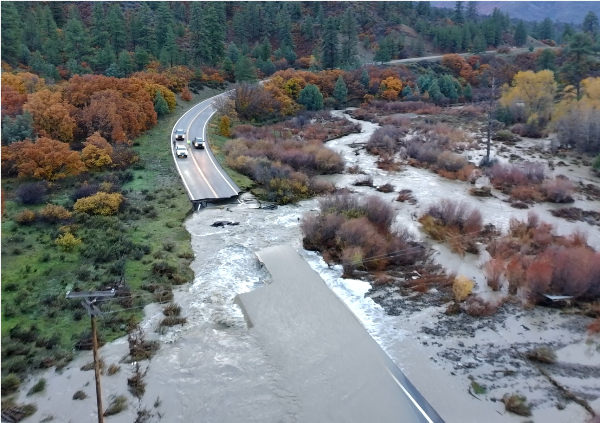
Aerial view of Colo. 151 flood damage, between Ignacio and Pagosa Springs.
Photo courtesy Colorado Department of Transportation
Posted
Colorado Department of Transportation
The Federal Highway Administration (FHWA) has approved $6.5 million in quick-release funds to help the Colorado Department of Transportation (CDOT) begin repairing highways damaged by severe flooding in southwest Colorado last week. The funds are an initial portion of CDOT’s request for federal emergency relief, which estimates about $65 million in damage to federal-aid roadways.
The emergency relief funds will go toward immediate repairs on U.S. 160, U.S. 550 and Colo. 151, the three highways that sustained significant structural damage during historical rainfall from Oct. 22 through Oct. 25. In particular, these repairs will support work that is needed to restore roadway capacity before winter.
“I’m glad that the Federal Highway Administration has approved our request for immediate assistance to repair roads and highways that have been severely damaged by this storm before the winter weather makes it harder to do this work. Coloradans, businesses and emergency responders rely on these roads to get where they need to go and move goods across the state. We have resources on the ground now working around the clock to open damaged roads and highways, and this funding means our crews can start right away clearing debris and repaving roads,” said Gov. Jared Polis.
“We are grateful to FHWA for acting so quickly and for their partnership,” said CDOT Executive Director Shoshana Lew. “Southwest Colorado depends on these highways to move people, goods and emergency services. This funding means crews can start rebuilding now and restore safe and normal traffic patterns while the weather still lets us do the work. Under the best of circumstances, winter is a challenging time of year for both the traveling public and our highway maintainers who work around the clock to keep challenging mountain terrain safe. Restoring functionality to critical routes like U.S. 550 and U.S. 160 as quickly as possible is imperative.”
“We are so appreciative of the support and rapid engagement from our federal partners,” said Transportation Commissioner Barbara McLachlan. “Just days ago, CDOT submitted an emergency relief request to the Federal Highway Administration which included quick release funds to help get us back up and running before winter. Combined with the $5 million that the Transportation Commission approved from our contingency funds, these dollars will help us do just that. This is an example of partnership at work.”
FHWA is working closely with CDOT to ensure reconstruction and repairs from flooding are completed as soon as possible for the people of southwest Colorado. The emergency relief funding will help restore travel for residents who rely on these highways for their livelihoods and businesses.
The $65 million damage figure is a preliminary estimate. High water has limited full inspections of bridges and other structures, and CDOT expects to provide a more accurate and comprehensive estimate in eight to 10 weeks. Additional funding requests will follow as assessments continue.
Know before you go
Travelers are urged to “know before you go.” Gather information about weather forecasts and anticipated travel impacts and current road conditions prior to hitting the road. CDOT resources include:
Road conditions and travel information: COtrip.org


 >