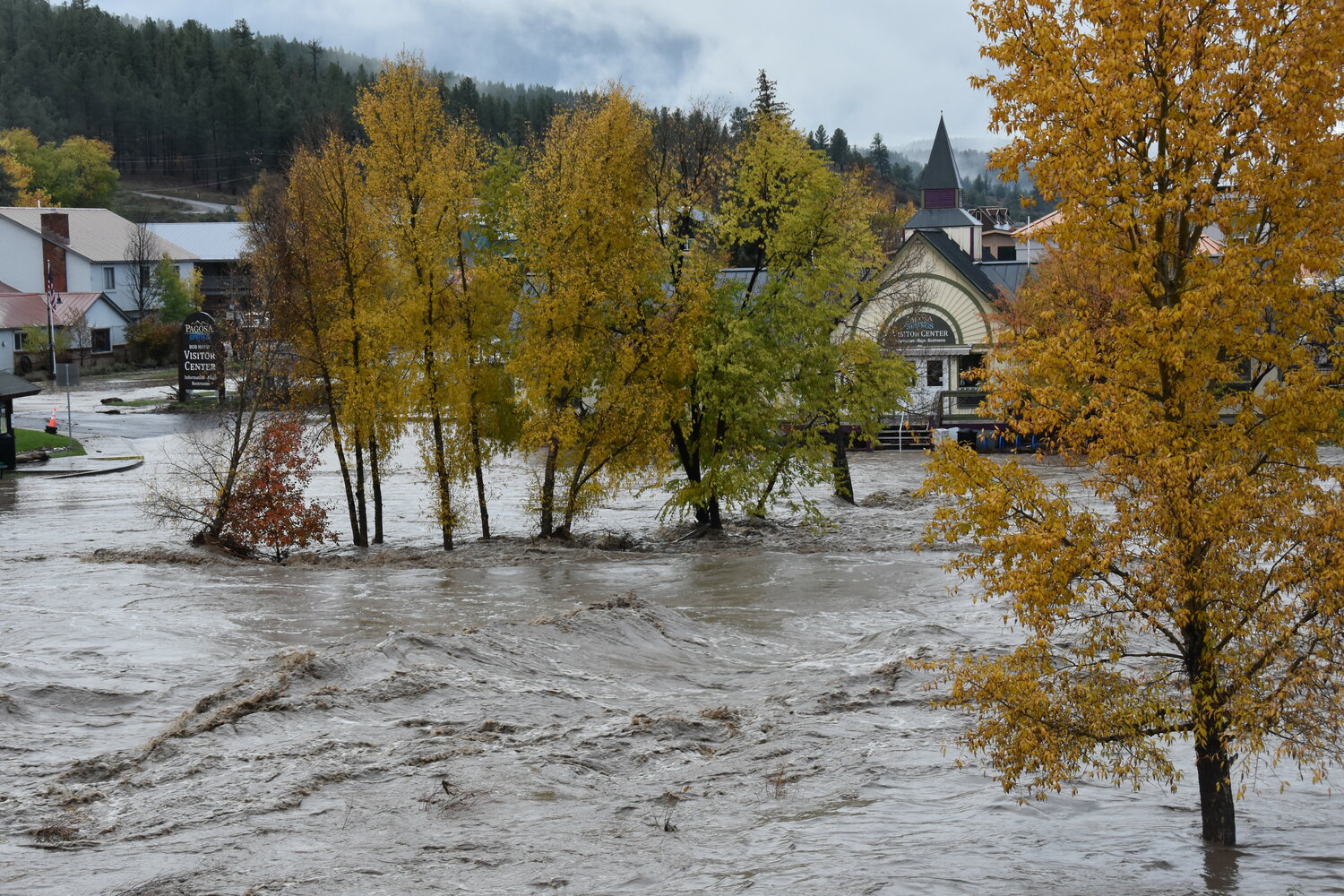
The San Juan River peaked at 15.02 feet at about 5:45 a.m. on Friday, Oct. 23, becoming the second highest flooding event in recorded history for the river, short of only the 1911 flood which peaked at 17.8 feet.
Extensive damage was caused to roads, homes and other critical infrastructure all throughout the county.
Last year, Pagosa Springs experienced what was then the third and fourth largest flooding events in record history with the San Juan River, peaking at 12.82 feet and 12.66 feet.
There have been no known fatalities or injuries, according to incident officials.
Archuleta County Commissioner Warren Brown indicated at a community meeting on Tuesday, Oct. 27, that 800 structures in the county have been impacted by the flood, with 540 of those structures being homes.
Evacuations, closures
follow changing forecast
During a joint meeting held by the Archuleta County Board of County Commissioners and Pagosa Springs Town Council on Monday, Oct. 26, Archuleta County Sheriff Mike Le Roux and Pagosa Springs Police Chief Bill Rockensock addressed the BoCC and town council, providing a review of how the community prepared and responded throughout the disaster event.
Le Roux explained that the Archuleta County Sheriff’s Office (ACSO) began receiving forecasts early in the week, working with the Pagosa Weather team.
He explained that based on the flooding that occurred in 2025, “We understood what a forecast level in that flood zone would look like.”
Le Roux explained that on Monday, Oct. 19, extra sandbags and a sandbag-filling machine were ordered and brought to the county.
He noted that more than 1,000 sandbags were filled.
However, as the forecast on the river level was being re-evaluated, “we realized that it didn’t matter how many sandbags we had, [it was] unlikely that was going to stop the total volume of water,” Le Roux said.
He noted that the ACSO began sending out messaging on social media about the upcoming forecast, and a multiagency coordination (MAC) meeting was held on Thursday, Oct. 29.
“At that point things were looking typical,” he said, noting the forecast was at 10.73 feet for the San Juan River, putting it in a moderate flooding level. “But, that changed pretty quickly.”
Le Roux explained that an evacuation warning was sent out through the county’s NIXEL Alert system around 1:30 p.m. on Thursday, Oct. 22.
Rockensock explained that a mandatory evacuation was issued for low-lying areas at 2:35 p.m., and that, by 4 p.m., “we were already closing highway 160” between 5th and 8th streets due to localized flooding.
Archuleta School District schools were closed on Friday, Oct. 23.
Le Roux explained how this year’s flooding event was different than last year’s, with the majority of rainfall received during last year’s flood falling in the “catchment area.”
He noted there was more localized rain this year.
“The volume and intensity of rain that we received down low started creating localized flooding and which we were starting to see the impact to the community prior to the river level getting to high flood,” he said.
“Flash flooding impacts started to occur,” he added, noting incidents were occurring that didn’t have anything to do with the river level.
Le Roux explained that response crews continued working through the night on Thursday, with the San Juan River peaking the morning of Friday, Oct. 23.
“One of the most amazing things I’ve ever seen, to be honest with you,” Rockensock said.
Rockensock also provided a timeline of road closures that occurred within the town, while commending WW Clyde and its efforts in managing water on roadways.
“Without them, we would’ve had a whole lot more business and houses in that area flooded,” he said.
Rockensock explained that North 5th Street and Juanita Street were closed around 10:30 p.m. on Thursday, and that “the culvert gave way, or the road gave way” leaving vehicles and houses in the area underwater.
He noted that a travel advisory was sent out around that time, as issues with water on U.S. 160 uptown started to occur, as well.
Rockensock mentioned that Pinion Lake “literally just crossed the highway.”
“It was like a river across there,” he added, noting water was running from the Alpha subdivision near Walmart across the highway and all the way down to Park Avenue.
Rockensock also explained that Hot Springs Boulevard was shut down around 2 a.m. on Friday, before the river peaked, due to a foot of water running through Mary Fisher Park and onto the roadway.
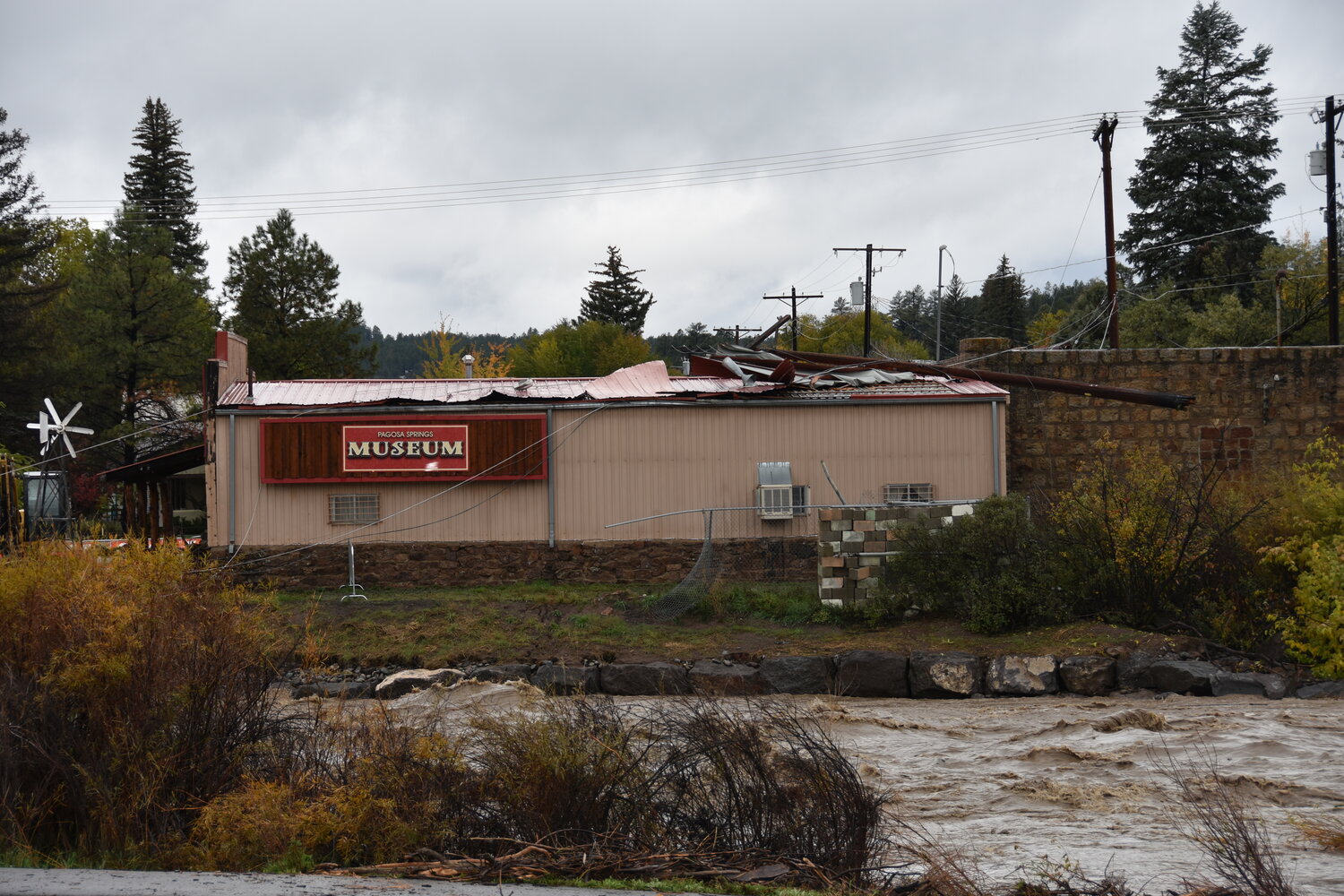
He explained that a power pole was taken out behind the Malt Shoppe and carried downstream, where it took out another power pole that fell on top of the Pagosa Springs History Museum, causing power outages.
Le Roux explained that in the county, “we’ve had road infrastructure severely damaged,” referencing mile marker 134 on U.S 160, where the road “started to become undermined” and exposed fiber lines.
Le Roux then explained that the Colorado National Guard began arriving on Friday, Oct. 23, with 64 troops and 35 high-ground-clearance vehicles to assist with rescue operations.
He mentioned that throughout the day on Friday as crews were able to begin assessing damage it became apparent that “our road infrastructure is severely damaged,” noting issues in San Juan River Village.
“There are parts of County Road 500 that are nonexistent at this point,” he added, mentioning numerous other county roads that have sustained damage.
Le Roux added that Colo. 151 is “100 percent compromised” with no option for single-lane traffic at this time.
He mentioned that everything on the response side of things up until that time had been focused on life and safety, indicating there has been no loss of life.
River, reservoir levels
While the San Juan River hit its second highest level on record, the other three rivers that run through Archuleta County experienced record flows on Friday, Oct. 23, according to National Water Predictions Service data.
The Piedra River near Arboles surpassed its previous record of 6.4 feet, hitting 10.48 feet at about 5:45 a.m.
The Navajo River near Chromo hit 7.8 feet at about 4:15 a.m., surpassing the previous record of 5.1 feet.
The Rio Blanco near Pagosa Springs hit 5.56 feet at about 7 a.m., besting the previous record of 5.26.
Late Wednesday morning, Navajo State Park reported the lake’s current elevation is 6,045 feet — 66.29 percent full pool.
In a statement on Facebook, the park states that, on Oct. 21, the reservoir’s elevation was 6,022.
“The reservoir has risen 23 feet in 7 days! On Friday, October 23, in one day, the lake rose 8.89 feet. Unbelievable! The inflow on that day was 45,205 cfs,” the statement reads.
It later adds, “The San Juan River is still cranking out significant water. The current CFS is 1430 as of today. No current data is available on the Piedra River since the gauge is either gone or not functioning from the flooding.”
Rain totals
According to reports entered into the Community Collaborative rain, Hail and Snow Network (CoCoRaHS), more than 6 inches of rain fell across all parts of Archuleta County from Oct. 22 through Oct. 26.
The highest report was 6.92 inches in the eastern part of the county.
A total of 6.55 inches fell south of Pagosa Springs, and 6.56 inches fell near Hatcher Lake.
Totals in town ranged from 5.18 inches to 5.83 inches.
Higher elevations received snowfall during that time, with Wolf Creek Ski Area reporting 20 inches of fresh snow.
According to CoCoRaHS, parts of Archuleta County have received anywhere from 7.52 inches to 10.06 inches of total rainfall from Oct. 1 through Oct. 28.
The October rainfall average for Pagosa Springs is 2.27 inches.
Disaster declarations
Pagosa Springs Mayor Shari Pierce and Town Manager David Harris declared a local disaster emergency on Oct. 22 in response to severe flooding affecting Pagosa Springs and the surrounding community.
County Manager Longinos Gonzalez initially signed a disaster declaration on Sept. 25 due to heavy rains and flooding, with the commissioners extending that declaration on Oct. 1.
During an Oct. 27 special meeting, the commissioners further extended the declaration, with the extension “clearly stating” the more recent flooding and damage, Gonzalez explained.
At 8:36 p.m. on Oct. 22, Gov. Jared Polis verbally declared a disaster emergency in response to flooding in La Plata, Archuleta, Montezuma, Dolores, Hinsdale, San Miguel, Ouray, San Juan, Mineral, Alamosa and Rio Grande counties.
Polis’ verbal declaration engaged the State Emergency Operations Plan and authorizes the use of the Colorado National Guard, including but not limited to air, ground, and engineering assets and unarmed personnel to support flood and debris flow response, evacuation, and search and rescue efforts as deemed necessary by the Colorado Department of Public Safety.
What’s next
Multiple local officials have emphasized that bouncing back from the flooding will take place over a long period of time.
Federal Emergency Management Agency assessments begin
Federal Emergency Management Agency representatives and contractors made their way to Pagosa Springs on Wednesday, Oct. 28, to begin preliminary assessments.
“We had a very, very busy morning. We were informed yesterday that FEMA would be bringing in a couple of folks to start assessments. We built a plan to accommodate getting a couple of folks in the helicopters ... and then putting them on the ground in vehicles to go look at things we can get vehicles to,” Incident Commander Trainee Thad McKain of the Colorado Incident Management Team said mid-morning on Wednesday, Oct. 28.
On top of that, he noted, there were multiple missions going on.
He also noted that the idea was that there would be a few FEMA representatives to take around.
“FEMA I guess decided maybe because of the urgency and the incoming storm that they needed to up their game, so they hired additional contractors,” McKain said, adding he believes there were seven or eight contractors they were working to get on flights at that time.
He added they would only be on the ground for about 48 hours.
Local officials discuss flooding
During the joint work session on Oct. 26, Pierce described the flooding event as “unprecedented,” adding that “no one alive has seen this.”
Pierce added that she hopes President Donald Trump will provide assistance to the community after the “catastrophic” event, describing it as “way worse than last year.”
Commissioner Warren Brown commended the efforts of everyone putting in time to aid the community.
“You’re not going to find people more committed to their home and taking care of their neighbor than you will right here in Pagosa Springs and Archuleta County,” he said.
At the same work session, Le Roux spoke about the process for issuing a disaster declaration, and what kind of costs the community might expect if a declaration issue is signed by the president.
Le Roux indicated that if signed, the federal government would cover about 75 percent of the recovery costs, leaving 25 percent to be split between the state and local agencies.
Harris indicated that initial assessments are indicating that the total damage costs could be upward of $90 million, although a more detailed assessment will take place at a later time.
Sen. John Hickenlooper’s representative, Lisa Pool, was present at the work session virtually and stated that “Sen. Hickenlooper will do everything he can to advocate for a major disaster declaration for Pagosa.”
In response to a question from Council Member Gary Williams about early warning systems, Le Roux explained that temporary river gauges had been placed upstream on the east and west forks of the San Juan River just a few weeks before the flood.
Le Roux noted that more equipment and funds are needed in order to make those stations permanent.
Brown offered more comments in regard to the community’s priorities in responding to the flood, highlighting that the focus is still on rescuing people.
“While I appreciate you may have potholes … we’re still focused on rescuing people and lives,” he said.
Brown also expressed gratitude for the communication from state- and federal-level representatives.
“I can’t help but wonder had we been able to get funding to properly repair some of the damages last year, if we would not have been in a better place this year to absorb some of this water that we’re facing this year,” he said.
Commissioner John Ranson also expressed gratitude for the communication from state federal level representatives, and the collaborative work done in the county to respond to the flood.
He then read a statement to Trump, pleading for him to sign a local disaster declaration.
“This catastrophic event will be a long road back for everyone in the Four Corners, in particular for Archuleta County, where we all live. We are a resilient community and we will bounce back stronger than ever. Last year we had zero help. No dollars, and had to dig out of a 100-year flood. I plead with you, sir, to sign the local disaster declaration as soon as possible,” Ranson read.
Commissioner Veronica Medina echoed the statements of Ranson and Brown, adding she hopes the president hears and understands “the need that we have here.”
“This definitely is historic, catastrophic, and hopefully that message is just loud and clear to our electeds at the state level and at the federal level of getting this message to the president,” she added.
Council Member Leonard Martinez commented that it was “almost unbelievable” that no fatalities occurred, crediting the “consistent, clean and clear messaging” in the community about the flood.
He noted that with 3.5 inches of rain falling in 24 hours, that would be equivalent to 50 inches of snow.
Council Member Madeline Bergon commented that she hopes the focus going forward can be on resilience, noting that more extreme weather patterns have occurred over the past few years.
Le Roux added, “I think we have a very resilient community,” but that doesn’t mean anything if there is no infrastructure in place.
Le Roux also commented on the historical significance of the event, stating that 100 years from now when people look back on the event, “we’ll be those guys” that dealt with history.
Pierce commented that this flood event is bigger in some ways than the 1911 flood, due to the amount of infrastructure and people in Pagosa Springs now.
Harris asked for people to continue to “please respect the barricades that are in place” for road, trail and park closures.
He also provided more information on estimated damage costs, indicating that the town is facing approximately $38 million in damage as of now, compared to $6 million in damage from last year’s floods.
Harris also explained that the town’s sewer system is expected to have about $9 million in damage including everything from a missing pipe on the 1st Street bridge and multiple lift stations.
He noted that those lift station facilities were not able to keep up with the flood waters.
“So, we were discharging onto the river,” he said, explaining that a temporary bypass pump is now operating on the 1st Street bridge.


 >