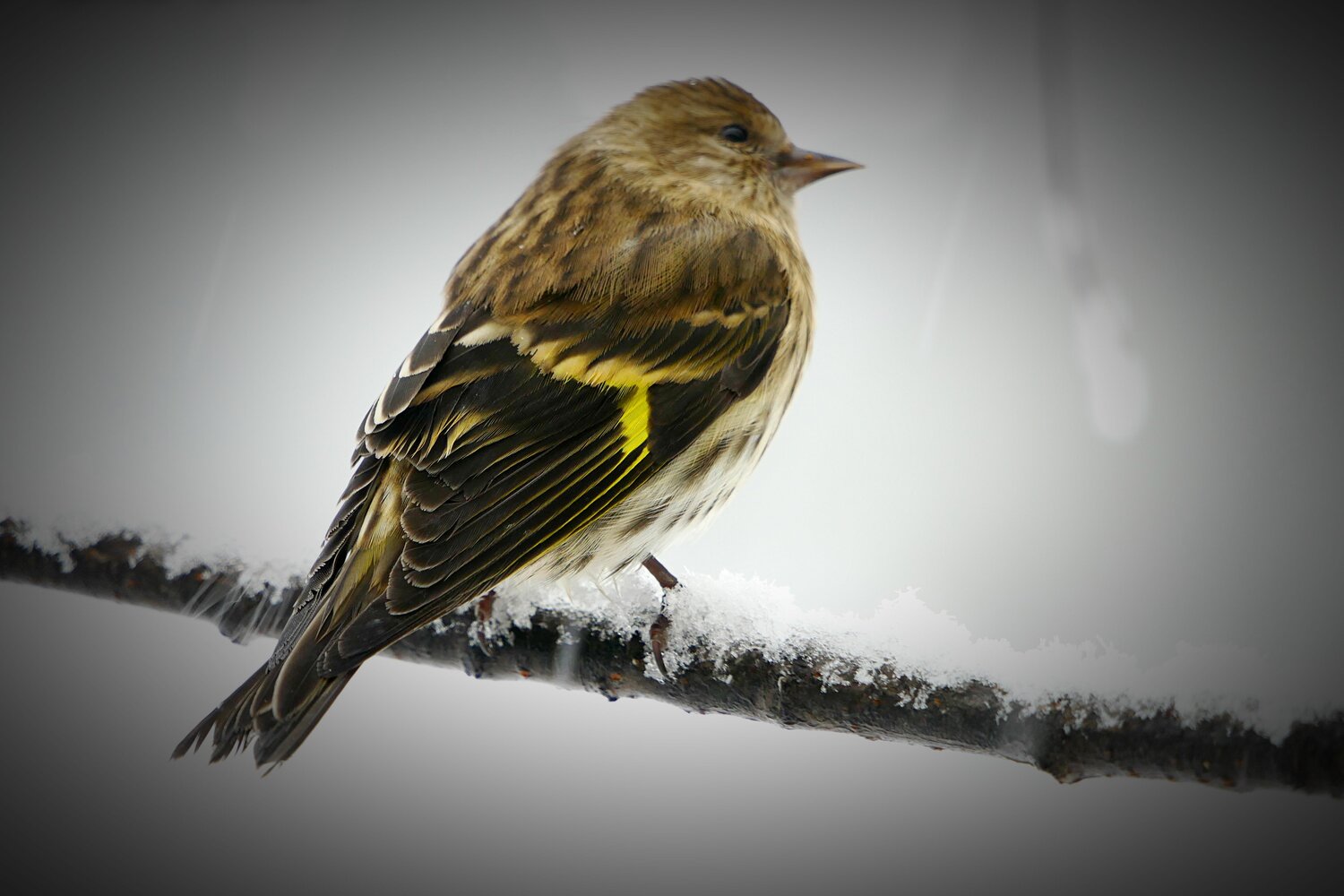
This week’s Bird of the Week, compliments of the Weminuche Audubon Society and Audubon Rockies, is the pine siskin.
These small, social birds travel in gregarious flocks where they keep in contact while foraging or in flight with a rising, buzzy, zhreeeeet call. Even on their breeding grounds they are unusually unterritorial, nesting in loose colonies and tolerating other pairs nearby. But the story changes in winter, when flocks and individuals can become aggressive around food sources. Then a siskin is quick to chase other flock members from a feeder by lowering its head and lunging with wings and tail spread. Competing birds may spiral together several feet up in the air while fighting to establish dominance.
Seeds dominate the pine siskin’s diet. They forage in the topmost canopy of seed-bearing trees, often hanging upside down to harvest seeds from cones. Their primary natural foods are the seeds of pines, spruce, hemlock and cedar. But, they also eat seeds of deciduous trees like alder, birch and maple, young buds, stems and leaves, the seeds of weeds, and insects, spiders and grubs in summer. After nesting in conifer forests, they move into semi-open country to feed in fields of thistles and wild sunflowers. Feeders with nyjer seeds will attract pine siskins to your yard.
You could hold a pine siskin in the palm of your hand. They are small, brown streaky birds with a sharp, pointed bill and short notched tail. Yellow feather patches are visible when they spread their wings and tail.
Although we are in their year-round range, in other areas pine siskins are an irruptive species that move in irregular patterns in winter in search of food. Depending on the abundance of cones in northern boreal areas, they may stay put or move far south some years. They are still believed to be fairly common, but their erratic movements make numbers hard to assess. Partners In Flight categorizes them as a “Common Bird In Steep Decline.”
You can help document bird numbers in winter by participating in Cornell Lab’s Project FeederWatch, which starts on Nov. 1. It’s a fun way to focus your attention and contribute observations of the natural world. Despite the name, you don’t even need to have a feeder to participate in this valuable citizen science project. Visit feederwatch.org for information.
For information on events, visit www.weminucheaudubon.org and www.facebook.com/weminucheaudubon/.
Photo courtesy Charles Martinez


 >