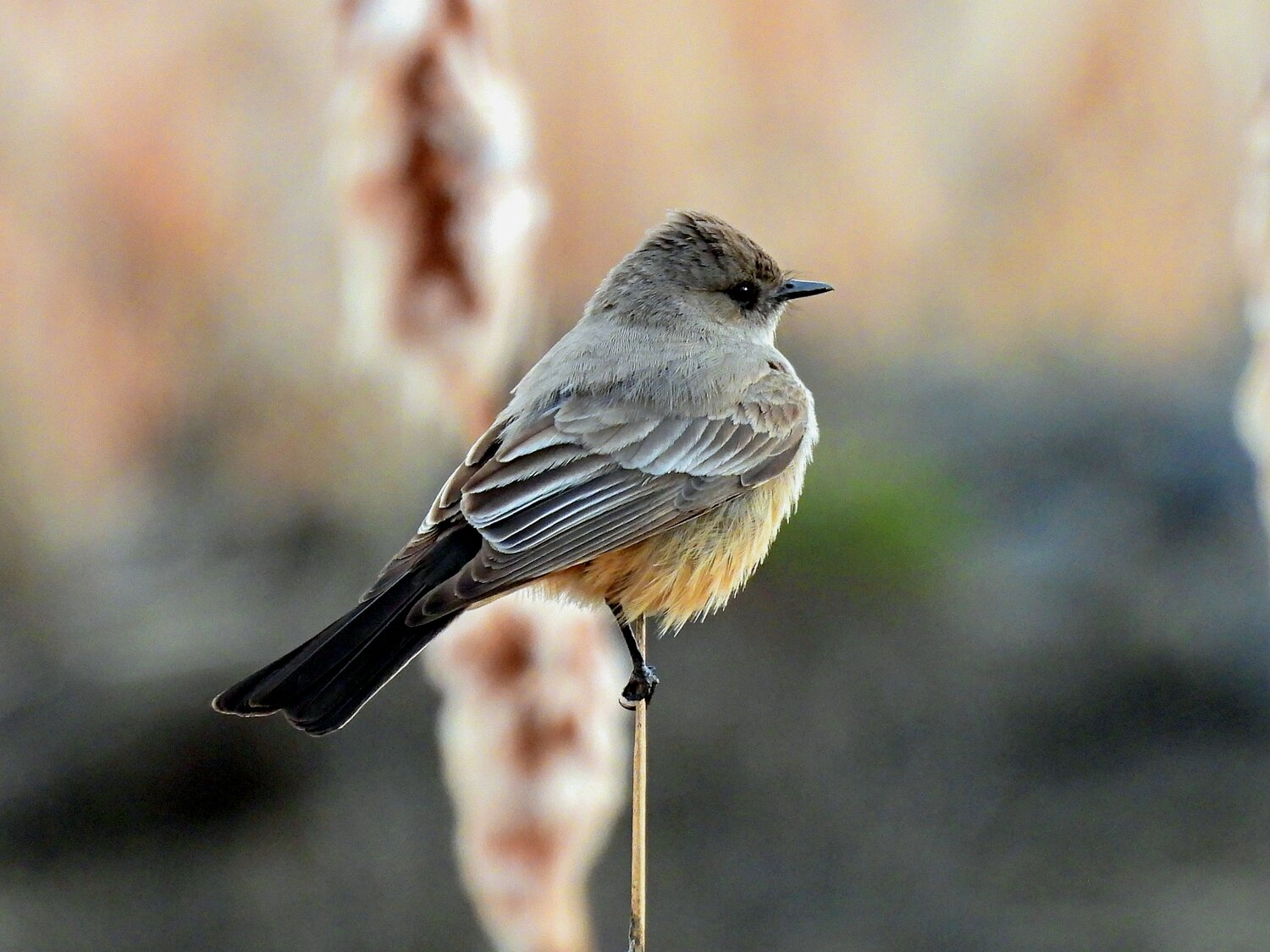
This week’s Bird of the Week, compliments of the Weminuche Audubon Society and Audubon Rockies, is the Say’s phoebe.
This flycatcher will nest on rocky ledges or crevices, in abandoned wells and mine shafts, in tree cavities, holes in banks and under bridges. The feature that these sites have in common, and that often puts the Say’s phoebe in close contact with people, is protection from above, a requirement that is easily satisfied under the eaves of a porch or on rafters in an outbuilding and where we often find them.
Say’s phoebes may share the same territories as black phoebes, but their use of different habitat types means they rarely compete for resources. Black phoebes nest near water, and Say’s often live in very dry, sparsely vegetated open areas far from water. Say’s breed further north than any other flycatcher, from central Mexico to the arctic tundra, in an area west of a line that almost divides the United States in two.
Say’s phoebes are small, long-tailed birds colored brownish-gray above with a gray breast and cinnamon on the belly. For its size, the head of this bird looks large and sometimes has a peaked shape. Their simple, whistled songs in spring are short, but repeated for several minutes.
Like other members of the tyrant flycatcher group, Say’s phoebes eat almost entirely insects, adding spiders, millipedes and berries on occasion. Their most common prey are wild bees and wasps. These birds are often seen perched on fence wire or posts, low shrubs, plants or rocks, watching to dart out and nab an aerial insect or pouncing to grab one from the ground.
Like a mountain bluebird or American kestrel, this phoebe will hover low over the ground when aerial insects are scarce. In cold weather, this hunting tactic allows the bird to forage closer to the ground where it is warmer and insects are more active. It is one of the reasons why the Say’s phoebe arrives earlier in spring and stays later in fall than other insect dependent birds.
For information on events, visit www.weminucheaudubon.org and www.facebook.com/weminucheaudubon/.
Photo courtesy Charles Martinez


 >
>