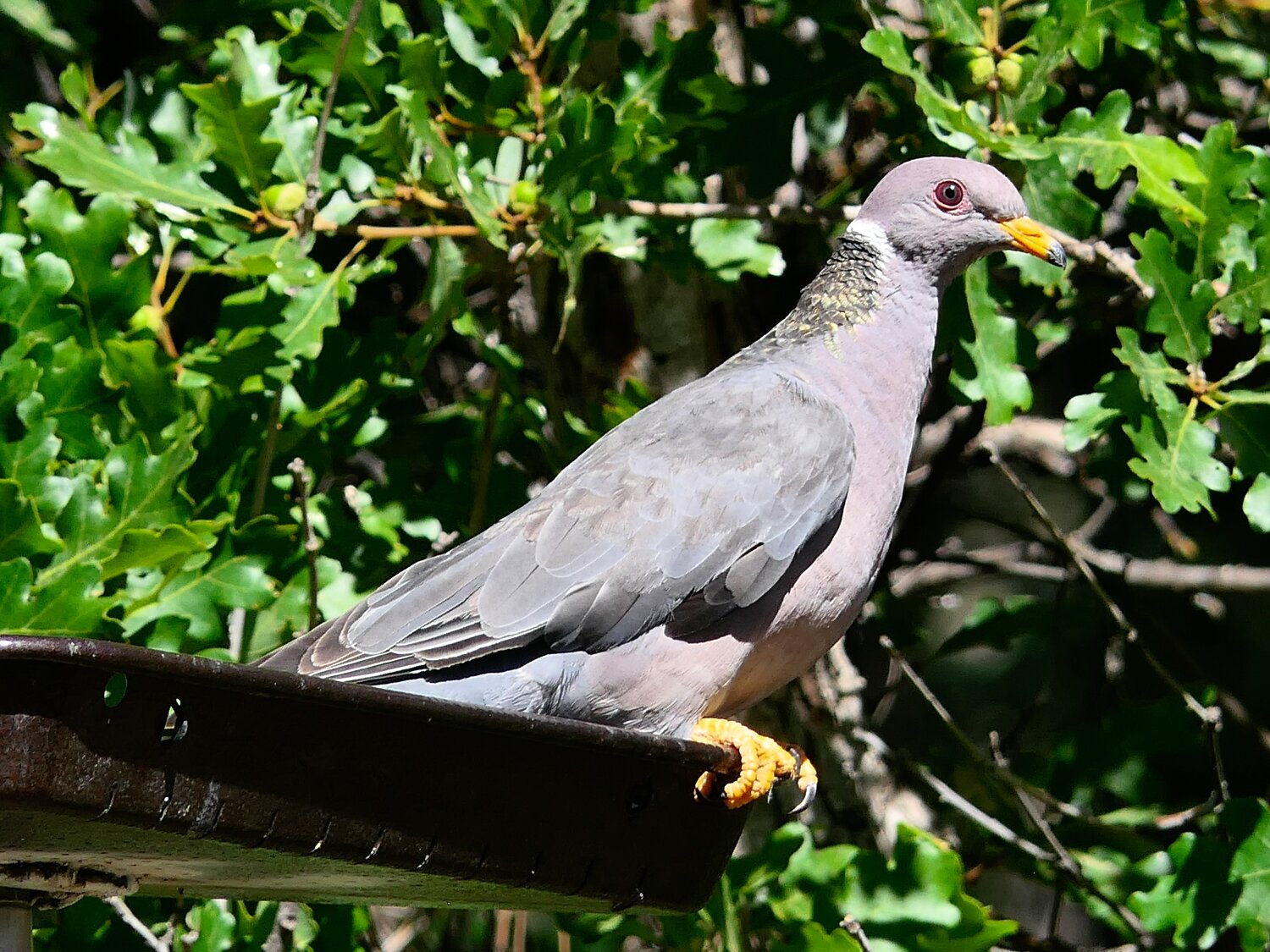
This week’s Bird of the Week, compliments of the Weminuche Audubon Society and Audubon Rockies, is the band-tailed pigeon.
The family of birds that is comprised of pigeons and doves includes more than 300 species worldwide, but only 12 are regularly found in the United States. Common characteristics of this group include compact, chunky bodies, small heads, short legs, strong wings for sustained flight, and a vegetarian diet of seeds and fruits.
Familiar to residents of cities, where tall buildings mimic its natural cliff habitats, is the introduced rock pigeon. Its forest-dwelling counterpart is the elegant band-tailed pigeon, North America’s largest native pigeon. In Colorado, band-tails belong to the Four Corners population, found in the dry forests of parts of Colorado, New Mexico, Arizona, Utah and Mexico. This migratory population winters in Mexico and arrives in Colorado between mid-April and mid-May. Depending on weather and food supply, they may stay through September before returning south.
These social birds travel in flocks and nest in small colonies in mountain forests, here primarily in those dominated by ponderosa pine and gambel oak. Typically the female lays only one egg, and both parents share in incubation and care of the chick. For the first few days, the chick is fed a milky protein and fat rich substance called pigeon milk, which is secreted in the crops of the parents.
When available, acorns are a major part of their diet, which also includes berries, pine nuts, flowers of trees and shrubs, agricultural grains and orchard fruits. They will feed on sunflower seed in feeders, with several individuals vying for a space to perch. A flock taking off in flight with wings clapping is loud and noticeable.
An adult band-tailed pigeon has a blue-gray back, gray underparts with a purple sheen, yellow bill and feet, and a white crescent and green iridescent feathers on the back of the neck. The pale band on its long tail is visible when these feathers are fanned in flight. Juvenile birds lack the white neck crescent.
Band-tailed numbers were once seriously depleted by over-hunting and there was concern that they might share the fate of the related passenger pigeon, now extinct. Current declines may again be related to hunting pressure.
For information on events, visit www.weminucheaudubon.org and www.facebook.com/weminucheaudubon/.
Photo courtesy Charles Martinez


 >
>