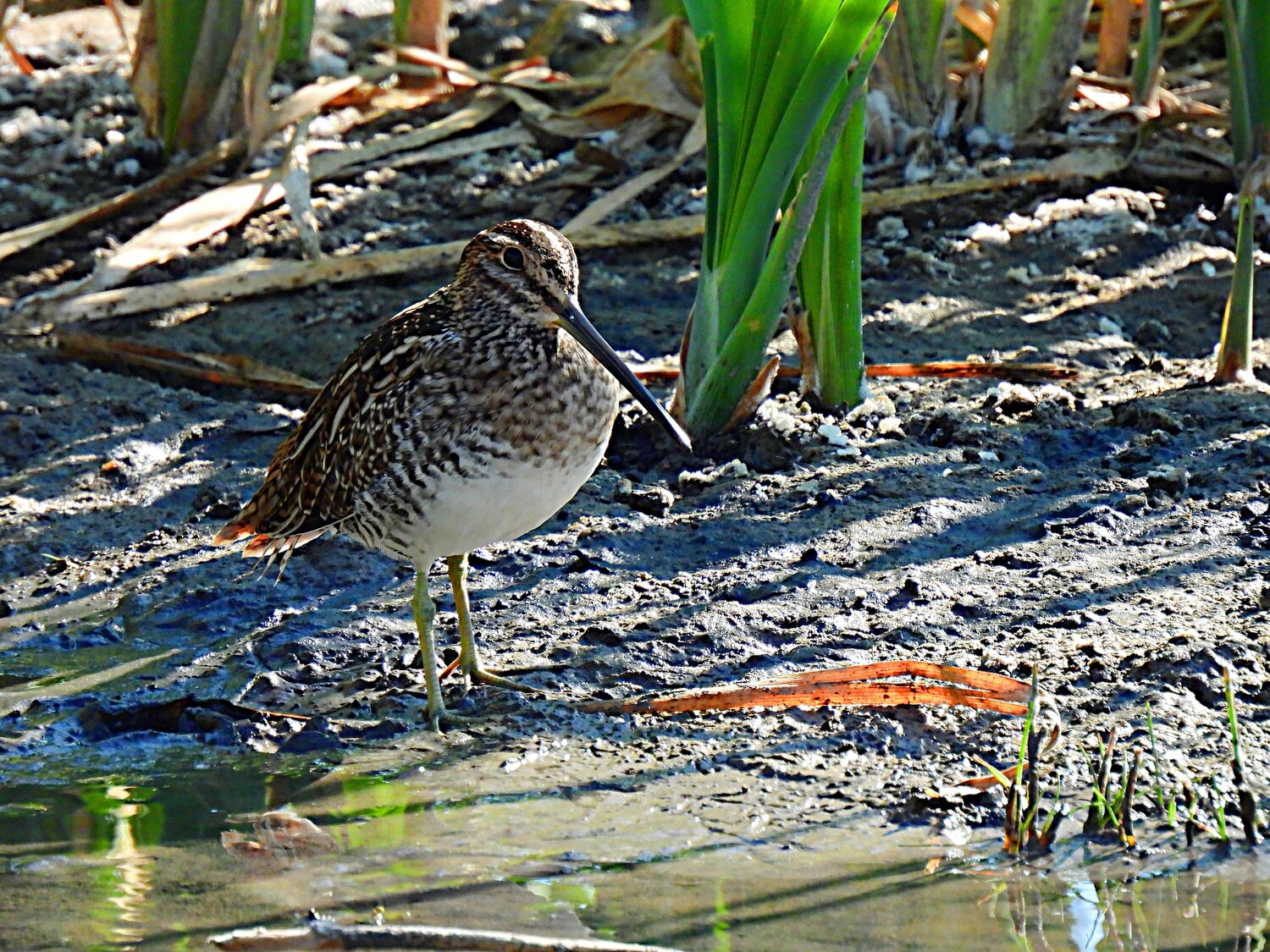
This week’s Bird of the Week, compliments of the Weminuche Audubon Society and Audubon Rockies, is the Wilson’s snipe.
Despite being one of the most common and widespread shorebirds in North America, this bird can be difficult to spot. Its cryptic coloring and secretive nature can have you looking right at the snipe without actually seeing it. This is a solitary creature of wet fields, bogs and pond edges. It avoids areas of tall, dense vegetation, but requires the cover of sedges, rushes and cattails to duck in and hide. Feathers patterned in buff and brown with stripes and bars, which include three long buffy stripes on the back and a striped head, provide camouflage against the muddy edges where the snipe is often found.
Without having to perform weight training, this bird develops extra large pectoral muscles that can make up one-quarter of its total weight and give it a pudgy look. These muscles power the straight, strong flight this bird achieves at speeds up to 60 miles per hour, but when a snipe is flushed, it explodes in zigzagging flight that is hard for a predator to track. The term “sniper” was originally given to those British soldiers in the 1770s who were accurate enough shots to successfully hunt the snipe as a game bird.
The Wilson’s snipe uses its long, straight bill to probe in the soft mud and detect and capture prey underground. The sensitive and flexible bill tip can feel insect larvae and earthworms that burrow in damp soil and open to slurp them up with the bill still buried. Eyes set far back on its head provide the snipe with vision to the front, sides and back, even while feeding with its bill buried in the mud.
The haunting winnowing sound associated with the Wilson’s snipe during courtship is not a vocalization, but instead is produced in flight by air rushing over the spread outer tail feathers. Renowned wildlife recordist Kevin Colver introduced it as “A bewildering, wavering sound drifts from everywhere and yet from nowhere.”
The Wilson’s snipe is still common enough that it is one of only two shorebird species allowed to be hunted in the United States. Over half of the 35 shorebird species found in North America are in trouble. Unregulated hunting on their wintering grounds may be a factor in population declines.
For information on events, visit www.weminucheaudubon.org and www.facebook.com/weminucheaudubon/.


 >