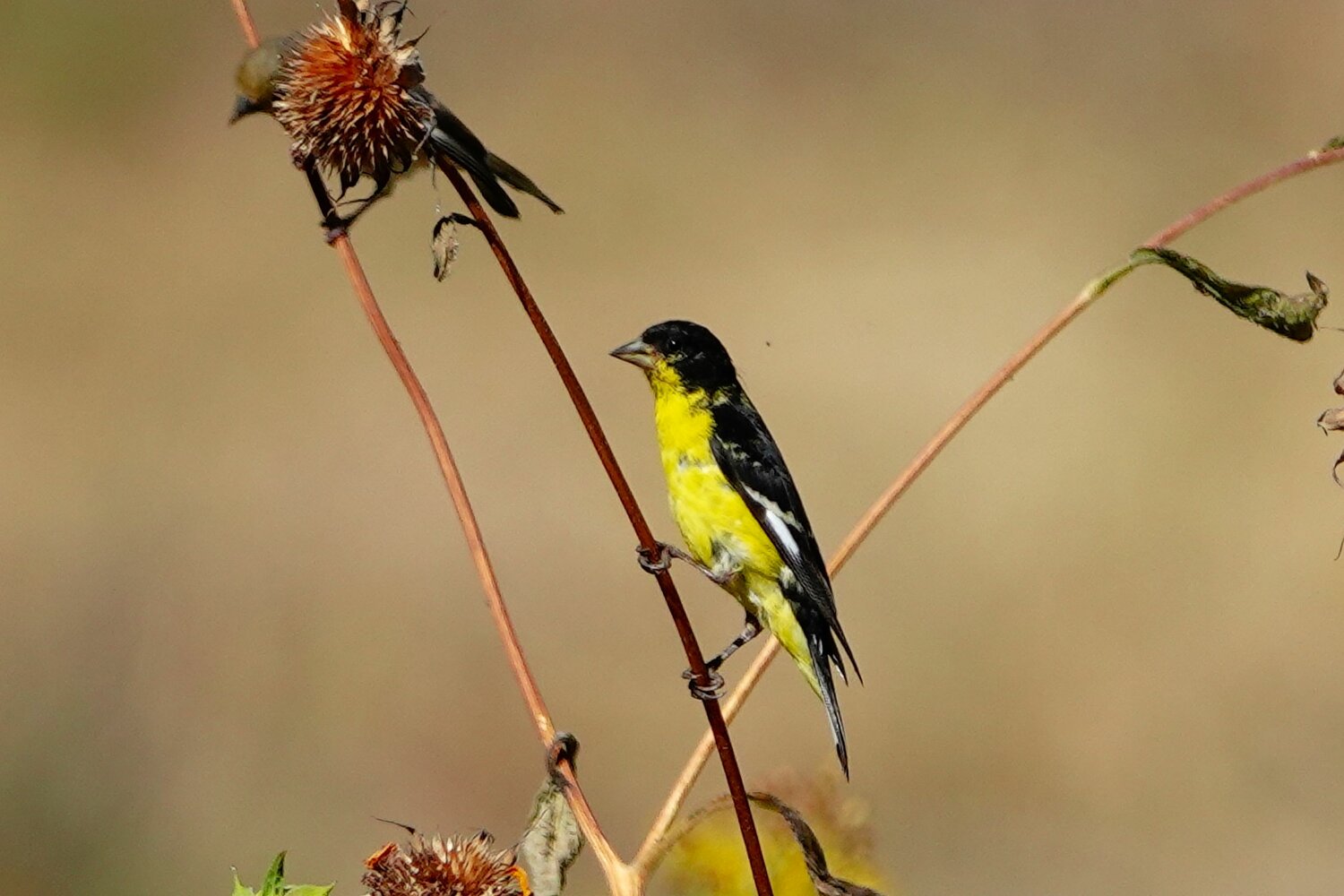
This week’s Bird of the Week, compliments of the Weminuche Audubon Society and Audubon Rockies, is the lesser goldfinch.
In many types of patchy, open habitats this bird is found from South America all the way to Washington State in North America, with much of the population in the United States living west of the Rocky Mountains. While these small birds in North America were historically found primarily in the southwest, they are rapidly expanding their range throughout the Pacific Northwest. Data supplied by birdwatchers who log their observations online in eBird and Project Feeder Watch has been instrumental in documenting this population shift.
Goldfinches are primarily seed eaters, and even nestlings are fed a mix of moistened seeds regurgitated by their parents. They mainly eat seeds of plants in the sunflower family. Their small size allows them to cling to the seed heads, bending the stem and ending upside down in the process. After prying open the outer seed covering with its bill, the goldfinch shakes its head to loosen the husk before swallowing the seed. They also readily come to feeders for Nyjer seeds.
Lesser goldfinches lose water quickly and need to drink frequently. During hot temperature extremes they may risk dehydration in less than two hours. Recent research conducted in partnership between the Cornell Lab of Ornithology and Washington State University revealed that “rivers emerged as crucial corridors” along with urban areas in the northward range expansion of these birds.
Adult lesser goldfinch males are yellow below and have a glossy black cap and white wing patches. Typically their backs may be solid black in the eastern part of their range or dull green along the coasts. Females and immature birds have olive backs and dull yellow undersides. They are often found feeding in mixed flocks with other finch species, white-crowned sparrows and western bluebirds. Contact calls between flock members are frequent and sad sounding.
While lesser goldfinches are permanent residents in much of their range, inland populations may move south or downslope in winter in search of food. We see them here much more commonly in summer than in winter. At a time when many species are struggling to thrive under a warming climate, lesser goldfinches are seemingly adapting better than others.
For information on events, visit www.weminucheaudubon.org and www.facebook.com/weminucheaudubon/.


 >
>