The recent flooding in Archuleta County has left many residents facing difficult decisions about their homes, finances, livestock and what the coming winter months may bring.
We understand that being asked to consider leaving your home for an extended period can feel overwhelming, especially when you have a mortgage, animals to care for or a livelihood tied to your property. While mandatory evacuation orders have been lifted as of Nov. 9, significant infrastructure damage remains. Some roads and bridges may not be repaired for several months, and winter weather could make access even more challenging.
The following frequently asked questions are intended to help residents understand their options, identify available resources, and connect with organizations that may be able to assist.
No mandatory evacuation orders are currently in effect. However, the Archuleta County Sheriff's Office strongly encourages residents in areas with compromised or limited access to consider voluntarily relocating until conditions improve.
Residents should carefully consider whether they will have reliable road access, utilities, emergency medical services, food, medications, and other essential supplies throughout the winter.
Several organizations may be able to help residents identify temporary housing and other resources.
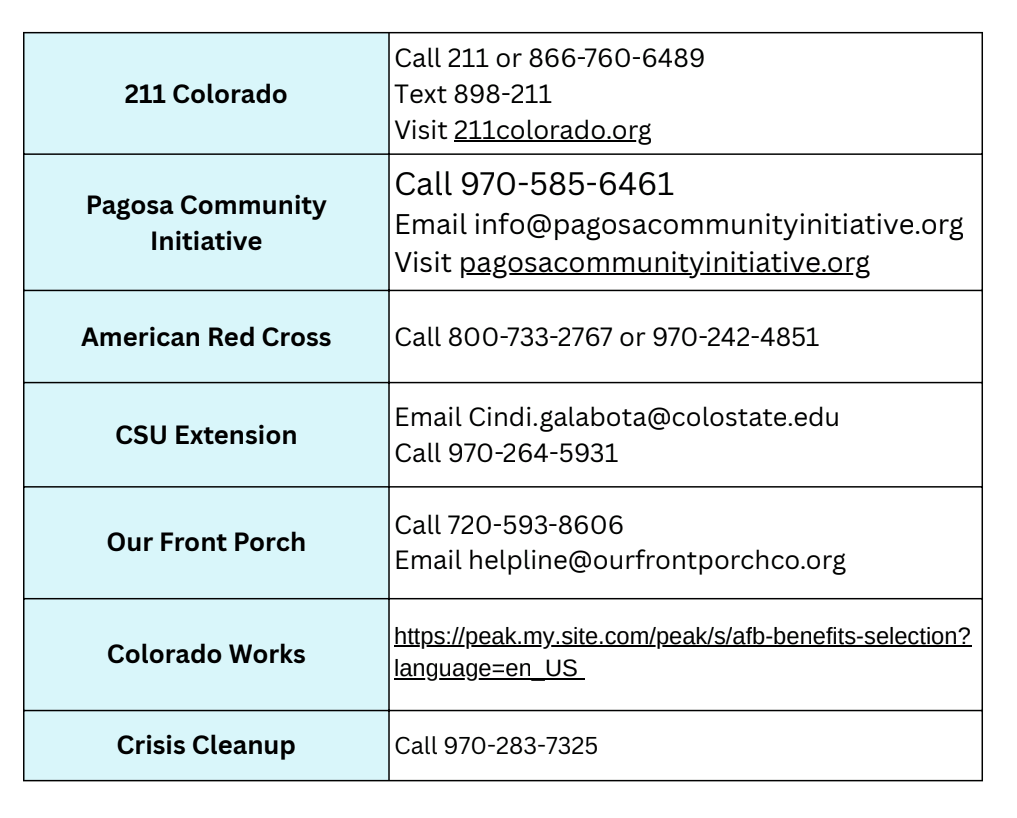
211 Colorado: Assistance locating shelter, temporary housing, food, and financial resources. Previously announced assistance includes potential 28-day Airbnb stays for eligible flood-displaced residents. They will also be able to advise and provide assistance after the stay is over. Dial 2-1-1 or 866-760-6489
Pagosa Community Initiative (PCI): May provide assistance with temporary lodging, rent, utilities, transportation, and other eligible flood-related needs. Call 970-585-6461 or email director@pagosacommunityinitiative.org
American Red Cross: Can help connect affected individuals and families with disaster recovery resources and available assistance. Call 1-800-733-2767
Residents should contact their mortgage servicer as soon as possible to explain that their property has been affected by flooding or that access has been compromised.
Ask about disaster-related mortgage forbearance, temporary payment arrangements, or other hardship assistance. These options are not automatic, and terms vary by lender.
Residents should also contact their homeowners insurance provider to ask whether their policy includes any applicable coverage for temporary living expenses or property damage.
Who can help? Your mortgage servicer, insurance provider, 211 Colorado, Pagosa Community Initiative, and the American Red Cross
This is a significant concern, especially with the possibility of heavy snowfall, freezing temperatures, and prolonged road closures. Before leaving, residents should consider arranging for a trusted person or qualified professional to monitor their property, if access is safe and permitted.
Important considerations include winterizing plumbing, protecting heating systems, securing the property, and making arrangements for snow removal or other necessary maintenance.
At this time, residents should not assume that a government agency or relief organization will provide ongoing property maintenance or monitoring. Contact your insurance provider to discuss requirements for protecting an unoccupied home.
Residents with livestock-related needs resulting from the flooding should contact the Colorado State University Extension Office. Email Cindi.galabota@colostate.edu or call 970-264-5931.
Residents are encouraged to explain their situation, including livestock needs, access challenges, feed and water concerns, and any potential relocation needs.
Agricultural producers, ranchers, and residents whose income depends on their property should document flood-related losses, access restrictions, and interruptions to their operations.
CSU Extension can serve as an initial contact for identifying agricultural and ranching needs and helping connect producers with appropriate resources. Residents may also qualify for USDA disaster assistance programs.
For CSU Extension, call 970-264-5931 or email Cindi.galabota@colostate.edu.
Financial assistance may be available depending on household circumstances, eligibility, available funding, and the specific type of need. Pagosa Community Initiative provides assistance for certain flood-related expenses and makes approved payments directly to vendors or service providers. For PCI, call 970-585-6461 or email director@pagosacommunityinitiative.org
Colorado Works may also offer assistance to eligible families affected by the evacuations. Previously shared eligibility criteria include household income limits, residency in the impacted area, qualifying children or pregnancy, and applicable legal-presence requirements. Applications for Colorado Works can be submitted through Colorado PEAK. Go to the Colorado Peak website
Residents who anticipate needing longer-term housing should contact 211 Colorado and ask about available housing assistance and disaster recovery case management.
Our Front Porch (out of Denver) may also provide free disaster recovery casework, including housing advocacy, insurance navigation, and help developing longer-term recovery plans. They provide statewide assistance.
Contact: 720-593-8606 or helpline@ourfrontporchco.org.
The Archuleta County Fairgrounds, located at 344 Highway 84 in Pagosa Springs, has been identified as a livestock evacuation shelter. Residents should contact CSU Extension or local emergency management to confirm current shelter arrangements, availability, and any requirements before transporting animals.
The Crisis Cleanup program connects affected households with volunteer organizations that may be able to assist with flood-related cleanup.
Crisis Cleanup: 970-283-7325
Assistance depends on volunteer availability and is not guaranteed. Residents should not enter unsafe areas or disregard road closures to perform cleanup.
Residents should document damage with photographs (before, during, and after, if possible), descriptions, and receipts whenever it is safe to do so. Flood-related property damage and unmet needs should also be reported through the Archuleta County Crisis Track Survivors Portal. Reporting helps officials understand the extent of the disaster and identify recovery needs. Reporting damage does not automatically constitute an application for financial assistance.
Disaster recovery involves more than physical damage. Uncertainty about housing, finances, family, and livestock can create considerable emotional stress.
The American Red Cross provides disaster-related mental health support and casework. Our Front Porch also offers free individual recovery support and a virtual support group.
Residents can call 1-800-RED-CROSS (800-733-2767) for assistance.
While all mandatory evacuation orders have been lifted throughout Archuleta County, this does not mean every property is currently safe or accessible.
Residents who voluntarily evacuate may return to their properties when they can do so safely and when access is legally permitted. However, significant damage to roads, bridges, and other critical infrastructure may prevent access to some properties for an extended period.
With winter approaching, snow, ice, and freezing temperatures could further complicate travel and delay repairs. Some access routes may not be fully restored until spring or later.
Residents should understand that leaving their property does not guarantee they will be able to return whenever they choose. Road conditions, weather, infrastructure damage, and emergency access limitations may affect their ability to reach their homes. Before attempting to return, residents are encouraged to:
Check official Archuleta County road and infrastructure updates.
Confirm that their access route is open and safe for travel.
Never bypass barricades or attempt to cross damaged or unverified roads and bridges.
Consider whether they will have reliable access to utilities, essential supplies, and emergency services once they return.
Important: Even if a road appears passable or has been used by other residents, that does not mean it has been formally inspected or determined safe.
The Archuleta County Sheriff's Office encourages residents to carefully evaluate these conditions before returning and to continue monitoring official County communications for updates.


 >