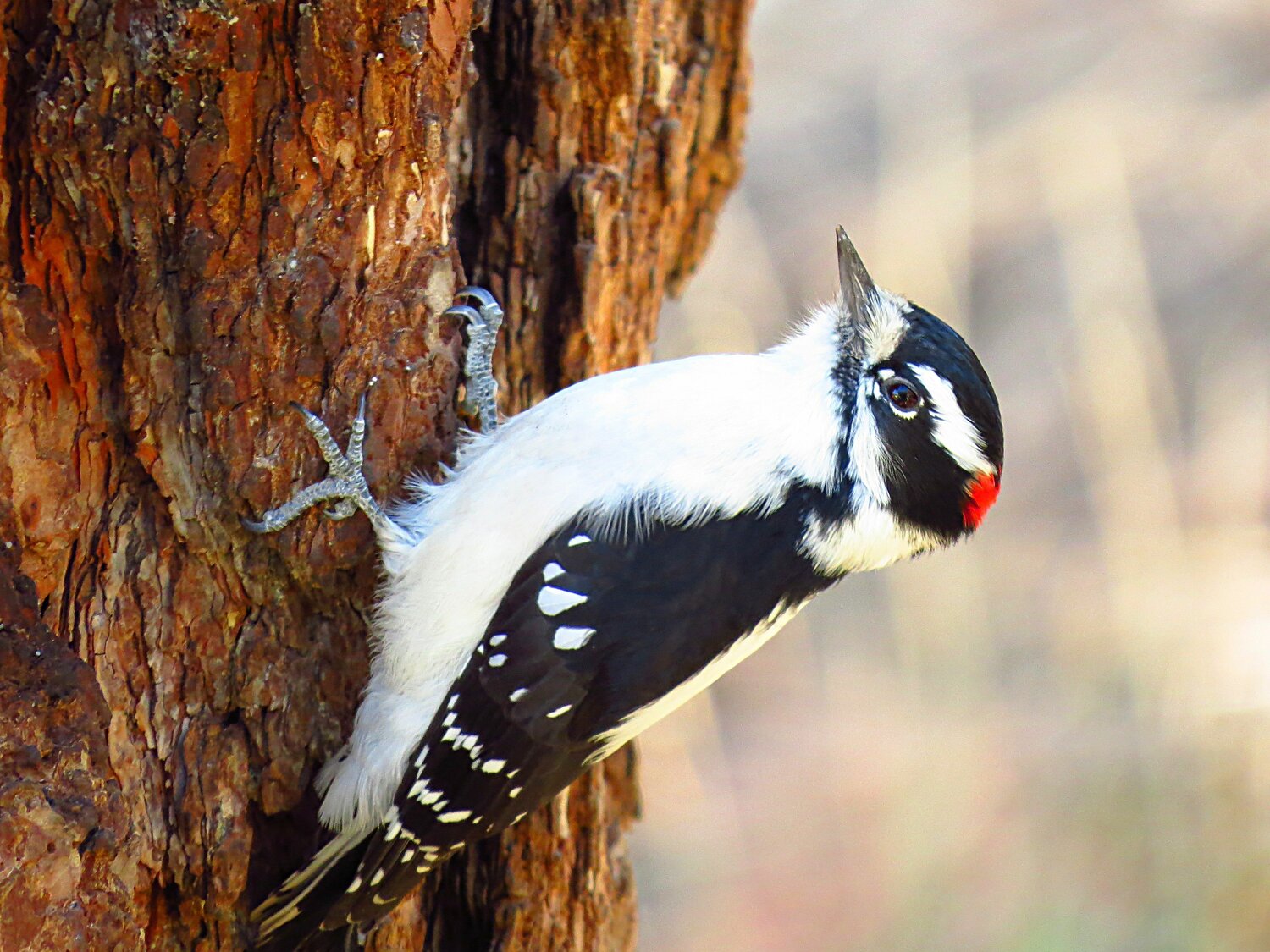
This week’s Bird of the Week, compliments of the Weminuche Audubon Society and Audubon Rockies, is the downy woodpecker.
North America’s smallest woodpecker is a permanent resident across Canada and all of the United States except Hawaii and the most arid southwestern regions. They occupy open woodlands, particularly those with deciduous trees, and riparian areas along streams. In summer, downy woodpeckers consume enormous numbers of insects, including some that are forest and agricultural pests. Their small size allows them to feed on places like weed stems and galls that larger woodpeckers can’t reach.
In winter, they are frequently found foraging in mixed flocks with birds of similar size, including nuthatches and chickadees. They readily come to feeders, especially those with suet, and add acorns, berries and grains to their diet. Male and female downies maintain separate feeding areas in fall and early winter, with pairs forming in late winter. Even when the sexes are together, they separate feeding areas, with males chasing females away from the best feeding spots.
Downies share adaptations with other woodpecker species that allow them to drill on trees and uncover insects and larvae under the bark. They are able to position their toes with two forward and two backward to better cling onto the trunk, and a stiff tail provides stability when they lean back. Feathers over the nostrils and nictitating membranes that shield the eyes keep wood particles out.
The downy woodpecker’s name is a reference to the soft, white feathers that make up the white stripe on its black lower back. Its head is striped in black and white, with males wearing a small patch of red on the nape. Black wings are checkered with white patches and the white outer tail feathers have black spots. Its bill is short and chisel-like.
Distinguishing between the nearly identical downy and hairy woodpecker species can present a challenge. When the two are together, the larger size of the hairy is apparent. The hairy’s bill relative to head size is much longer, and its outer tail feathers are not spotted.
Research has presented evidence that the plumage mimicry between downy and hairy woodpeckers is an example of one species evolving to look like another. When mimicry like this occurs in nature, it is believed to confer an advantage to one of the species.
For information on events, visit www.weminucheaudubon.org and www.facebook.com/weminucheaudubon/.


 >