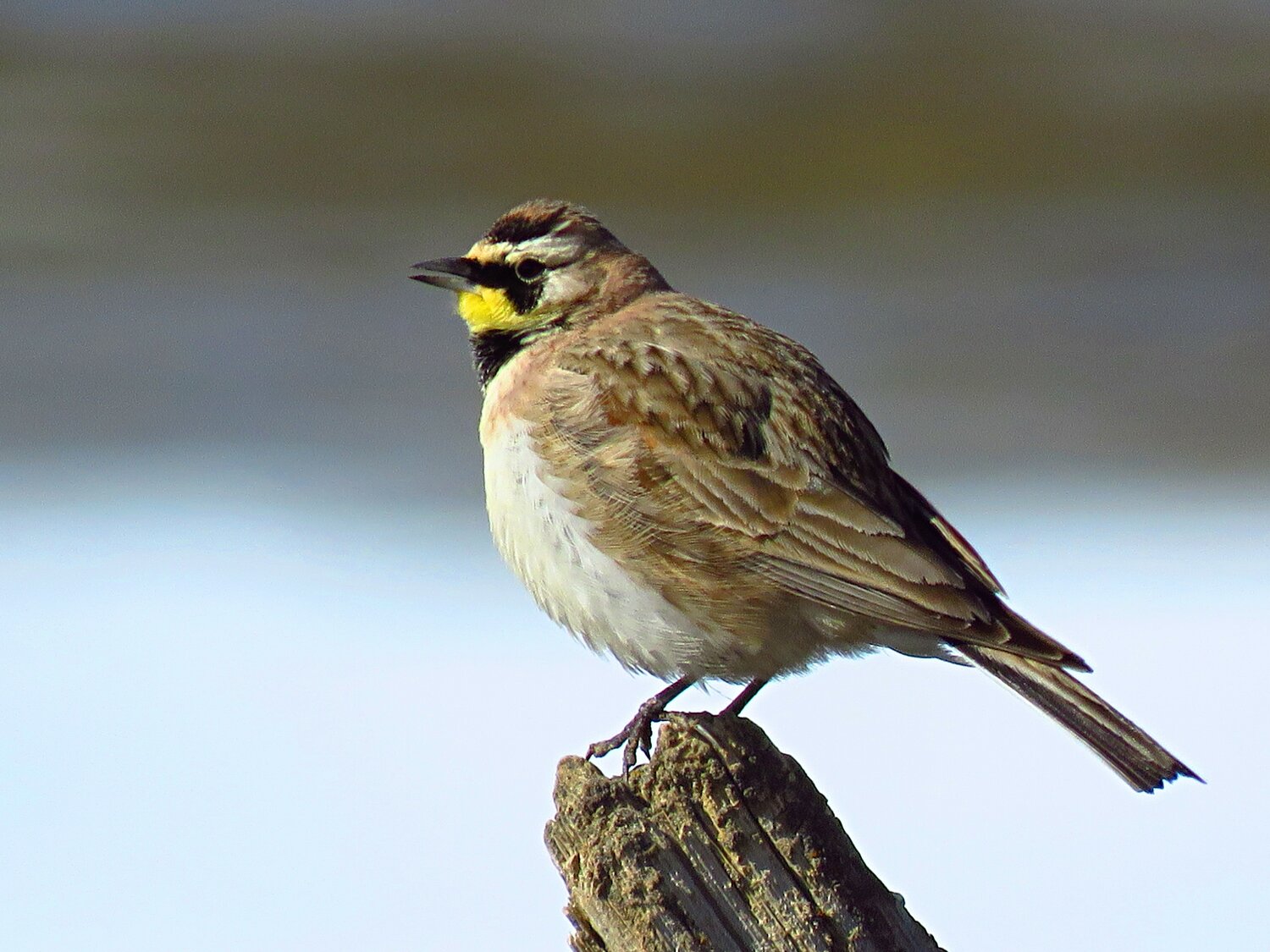
This week’s Bird of the Week, compliments of the Weminuche Audubon Society and Audubon Rockies, is the horned lark.
When the American Birding Association chose the horned lark as its 2026 Bird of the Year, it was described as “adaptable, beautiful, bold and tough.” This is a bird of open-country, short-grass habitats that avoids areas with trees. It is the only lark species native to the Americas, but is also found in much of the northern hemisphere across the globe.
Its scientific name, Eremophila alpestris, describes it as desert loving and high mountain, but this bird has adapted to live in virtually any habitat with low vegetation. It is at home on beaches, sand dunes, deserts, grassland, tundra, alpine areas, pasture and agricultural lands. More than 40 subspecies are recognized which differ mainly in their color as seen from above, enabling them to match the color of the local substrate.
Brownish above and white below, males have a black mask and yellow on the throat and head. Tiny black, hornlike head feathers which give him a rakish look are not always visible. His high-pitched musical song is a delicate tinkling sound. Females are paler and lack the black face mask. Outside the breeding season, these sparrow-sized birds are social and often mix with other open-country birds.
Primarily, horned larks live their lives on the ground. A female chooses a nest site in a natural depression on bare ground or excavates one herself. She collects small pebbles, dirt clods or other small objects to construct a type of walkway beside the nest. The exact function that this pathway serves is unknown. On hot days, she stands over the nest with wings spread to shade the eggs or chicks.
Horned larks are often discovered when they are disturbed from foraging for seeds and insects along the shoulders of gravel roads. Cryptic coloration makes them hard to locate even when they are moving in small flocks across the landscape. They often forage in agricultural fields, where they are at risk of ingesting the harmful pesticides commonly applied to the seeds of commercial crops or the insects that they target.
Keep your eyes open for these interesting birds in open areas off Piedra Road, near the Riverwalk and Vista pond, and other open areas, including those at high elevation.
For information on events, visit www.weminucheaudubon.org and www.facebook.com/weminucheaudubon/.
Photo courtesy Charles Martinez


 >
>