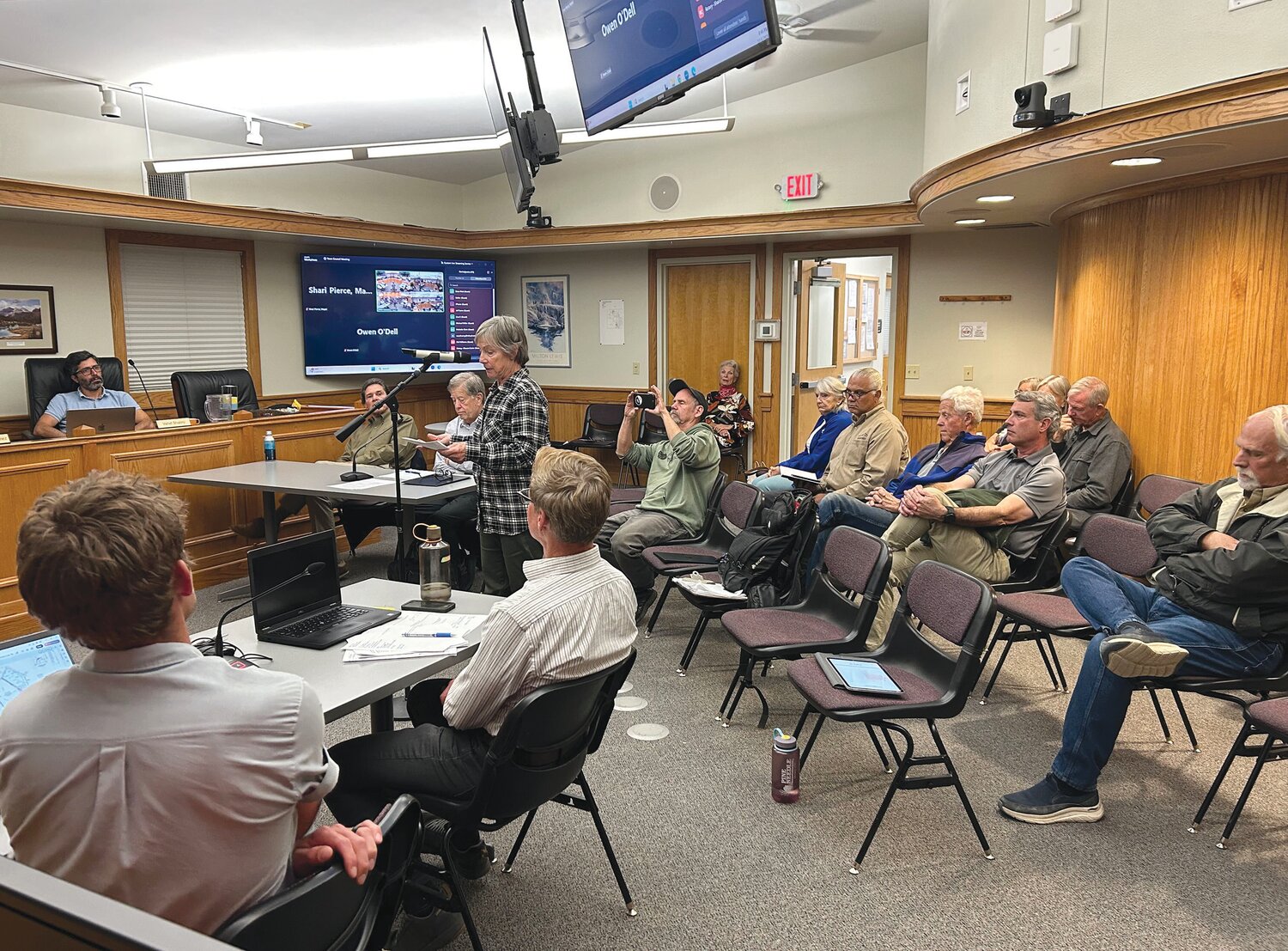
On Oct. 6, the Pagosa Springs Town Council decided to continue a decision on a proposed subdivision development being called Ponderosa Mountain by the developers.
A continuance decision by the council is a formal vote to postpone a final decision on the specific agenda item to a future date and time, Town Manager David Harris explained.
The decision came after the majority on the council expressed that they were leaning toward denying the application, but needed more clarity on the criteria the denial decision would be based upon.
The developer, listed as Modern Community Builders LLC, came before the council seeking approval of a planned development agreement (PDA) with the town and a zoning map amendment.
Both of these items came before the Pagosa Springs Planning Commission on Sept. 8, where it recommended approval to the council.
The planning commission also approved the sketch major subdivision application for the development at that meeting.
The subdivision in question proposes to have its main access point off of U.S 160 and Great West Boulevard, west of downtown.
The developer, represented by Jonathan Fink at the meeting, plans to fully develop the 70 acre site in phases, with a mix of residential and commercial lodging units.
Fink explained that phase one would include building 82 for-sale residential homes and 82 stand-alone cabins for commercial lodging, equipped with a clubhouse, pickleball courts and a swimming pool.
He explained that 30 homes, out of the total of 82, would “qualify as workforce housing” and would be deed restricted in perpetuity.
In the future phases of development, which would take place over about a 10-year period, 12 percent of the remaining homes would be dedicated to workforce housing for the community, he explained.
“There will be no difference in quality between the workforce-dedicated homes and the market price homes,” he explained.
“All homes will be built to the same standards, and no one will know the difference between them,” he said.
The price tag quoted by Fink for the workforce housing dedicated homes would land around $360,000 and would be aimed at those making 90 to 130 percent of the area median income (AMI).
The market price homes would land at around $590,000, he added.
Development Director James Dickhoff explained that the town could receive some public benefits from the development, such as addition to the secondary road network and a public commuter trail (known as the Town-to-Lakes Trail) and public open space.
While many of the public comments on the matter expressed concern about too high of a density for that area, Dickhoff explained that the proposal actually displays “fairly low density.”
The planning commission recommended an R-12 zoning for the residential section of the subdivision, but the proposal for phase one was coming in at “more like R-6,” he explained.
When opened to questions, the council also expressed concern about density issues and if the public infrastructure in place could support the amount of growth that this area would see.
Mayor Shari Pierce expressed concern about the roads in that area, the access point off of U.S. 160 and if they’d be able to support the level of growth that the subdivision is proposing.
“Those roads aren’t meant to handle that much traffic,” she said.
She also asked why, if the development is coming in at R-6, rather than R-12, the council wouldn’t just zone it to R-6 to keep the density lower for that area.
Dickhoff explained that future phases might come in at higher density and the developers wanted that flexibility.
Council member Leonard Martinez expressed that he was concerned that the development is coming at a time when the town is in the middle of attempting to upgrade its troubled sewer infrastructure.
“Why now?” he asked, when “we’re in the middle of fixing our infrastructure?”
Martinez also expressed that the tourism economy represents a “single point of failure” for the town’s economy, and that he is worried that this development would “exacerbate” that problem.
In the past, Martinez has advocated for seeking to diversify the economic activity in the area, beyond the tourism economy.
Several public commenters on the matter showed concern about water availability in the face of persistent drought, but Fisk explained that he has received assurances from the Pagosa Area Water and Sanitation District (PAWSD) that there is sufficient supply to meet the demand.
Fisk also said that “no one would be moving in until 2028, and the way that PAWSD is going, they are highly confident that the infrastructure is already there … and we’re lucky that we’re right on the main line of all the utilities running down Highway 160.”
He added, “The electricity is there, the television distribution people are there, the water is there, the sewer is there, but even with that we’re not going to build 164 houses on day one.”
One public commenter, Robin Nay, explained that she is concerned about fire danger and evacuation routes if this section of highway becomes a dense residential area.
“It scares the hell out of me,” she said.
Another commenter said that she agreed with the mayor that an “R-6 zoning would be much more palatable,” to reduce the density in the area.
Council member Mat deGraaf expressed concern that this just isn’t a good fit for Pagosa Springs.
“I want to be upfront,” he told the developers, “that I think I’m going to be a burr in your side through this process.”
He added, “I don’t believe that you quite understand what this community needs and wants … I respect what you’re doing, but I will be a voice of opposition in a lot of places.”
A public commenter also stated that he thought the developer came in with a “certain amount of hubris, when he said that the people who live here want a certain lifestyle.”
How do the developers know “what that lifestyle is when they themselves don’t live here?” he asked.
Resident Terri Pritchard added during public comment, “This project is not for Pagosa. We can do better than this.”
She explained that she came here from Los Angeles, commenting, “Don’t Los Angelize this place. We all ran away from it.”
She added the council should break the cycle and say no to the development.
One public commenter, Shane Jones, who explained that he is the listing broker on the property, described a situation where the developers came to him asking questions about the property, and he referred them to the town-approved Comprehensive Plan of 2018, which is the guiding document for future development in the town.
Jones explained that the comprehensive plan foresaw higher density for this area of development.
“If density is the concern, well, they are doing less density than the recommendation of the comprehensive plan,” he said.
He added, “Maybe we should redo the plan if we decide we don’t like it,” but, for now, the plan is the guiding document.
After public comments had ended, it was time for the council to discuss further and make a decision on the matter.
Martinez made a motion to deny the approval of the PDA and zoning amendment, citing his “heritage” as a sixth-generation community member and that “the decisions we make now have an impact generations from now.”
He continued, “And I believe the timing for this project is not good for our community at this time.”
Council member Brooks Lindner stated that he respects Martinez’s point of view on this, but also added that what Jones explained about the Comprehensive Plan approved by the town as its guiding principle also makes a lot of sense to him.
“There’s a real disconnect there that needs to somehow be addressed,” he said, adding that the fact that the applicant is not currently the owner of the property made him lean toward denying approval.
Pierce chimed in to say that, “For me, them not having the things worked out with PAWSD and La Plata Electric and even with our own sanitation district,” citing the “amount of money they are gonna have to invest for the modeling for that.”
deGraaf expressed that what the developers “are proposing, in my mind, does not fit with what I want this community to look like in the future … I chose to sit up here so that my voice can be heard, because I feel that I speak for other members of the community.”
Pierce asked Dickhoff about the process going forward, asking if the council could slow down the process while the outlook for the utilities is figured out.
Dickhoff explained that if the utilities say they can’t handle the development, at that point the developers would “make the determination that they can’t move forward.”
He explained that the next step for the developers would be the “preliminary major subdivision application,” and it’s at that point they have to include all the modeling for utilities.
If the items on the agenda were approved, “their next step is engaging with all that utility stuff right away … so they know the capacity and their obligation for each one of those entities,” he explained.
Martinez again stated that, from a risk-management perspective, he thinks that now is not the right time to approve this.
Dickhoff advocated for the need for workforce housing in the community, saying, “If we don’t have workforce housing for our youth and our young families, we are not going to have young families in our community, and we are really struggling right now.”
He added that if the council does in fact deny this application, town staff would want “some guidance” on the rationale for denial, because the application seems to fit all the criteria in the comp plan and the Land Use and Development Code.
Pierce suggested that it was time for some sort of decision, either to approve, deny or continue the decision.
Dickhoff again explained that if the council denies the application, that he would like the council to refer to the “portion of approval criteria that you feel that this project did not meet as the basis for denial.”
deGraaf said that, “Personally … it’s just my feeling” that this project doesn’t fit “in our town.”
“I understand what you’re asking for,” but, he said, “I feel like I can’t give you that concrete direction that you would want so you can do your job. My feeling doesn’t have the foundation that I wish it could.”
Lindner chimed in to say that he would “not be ready” to give enough detail on the criteria for which he would deny the application. “Which is why I would be more in favor of a continuation … just so we can be thorough on what we are not approving.”
He added the developers have “worked hard on this, they’ve got all this approval criteria that follows our code that follows all of it, so we can’t just say we deny it because of a feeling.”
Pierce asked what information the council should bring back “at the next meeting for this” if it plans to deny the application.
Lindner made a motion to continue the decision until the next meeting, clarifying that the motion stated “that if we are going to deny, that we need to provide them with direction based on the approval criteria.”
It was seconded and approved, with Martinez opposing the motion on the grounds that he wanted to deny it right then and there.
“I don’t believe that this project is the right thing for Pagosa Springs at this time,” he said.
Council members Madeline Bergon and Gary Williams were absent from the meeting.
derek@pagosasun.com


 >
>