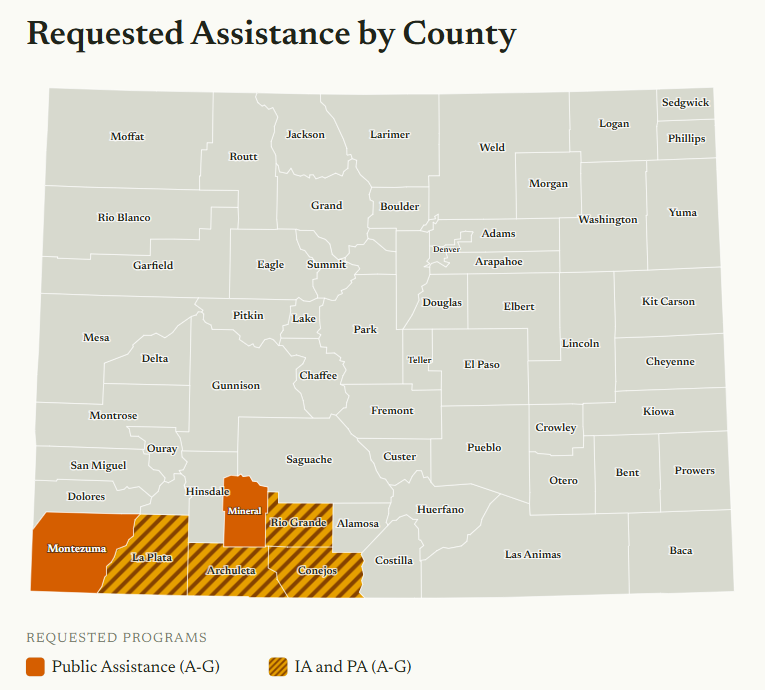
Today, Gov. Jared Polis submitted a second Presidential Major Disaster Declaration (MDD) request to President Donald Trump following another round of historic flooding across Southwestern Colorado and the San Luis Valley beginning on Oct. 31. This second request follows Colorado’s Oct. 31 MDD request for flooding that occurred in the same region from Oct. 22 through Oct. 25, which is still pending federal approval. The State had to submit two separate requests because the storms, which began on Oct. 22 and Oct. 29 respectively, are being treated as two distinct weather events by the National Weather Service (NWS). However, because both storms harmed the same region of the state, and the second storm created compounding damage in areas already damaged and recovering from the first storm, approval of both requests is essential for Southwestern Colorado’s recovery efforts.
“Coloradans living in the southwestern part of our state experienced unprecedented floods. Hundreds of families have lost homes, roads and bridges have been washed away, and communities are facing a large recovery effort as winter approaches. This region and its people are resilient, and they will recover. But Colorado needs the federal government to approve both of our Major Disaster Declaration requests to support this recovery. Approving one without the other would cause confusion, create unnecessary barriers to recovery, and leave families, businesses and communities without the assistance they need to rebuild. Time is of the essence and I urge President Trump to approve both requests without delay,” said Polis.
The two flooding events struck many of the same communities, causing overlapping damage to homes, businesses, and critical infrastructure such as roads, bridges, and telecommunications equipment. The first storm resulted in excessive runoff, flooding, and flash flooding across Southwestern Colorado, including record and near-record river floors. The second storm, which arrived just a few days later, damaged many of the same areas — many of which saw higher water levels than during the first flood. Colorado has been working with local governments and the Federal Emergency Management Agency (FEMA) to assess damage from each storm to demonstrate the urgent need for help from our federal partners. It is critical that the Federal Government approve both requests as only approving one would leave significant disaster-related needs without federal support, add substantial administrative complications for state and local governments still responding to the disasters, and delay recovery for communities already struggling to rebuild.
Today’s Major Disaster Declaration request includes:
“The terrible floods have left Southwestern Colorado facing an unprecedented recovery challenge. Our local and state responders have done an incredible job, but the damage to essential public infrastructure and the sheer number of displaced residents require federal support. Securing this Major Disaster Declaration is critical to ensuring our communities have the housing assistance and infrastructure funding they need to recover safely before winter conditions make rebuilding impossible,” said Trevor Denney, Director of the Colorado Office of Emergency Management.
Joint state and federal assessments identified and validated $28.5 million in PA damages from the second flooding event, along with 271 primary homes that were destroyed or deemed uninhabitable, with and an additional 136 impacted homes across the four counties requesting IA. At the height of the flooding, more than 6,300 residents were under mandatory evacuation orders and more than 3,300 homes were inaccessible. Hundreds of Coloradans remain displaced, with damaged roads, bridges, and water systems complicating recovery as winter approaches. Some households may remain without road access until spring, while others remain without homes to return to.
“Our communities have endured two devastating floods in a matter of days, leaving families displaced, critical infrastructure damaged, and residents facing an uncertain future. I’m incredibly proud of our first responders, county employees, and community partners who have worked tirelessly to help our neighbors, but recovery of this magnitude requires federal support. I urge President Trump to approve both Major Disaster Declarations without delay so our families and communities can begin rebuilding,” said La Plata County Commissioner Matt Salka.
Colorado submitted its first MDD request on an expedited basis while damage assessments were still underway across Southwestern Colorado. Before state and federal teams could fully assess the destruction from the first storm, a second round of historic flooding struck many of the same communities, causing additional damage and complicating recovery efforts.
“Our neighbors in Southwestern Colorado need our support now more than ever. I encourage Coloradans to give what they can, support local businesses, and plan a trip to these beautiful communities over the next several months. Whether it’s skiing this winter, rafting and boating this spring, or hiking and camping in the summer, as conditions allow for it, every visit helps these communities get back on their feet,” said Polis.
Polis issued two Executive Orders today memorializing and extending the state disaster emergency for Southwestern Colorado flooding and amending a previous wildfire disaster declaration consistent with an updated assessment of disaster-related costs and helps ensure funding is immediately available to meet the needs. For the Southwestern Colorado flooding disaster EO, the State has mobilized the Colorado National Guard, state emergency management personnel, mutual aid partners, and voluntary organizations to support affected communities, provide emergency supplies, assist displaced residents, and begin recovery operations. This is Colorado’s 13th declared disaster this year, and the state has already committed more than $128.2 million to the previous 12 disasters. With local governments and emergency responders stretched across repeated disasters, additional federal assistance is urgently needed to restore infrastructure, support displaced families and help Southwestern Colorado recover before winter conditions further complicate rebuilding.


 >