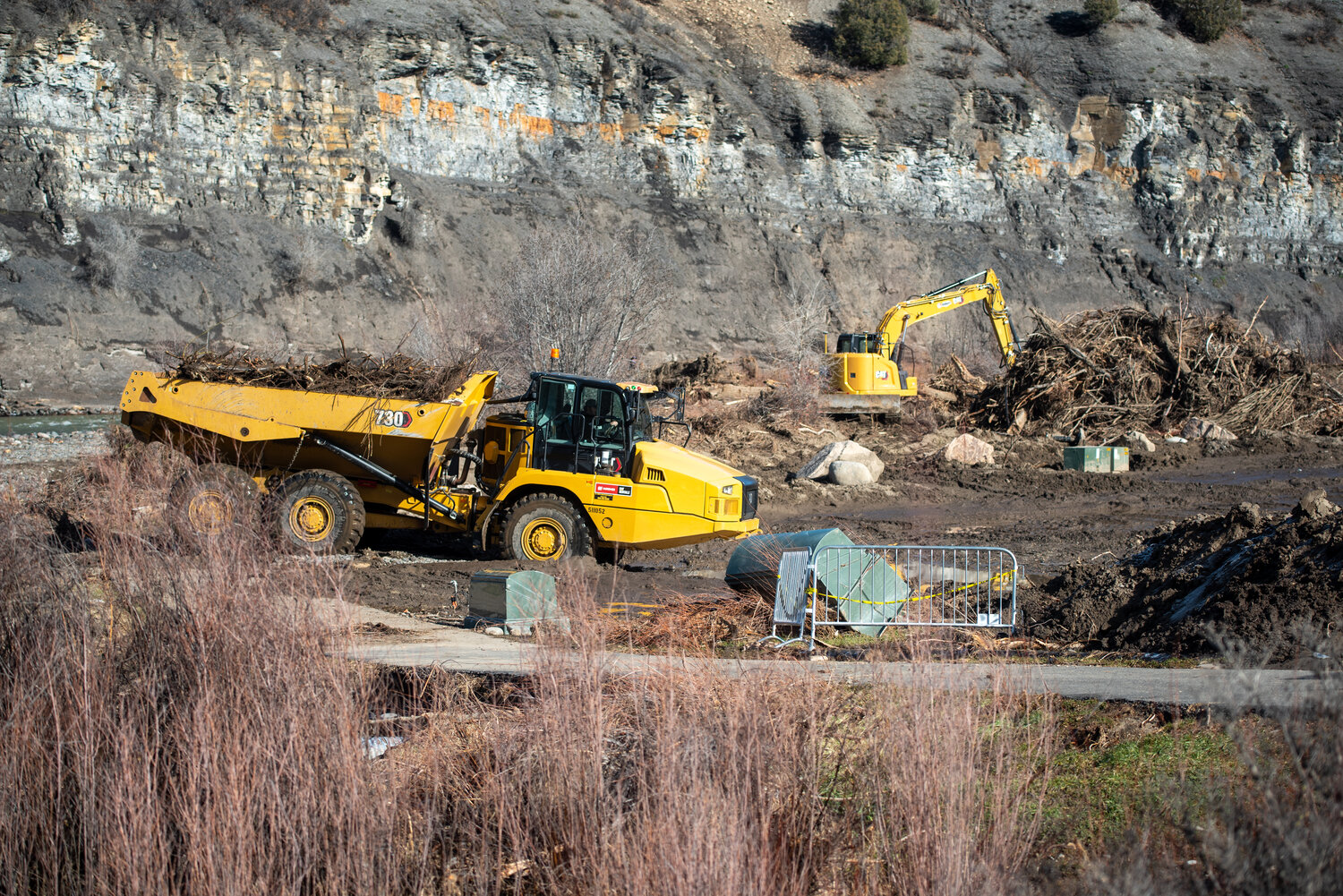
Flood response and recovery continues throughout Pagosa Country.
At their respective meetings this week, several local governmental entities provided updates on the flooding and response, including the number of structures affected.
Archuleta County
During a work session held by the Archuleta County Board of County Commissioners (BoCC) on Nov. 17, Emergency Operations Commander Roy Vega provided the board with an update related to flood recovery and response efforts.
Vega explained that the county still has a boil advisory for anyone on a water well, and noted that the county has ordered well-testing kits for residents to use.
Vega also noted that in terms of environmental hazards, “the biggest concern right now is the silt,” explaining that it may be contaminated with diesel gas or sewage.
Vega mentioned that the silt issue is “kind of new to everyone” and that La Plata County is dealing with the same issue.
He indicated that the Colorado Department of Public Health and Environment is working to address the matter and test the silt for contamination.
Vega commented that if the silt comes back as uncontaminated that would make it easier on everyone to dispose of it.
Vega explained that people are also applying for burn permits through the Archuleta County Sheriff’s Office (ACSO) and are able to burn wood debris as it dries out.
Vega also mentioned that there are still residents who do not have power along the County Road 500 section south of Estate Circle.
He explained that 170 households have temporarily relocated to Airbnbs, but that their time in those accommodations is starting to run out, and that the Department of Human Services and the Public Health Department are working on finding short-term and long-term solutions for people who are still displaced.
He noted that supplies are still available at the county’s Mountain Express Transit building.
Vega explained that crews still need to finish damage assessments for areas that they have not been able to reach yet, but that currently 37 structures are known to have been destroyed, meaning that water levels came up to door handles or higher.
He noted that 50 structures were majorly affected with water coming up to outlets inside, and that 72 structures were minorly affected with some level of water inside.
He also noted that 192 structures were affected in some capacity from the flood.
Commissioner Warren Brown asked about a specific number of residents still without power along County Road 500, with Vega explaining that it’s at least 39 structures and “they might not be occupied down there.”
Brown also asked about what kind of plans there are for assisting residents who do not have power until it can be restored.
“That’s what’s tough,” Vega said, explaining that the county has made contact with everyone multiple times.
He added that everyone knows winter is coming and that the county is “not going to be able to get that road built before winter.”
Vega mentioned that resupplying residents throughout the winter every couple of days “is going to be pretty tough.”
He commented that he is unsure what options the ACSO will have with supplying gas or electricity over the winter, clarifying that they will help in emergency situations.
“I think a lot of it will fall on themselves, or family or friends,” he said.
Vega stressed, “We might not be able to resupply you all winter long.”
Medina asked for Vega’s advice to residents with questions about what to do with silt built up on their property and how to dispose of sandbags used in the flood.
Vega explained that all the up-to-date information is shared on the county’s website, ACSO website, emergency management website and on county Facebook pages.
“We do our best to get the information out on as many platforms as we can,” he said.
He also explained that some questions are unanswerable at this time, specifically with what to do with built-up silt.
“We don’t know what to do with it yet,” he said.
Vega also encouraged residents to monitor the county’s websites for information, noting that it “is changing all the time.”
For more information on flood recovery resources, visit www.archuletacounty.gov/community/welcome-to-archuleta-county/news/archuleta-county-flood-resources.
Town of Pagosa Springs
On Nov. 17, the Pagosa Springs Town Council received updates from town staff department heads about how the flooding events have impacted various municipal departments.
Tourism Director Jennifer Green explained that, from the tourism marketing perspective, a lot of the post-flood work is about explaining to visitors and potential visitors that Pagosa is open for business.
Green explained that the town manager has done interviews with several news outlets and that she has one planned with the Denver Post to promote the area as an inviting and safe place to visit after the flood.
She also said that she is working with a few social media “influencers” to promote the area to potential visitors.
“We need to restore confidence … that it’s safe to visit here, and we want to support the local businesses … after two historic floods,” she said.
Council member Gary Williams remarked that he’s seen local business leaders on the news and that they are doing a “great job” at promoting the idea that Pagosa is open for business.
Green described a particular “Love Pagosa” campaign that she explained as a “shared community identity,” supported by the Chamber of Commerce, the Main Street Program, Pagosa Springs Community Development Corporation, the town “and various other entities.”
“It’s aimed at recovery and community pride,” she said, adding that the town’s visitor center had to be relocated due to the flooding.
“The new visitor center is now located at the Ross Aragon Community Center, and we are back open seven days a week,” she said.
On the Public Works side of things, Director Nick Freelen explained that some of the town’s streets are in bad shape.
“Sixth Street and 5th Street, those are gonna be pretty long closures, and we don’t have an estimated time for reopening those,” he said, adding, “They are going to have to be reengineered and then rebuilt appropriately,” he added.
Hermosa Street is also still closed, he said, adding, “We are trying to keep traffic off of there to prevent people from wandering down, looking [at the river] when folks are still trying to get debris out of their yards.”
He added that the town’s storm drains on Hermosa have been “completely silted over” from the flood.
“It’s going to be a slow cleanup, and we just ask the public’s help with that by staying out of those streets unless they have a need to be there. … We have those barricades there for your safety,” he said.
On that front, Town Manager David Harris urged patience, saying that “as much as we want the recovery to be fast, it’s going to be years.”
He added, “A lot of the projects that we are dealing with will take a few decades … that’s part of the sobering message.”
The town and the county are making applications to the governor for a state emergency declaration, and a “letter will go with Governor Polis’ packet to the president and [the Federal Emergency Management Agency (FEMA)] for their consideration. … We need the president to provide this,” he said.
He added, “It’s going to be tight financially even with that, so I just wanted to warn you that we have a lot of things that need to be repaired.”
Development Director James Dickhoff explained that the town conducted a residential damage assessment, with the goal to determine “the number of residential and commercial properties” damaged by the flooding.
He said that they used the FEMA Crisis Track to enter the damage “we observed,” explaining that there are four categories to consider.
Those are no damage; minor damage, which is “typically water in the crawl space”; major damage; or destroyed.
“If it’s knocked off of foundation and is floating down the river, as we observed,” he explained.
The main properties that were “inventoried and assessed” were those that received mandatory evacuation orders along creeks and riverways, explaining that the gauge for major damage is if the water got 18 inches high up from the crawl space, which typically impacts electrical outlets.
Approximately eight of those properties were considered to be in the major damage category, one was “destroyed, floating down the river,” and around 12, “don’t quote me on that,” had water on the floor, he noted.
“A number of other properties were definitely effected,” he said, adding that “a lot of our properties even if they were not along the river corridor had water filled crawl spaces and some of those sump pumps failed for them, and a lot of folks don’t have sump pumps in their crawl space.”
On the commercial side, he said the East End properties were impacted as well as Hot Springs Boulevard.
Quality Inn had water and mud on the floor on the lower level and Healing Waters had damage as well, he explained.
Some on the council wanted to know what they could do to change the code to not allow people to build in areas subject to flooding events.
Council member Vahid Shabro asked Dickhoff what council can “do to change the code on where people can build.”
He added we need to build to be “more resilient” since these types of events seem to be happening “more frequently.”
Dickhoff responded that’s discussion the council could have if and when it decides that it wants to put in place “more restrictive building requirements for building in the floodplain.”
He added, “With a 100-year flood, in essence, there’s a 1 percent chance every year that we could get a 100-year flood.”
From the Parks and Recreation Department side of things, Director Darren Lewis noted that, as of now, all pedestrian bridges remain closed.
He explained that his department’s priorities right now are the Centennial and Veterans’ (near Town Park) bridges.
He added that the 6th Street bridge will not be a priority at this time.
From the house hitting the Veterans’ bridge, “there’s some railing and things that need to be cut off and iron put back on and welded on,” he said.
The large parking lot by Mary Fisher Park has been opened, he explained as a positive thing, as well as the trail from there heading to Hot Springs Boulevard.
“Ideally, we want connectivity” with the town’s main street and its businesses, he said.
On Cotton Hole and River Center parks, he said, “It looks like a bomb dropped on both of those, ... and it’s gonna be awhile” until those are open.
Mayor Shari asked about keeping people out of the closed parks and what the town could do on this front.
Lewis explained that the barricades are there for a reason.
“I’m down at Town Park today and I look across to Mary Fisher, and everyone’s down by the river and that area is closed,” he said, adding, “There’s debris down there and we have tape to keep people from walking down there, but, just to be polite, you can’t fix stupid. I’m sorry … we can only put up our barricades and try to keep areas safe.”
Pierce asked if the town could adopt a steep fine for people disregarding closed-off parks.
Harris said, “We can always do something like that,” adding that it’s the “human condition to be curious, and that’s not excusing what they are doing, but we have contaminated soil and water down there.”
“We gotta do something for people to wake up, because we don’t have enough emergency resources to be fishing people out of the river when they are already helping other people who got flooded out,” Pierce said.
Lewis explained that the town wants to maintain the appearance that “we’re open, but some areas are “definitely closed.”
“And people do not need to be going around those barricades, by any means,” he said.
Pagosa Area Water and Sanitation District
At its Nov. 16 meeting, the Pagosa Area Water and Sanitation District (PAWSD) Board of Directors heard a detailed update from District Manager Andrew Connor on the impacts of the recent flooding on the district and the timelines for repairs.
Connor explained that the flooding on Oct. 22 and 23 and on Nov. 1 and 2 are considered separate events by state and federal emergency management agencies due to the time between them.
He stated that the first flood had a limited impact on the district, only causing impacts with its wastewater plant having to process large amounts of water and two roads with pipes underneath them being washed out, although the pipes were not destroyed — North Pagosa Boulevard and Mockingbird Place.
The impacts of the second flood were more significant, with PAWSD losing several water lines, Connor stated.
However, he indicated that the district was able to maintain pressure in the entire water system throughout the flooding and did not have to issue a boil water notice, partially due to efforts to close valves adjacent to river crossings as the flood rose.
“The staff did a phenomenal job in the response on this,” he said. “For us to not have the boil notice and to not lose everything and just put up our hands, act of God, no, that’s not the business we’re in. We operate 24/7 regardless of what is going on.”
PAWSD board member Bruce Jones complimented Connor on his work preventing a boil water notice and on his updates that he provided to the board during the flooding.
Connor stated that crews had worked extended hours for the last three weeks, leading to about 900 hours of regular time and overtime at a cost of about $40,000 in salaries.
Connor then moved on to outlining the various damage the district suffered in the second flood, starting with the Apache Street bridge over the San Juan River, explaining that a water line underneath it was damaged.
He stated that the district has been able to backfeed water to customers on both sides of the bridge and that repairs on the damaged line are not scheduled for 2026 since PAWSD will have to decide how to approach the repairs on the line before repairing it.
Connor added that PAWSD has been entering reports on the damage into the Crisis Track software provided by FEMA, which will help with processing payments for damages if federal aid is approved.
He stated that the district also sustained damage to a water line on the U.S. 160 bridge by 1st Street.
PAWSD has been able to install a temporary 2-inch water line across the bridge, and a permanent replacement will likely occur early in 2027.
He added that he has been speaking with a local boring company about the work and that many of the replacements will use fused high-density polyethylene pipes, which will be more durable than many of the damaged pipes.
Connor explained that water running 4 to 6 inches higher than the spillway at Stevens Reservoir washed out Honeybee Place, although it did not destroy the underlying head wall or culverts.
He added that the culverts were recently expanded from one to two, which helped with managing the flood, and the dam inspector inspected and found no issues with the reservoir, although the road would need to be rebuilt.
PAWSD would be working on completing road repairs at this location during the week, he stated.
Connor indicated that the ditch from Stevens Reservoir to Lake Pagosa held, although it will need to be cleared of debris, which will be done in 2026.
He stated that repairing the washout on North Pagosa Boulevard will require temporarily removing the water line and that PAWSD would reactivate its San Juan water treatment plant, which is currently turned off, to provide water to customers in the area during the disruption.
Connor added that these repairs are likely to occur in the next “couple weeks.”
The district lost 1,400 feet of water line on east U.S. 160 near High Country Lodge where the line runs near the riverbank, Connor explained.
He added that this replacement was completed last week and that water service was restored to some customers who had been cut off.
Connor also noted that this work cost about $65,000.
“Getting through these two events and keeping pressure up in the entire system is beyond what I can even fathom, and I can fathom a lot,” said PAWSD board chairman Gene Tautges.
Connor stated that he has been working every day except one Saturday since the flooding and has been primarily in the field with PAWSD crews.
Connor explained that the West Fork diversion that feeds PAWSD’s Snowball water treatment plant suffered damage in three areas, including regions where embankment slides near Jackson Mountain damaged the line.
He stated that repairing this damage is a top priority and thanked staff from Bootjack Ranch and the U.S. Forest Service for their assistance in helping PAWSD with gaining access to the area and preparing for repairs.
Connor indicated that he was able to secure a local contractor for the repair work and the replacement pipes are ordered, but that brush removal in some areas still needs to be completed, and PAWSD is working on finalizing plans for the repairs.
He stated that these repairs will likely cost between $800,000 and $1 million and that they will have to be completed before PAWSD receives any federal assistance, if such assistance is approved.
PAWSD is currently feeding the Snowball plant with water diverted from Fourmile Creek and is in “good shape,” but that repairs do need to proceed quickly.
In response to a question from Tautges, Connor confirmed that any FEMA relief money PAWSD receives could come in months and that PAWSD would have to pay for repairs and then be reimbursed later.
He added that FEMA relief would only cover up to 75 percent of the damages, with the other 25 percent being split between the state and local entities.
Connor also indicated that he was unsure when FEMA relief might arrive and this would depend on the president signing the federal major disaster declaration that is currently on his desk.
He stated that he was able to defer payments to the Colorado Department of Transportation for work on its U.S. 160 reconstruction project until 2027 as a way to free up enough money to pay for the repairs now, although how the district will move forward in the future is undetermined.
Connor indicated that the district’s Fourmile Creek diversion that feeds Hatcher Lake was undamaged, and that the intake structure and reservoir on the San Juan River that supplies water to San Juan water treatment plant experienced some damage and a large amount of silt accumulation during the floods.
He stated that removal of the silt accumulated at the front of the reservoir would likely occur in 2027 and that it would be usable until then, such as when the plant is needed to supply water during North Pagosa Boulevard reconstruction.
He indicated that the district also had to flush out the reservoir due to concerns about raw sewage flowing into the river upstream during the flood event, which it had done over the recent weeks.
When asked by Tautges for a “wild guess” of the total damage costs from the flood, Connor stated that he believes the repairs might cost $1.5 million, depending on the repair costs for the water lines crossing the San Juan at the Apache Street and 1st Street bridges.
Tautges closed the update by thanking all PAWSD staff for their work, including field crews and office staff who answered customer and board questions and provided information during the flooding.
Upper San Juan Health Service District
The board of directors of the Upper San Juan Health Service District, which oversees Pagosa Springs Medical Center, also heard an update on the flooding at its Nov. 17 meeting.
Chief Administrative Officer Ann Bruzzese noted that the district’s east side Emergency Medical Services (EMS) building located on San Juan Street had water all around it during the second flood, with some water in the garage area.
She noted the living quarters are higher, and added the building had no issues outside of things the district will address with its upcoming remodel of the facility.
“It’s a strong old building and it made it through,” she said.
PSMC CEO Dr. Rhonda Webb noted later in the meeting that the floor would be raised another 5 inches.
Chief Operations Officer Jason Webb noted that PSMC maintained operations through pretty much the entire event, but noted the district did spend some money to keep things up and going.
While there were capacity issues at times and there have been challenges moving people out to higher levels of care, he indicated PSMC remained operational.
He added EMS has been heavily dependent upon air transport, which it will continue to lean on until the roads improve.
“All in all, we were very resilient,” he said, adding the flooding is a big community challenge.


 >