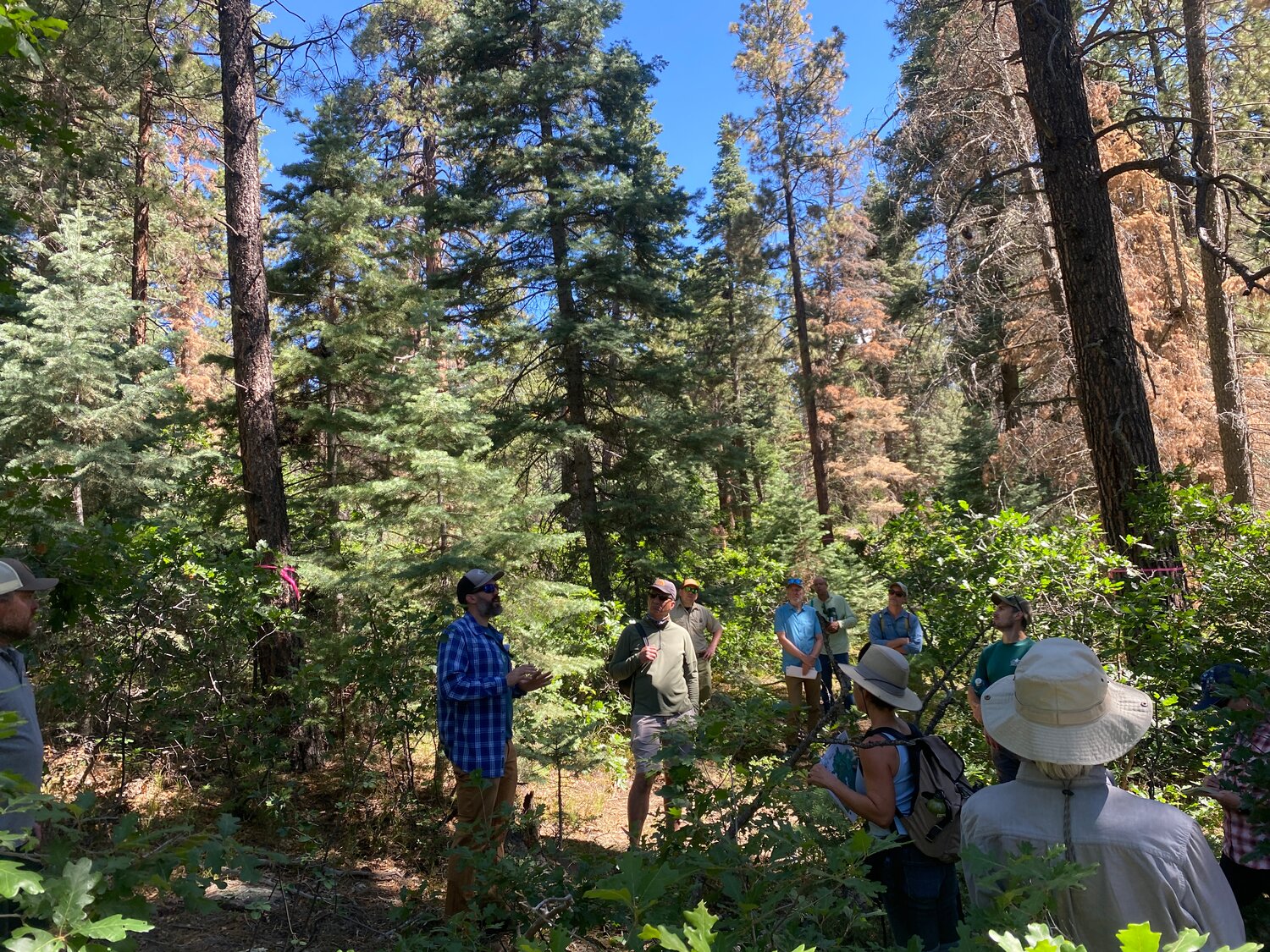
The San Juan Headwaters Forest Health Partnership (SJHFHP) will host its inaugural Headwaters Happy Hour this Friday, Oct. 16, at 4 p.m. at Motel SOCO.
The event, to be held monthly, is a casual gathering to discuss all things related to forest and watershed health in our region. An informal presentation from a topic expert will be followed by a Q-and-A.
This month’s theme is “What is ‘good fire’?” Local experts in forest and fire will join us to discuss. All are welcome.
The SJHFHP was founded in response to concerns about forest health, wildfire risk and differing opinions over forest management in Southwest Colorado. Following discussions about mixed-conifer forest management on the Pagosa Ranger District in 2008, a 2009 workshop convened by the Colorado Forest Restoration Institute encouraged a collaborative approach that included forest managers, scientists, land users and community members.
The resulting Upper San Juan Mixed-Conifer Working Group expanded its focus to encompass multiple forest types and nearby private lands, recognizing the connections between forest health, watershed resilience, water quality and critical community infrastructure. In 2013, the group formally became the SJHFHP.
The SJHFHP mission is to strengthen the long-term resilience of communities by improving forest and watershed health through collaboration, shared knowledge, adaptive management and high-priority restoration projects.
Its goals include advancing landscape-scale forest and watershed management, establishing shared principles and priorities, supporting regional economic viability through forest health products, and implementing treatments in high-risk areas.
The SJHFHP brings together a diverse range of stakeholders, including federal and state agencies, local governments, private landowners, businesses, conservation organizations, and community members. Its informal, inclusive structure encourages open discussion, allowing participants to contribute to decisions and build trust around complex forest management issues.
Since its launch, the SJHFHP has helped secure more than $1 million for forest thinning, contributed more than 3,000 volunteer hours, provided more than 20 community education opportunities, developed a citizen-science monitoring program and assessed wildfire risks to local water resources. Its wildfire risk assessments identified the Fourmile and Turkey Springs areas as priorities for forest treatments to protect critical water infrastructure, reservoirs and residential communities.
These efforts helped secure nearly $1.3 million in federal funding for treatments around water resources, with more than 700 acres treated across public and private lands.
The work demonstrates how collaborative planning can align restoration priorities, leverage funding and reduce the potential impacts of severe wildfire and subsequent erosion and runoff.
Ultimately, the SJHFHP’s experience illustrates how a locally driven, inclusive collaborative can advance landscape-scale forest restoration, protect essential community resources and strengthen resilience.


 >
>