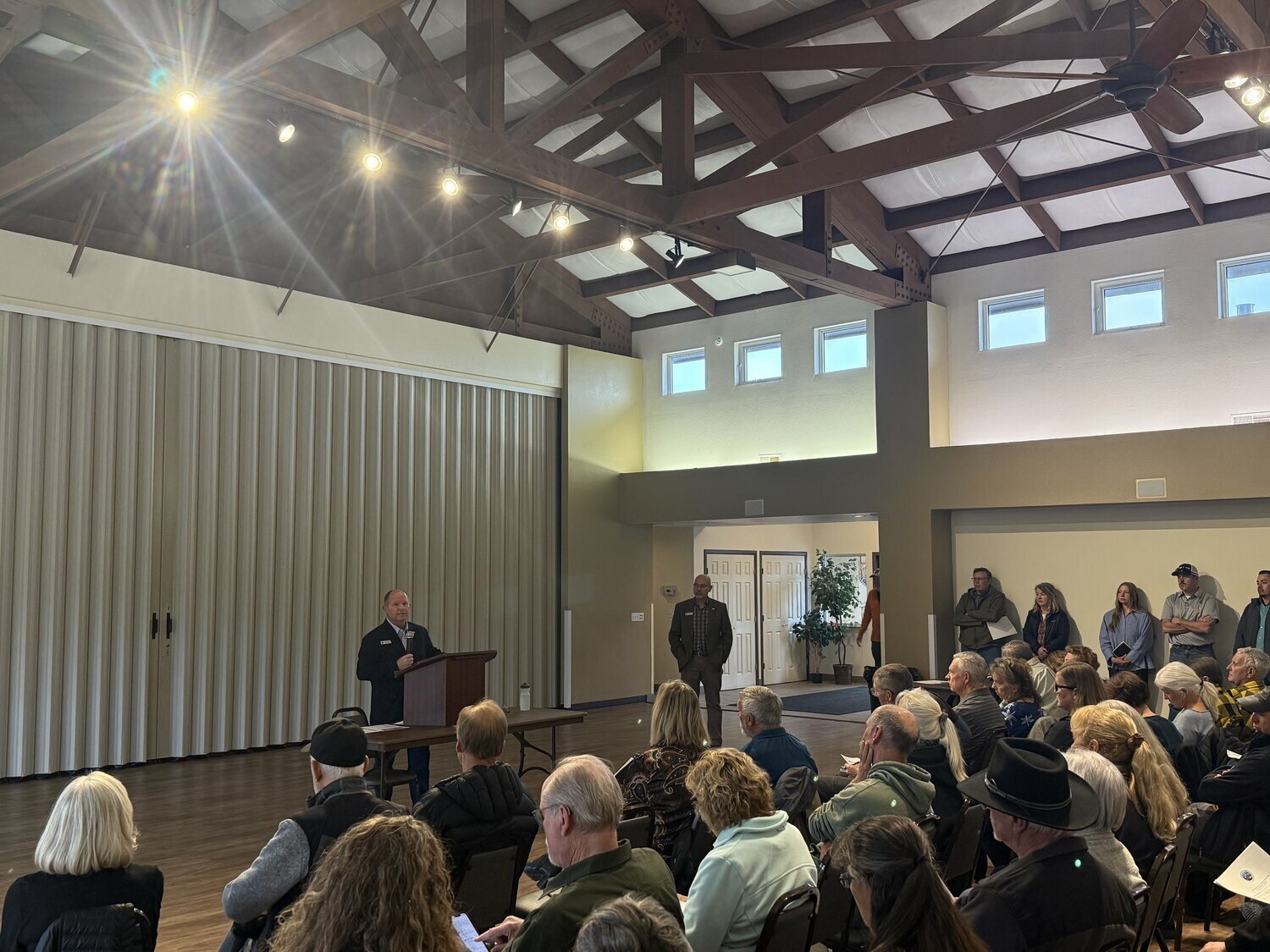
Dozens of residents attended a community forum on Monday, April 13, at the Pagosa Lakes Property Owners Association (PLPOA) Clubhouse, hosted by Commissioner Warren Brown.
The topics of unfunded mandates, adopting new building codes and public safety were discussed.
Brown offered some opening statements, explaining these forums are a way for constituents to provide input on how to serve visitors and locals better.
“That’s the point,” he said.
Brown then explained it is his belief that governments should not be about making money, meaning that what money the county has is what the taxpayers choose to allow it to have.
He posed the question of what happens when there are not enough funds to accommodate the demands of the government, answering with, “we have to increase the revenue somewhere,” noting that “if we don’t have funding, then we can’t complete the task at hand.”
Brown explained that local revenue dollars and the county being more self sufficient in order to avoid looking at grants could be an option, or that considering certain taxes, like a lodgers’ tax, could also be an option for the county.
He noted that if the county is looking at increasing revenue, it needs to know where those funds are going to be spent, adding that the county has “vast needs.”
Brown explained that, currently, he feels the county is meeting basic demands for service, “for the most part.”
He also commented that the county is “staying afloat,” but that if it were to do anything above and beyond basic service, it has to compete for grants, explaining that grant awards allow the county to do things such as road repair and maintenance, funding for public health and educational programs, airport upkeep, walking paths, waste disposal and low- to moderate-income workforce housing — “just to name a few.”
Brown commented that, without grants, the county would be “hard-pressed” to provide anything other than basic services, adding that these grants come with strings attached, usually in the form of matching funds or reporting requirements.
He also mentioned that “some of these strings” come with things like having to adopt new building codes.
Brown commented that with the new international building codes “that are being shoved down our throat by the state,” the county has to ask itself what options there are.
“Unfunded mandates from the state are coming our way,” Brown said.
Brown also spoke about the importance of standing up to the state and resisting unfunded mandates collectively with other counties, noting that “standing up alone is suicide.”
Brown stated that there is more power in standing up collectively with other counties, and that it also reduces liability for Archuleta County versus suffering repercussions on its own when telling the state no.
He explained that the goal is to be strategic about pushing back against unfunded mandates to have a better result for the county in the end with less suffering along the way.
Public safety
Archuleta County Sheriff Mike Le Roux provided information on the county’s dispatch center, explaining that he is a proponent in trying to secure some potential funding from a possible lodgers’ tax increase.
Le Roux explained that the dispatch center serves the Archuleta County Sheriff’s Office, Pagosa Springs Police Department, Pagosa Springs Medical Center Emergency Medical Services and Pagosa Fire Protection District.
He noted that, over the last five years, the dispatch center has more than doubled its calls for service specifically for the sheriff’s office, going from roughly 6,500 calls a year to more than 13,000 calls a year.
Le Roux clarified that not all of those calls are emergency situations with lights and sirens being dispatched, but that it is someone calling 911 or a nonemergency line and looking for some sort of response.
He noted that, as a group, all of the agencies receive approximately 26,000 calls per year.
Le Roux explained that the operating expenses for the dispatch center for this year came in at about $1.26 million, and that about $440,000 is received through funds derived from the Public Utilities Commission and the 911 cellphone surcharge for mobile phones registered within the county.
Le Roux then mentioned the county receives an influx of visitors in the summer and calls for service usually go up with more people coming into the county.
He explained that more than 460,000 people could visit the county from Memorial Day to Labor Day.
“Thats a huge strain on our resources,” he said, explaining that about 53 percent of the total calls received during come within that three-month period.
Le Roux explained that Archuleta County visitors exponentially increasing puts a burden on the 911 systems, and so the request is to start to offset the funding needed though a mechanism like increasing the lodgers’ tax.
“We believe that people from out of the county that are coming in here taxing our services should also be paying for some of that stuff,” he said.
Brown then explained that if the lodgers’ tax is raised to 6 percent, that would generate roughly $1.5 million in revenue for the county.
Under Colorado House Bill 25-1247, jurisdictions are allowed to raise their lodgers’ tax rates up to 6 percent, with revenues allowed to be used on public infrastructure and enhancing public safety.
Under Colorado House Bill 22-1117, lodgers’ tax revenue can also be used on child care programs.
County Manager Longinos Gonzalez added that if the county were to raise the lodgers’ tax from the current rate of 1.9 percent up to 4 percent, 80 percent of that revenue going to roads would mean approximately $500,000 in funds would be generated for road projects.
Brown commented that “this is likely going to be the opportunity” for the county to generate more funding to put toward those uses.
He noted he’s “fine” with putting 80 percent of the lodgers’ tax revenues toward roads and some going to public safety.
Brown also commented that he’s never visited somewhere and chose not to go back due to a small lodgers’ tax fee, adding that he also understands the local lodgers’ perspective on the matter.
“But, when we have the opportunity to have our visitors share in the expense,” Brown said, explaining it may be a good opportunity.
Building codes
Building Official Randy Betts also spoke about unfunded mandates, new building codes and the county’s recently adopted Colorado Wildfire Resiliency Code (CWRC).
Betts commented that unfunded mandates are coming down from the state, and that “we are working very hard everyday to come up with solutions to combat that.”
Betts noted that the CWRC was adopted by the Board of County Commissioners (BoCC) and will start to be enforced on July 1.
“That was an unfunded mandate,” he said, noting there were a few options for codes, but that he recommended the CWRC due to it allowing more local decision making.
In response to a question from the crowd, Betts explained that the county will also be considering multiple international building codes to adopt that have to do with commercial building, residential building and energy use of homes.
He mentioned the county is possibly going to adopt the 2024 edition of these international building codes, as the state is requiring jurisdictions to be within three code cycles of the most recent codes.
Betts noted that the county is currently on the 2015 edition of the codes and is in compliance until the 2027 editions are released.
Betts then responded to another question from a constituent asking about the possibility of informing the community on a larger scale outside of the builder community and addressing some of the “misinformation” about anticipated cost increases.
Betts mentioned that the BoCC choosing to table its decision on adopting the international building codes was “good,” as it gives the county more time for clarification on what exactly it needs to adopt with the new codes.
He then explained that he’s received information from six local builders who’ve recently completed a new build project that indicated that the highest increase seen was about $1,000.
“Most of us are already doing the things we need to do,” Betts said.
He explained that when he reached out to other jurisdictions around the state that have not been as proactive as Archuleta County in adopting building codes, those jurisdictions are reporting an increase in new building costs of 5 to 20 percent.
“When I’m talking to our building community here on a daily basis, we’re just not seeing those cost hikes,” Betts said.
A question was then asked about Colorado’s law that allows counties to refuse unfunded mandates.
Brown explained that there is a law that allows counties in Colorado to refuse a mandate pushed down by the state if it does not provide funds to cover it, “however, there will be strings attached to that refusal.”
He further noted that counties are able to refuse mandates, “but there will be a penalty for that refusal.”
Betts explained that what counties are being told is that certain funding may be withheld if jurisdictions choose not to adopt newer building codes, such as in the case of a natural disaster where relief funds could be withheld from communities not following their regulations.
In response to a question from the audience, Brown explained that a document has been signed by multiple Western Slope counties and sent to the state government expressing their resistance to these mandates.
Brown read part of that document, saying that these mandates that are issued without the financial support to implement them “place an unsustainable burden on local governments,” and undermine fiscal responsibility and the principle of local control.
In response to another question about the building codes, Betts explained that the goal is to have a community-wide discussion to gather input about what codes are best for the community to adopt.
He explained that if the county were to adopt the 2018-2021 code series, that would meet the state requirement, but part of the reason he is suggesting the 2024 series is so that the county will not have to revisit the matter again until 2030.
clayton@pagosasun.com


 >
>