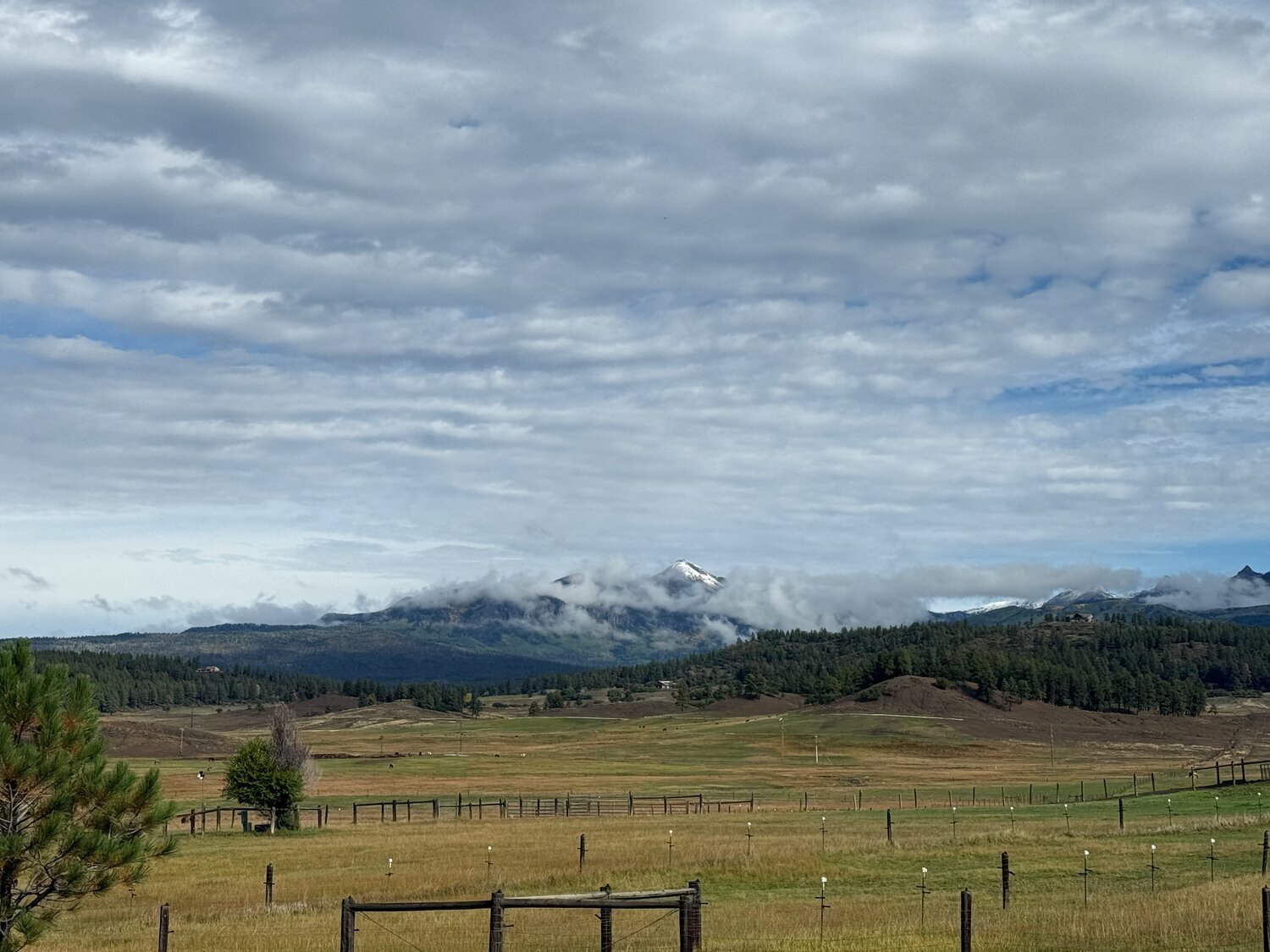
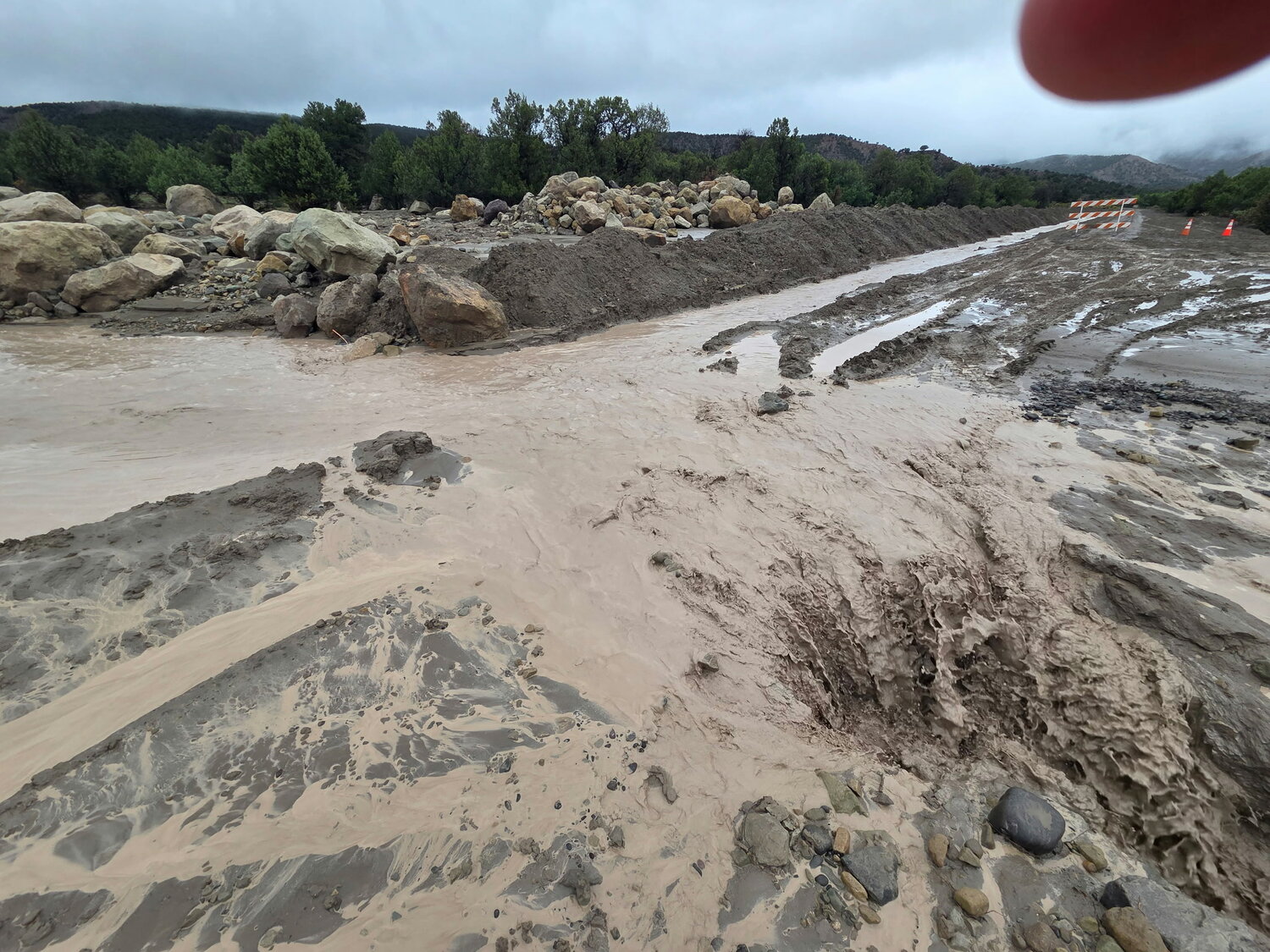
Pagosa County has seen consistent steady rainfall over the last week, causing record flows on the Piedra and San Juan rivers.
In the early morning hours of Tuesday, Sept. 29, the San Juan River flow peaked at 2,510 cubic feet per second (cfs), setting a record high flow for that date.
The Piedra River reached a peak flow of 2,410 cfs early in the morning on Tuesday, Sept. 29, also setting a record high flow rate for that date.
Record high flows continued with both rivers on Wednesday, Sept. 30.
As of 2 p.m. on Wednesday, the San Juan River in downtown Pagosa Springs was flowing at a rate of 1,190 cfs.
According to the U.S. Geological Survey (USGS), based on 90 water years of record, the previous record high for that date was set in 2014 at 902 cfs. The record low was set in 1953 at 12 cfs. The median flow for that date is 92 cfs, and the mean flow is 163 cfs.
As of 2 p.m. Wednesday, the Piedra River near Arboles was flowing at a rate of 1,890 cfs.
According to the USGS, based on 63 water years of record, the previous record high for that date was set in 2014 at 1,390 cfs. The record low was set in 2018 at 14.4 cfs. The median flow for that date is 107 cfs, and the mean flow is 190 cfs.
According to the National Oceanic and Atmospheric Administration, the Blanco River at the Pagosa Springs dam peaked at a flow rate of 677 cfs.
It notes that the “historical peak” was set on Aug. 24, 1992 at 3,130 cfs.
Local disaster
declaration
On Friday, Sept. 25, Archuleta County Manager Longinos Gonzalez signed a local disaster declaration due to recent flooding that has occurred in the county.
According to the declaration, “beginning on or about September 14, 2026, the County of Archuleta experienced severe flooding resulting from heavy precipitation, causing widespread damage to roads, bridges, culverts, and other public infrastructure, and posing a threat to the health, safety, and welfare of residents.”
The declaration also explains that “the magnitude of this event has exceeded the County’s capacity to respond with available resources, and immediate action is necessary to protect life and property and maintain critical infrastructure and public safety.”
The Archuleta County Board of County Commissioners has a special meeting scheduled for today, Thursday, Oct. 1, with an agenda item to consider extending the declaration of a local disaster in the county.
Rain totals and drought
According to reports from the Community Collaborative Rain, Hail and Snow Network, rain totals across Archuleta County from Sept. 25 through Sept. 30 range from 2.76 inches up to 4.27 inches.
The most recent drought map released by the U.S. Drought Monitor was published on Sept. 22 and shows just over 92 percent of Archuleta County being in a stage two, severe drought.
It also shows that less than 1 percent of the county remains in a stage three, extreme drought.
For more information and to see an updated drought map, visit droughtmonitor.unl.edu/CurrentMap/StateDroughtMonitor.aspx?fips_08007.
Road conditions
On Monday, Sept. 28, the Archuleta County Sheriff’s Office announced that County Road 500 near mile marker 37 was shut down until it can be repaired.
According to a Facebook post from Archuleta County on Wednesday morning, Sept. 30, “Due to the ongoing storm and recent flooding, many County roads are currently in poor condition.”
The post also explains that county crews are monitoring conditions “and will begin necessary repairs and maintenance as soon as the storm subsides and conditions allow.
“Our priority is keeping roads passable while preventing further damage during the ongoing weather event.”
clayton@pagosasun.com


 >
>