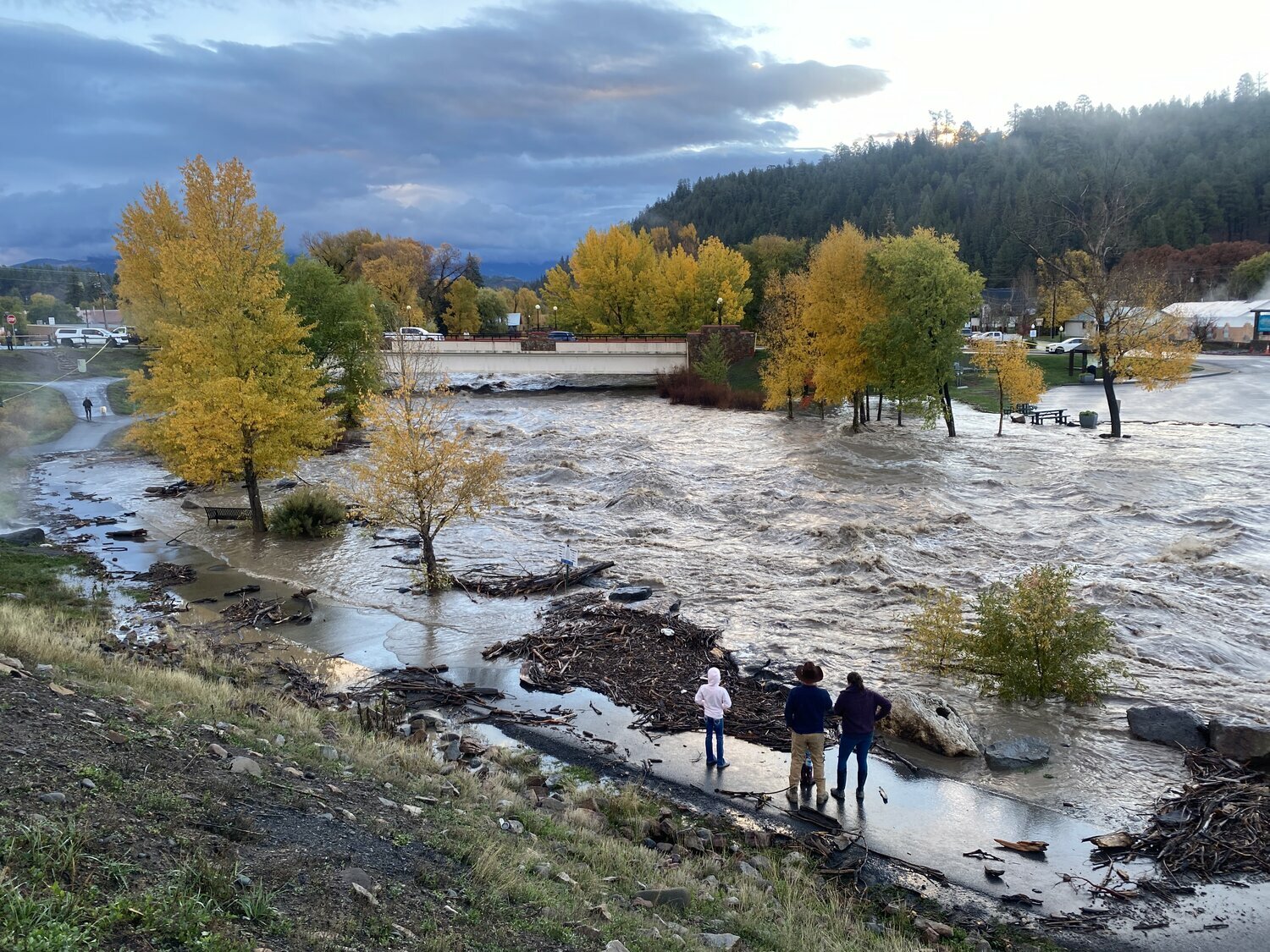
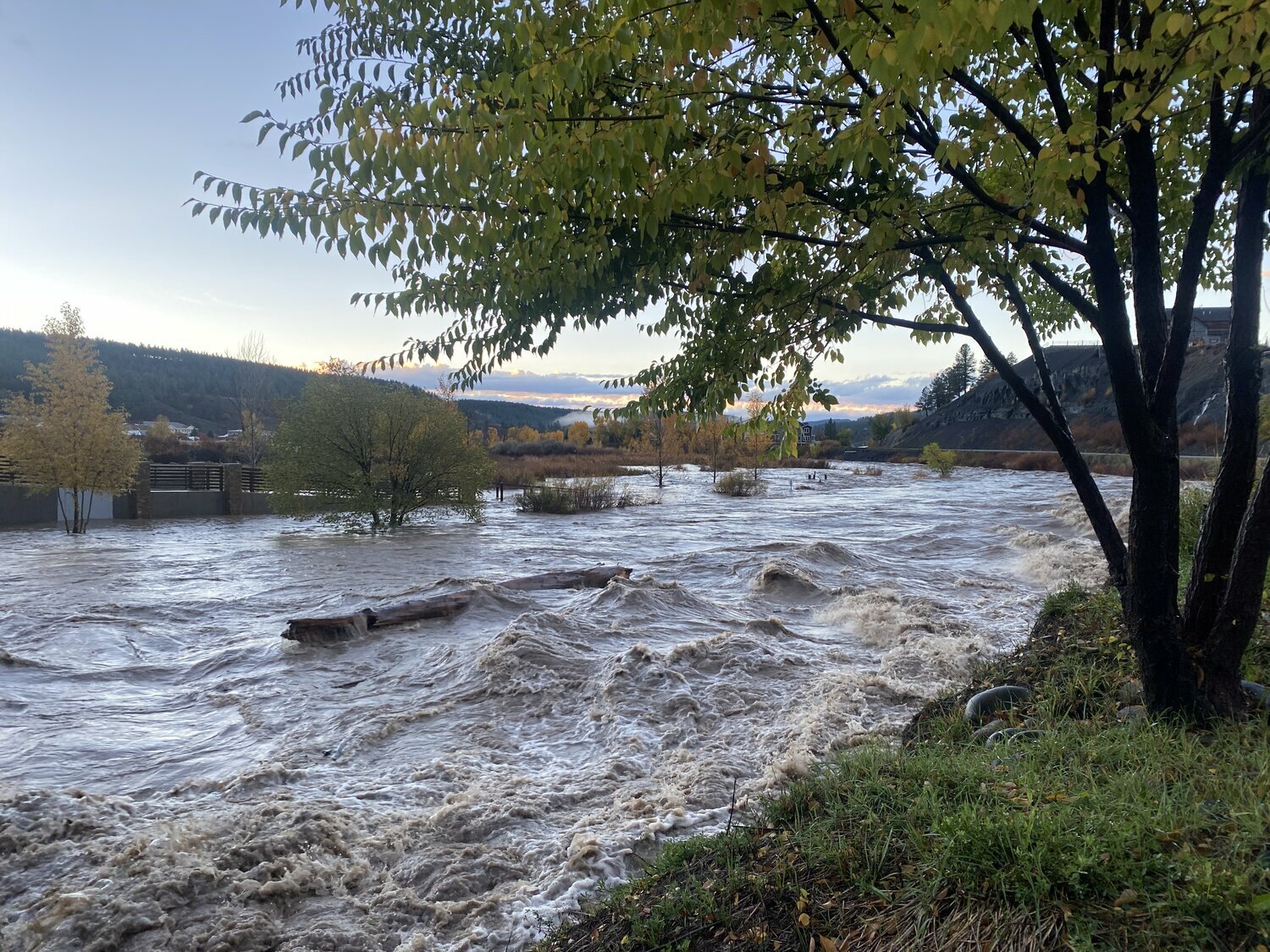
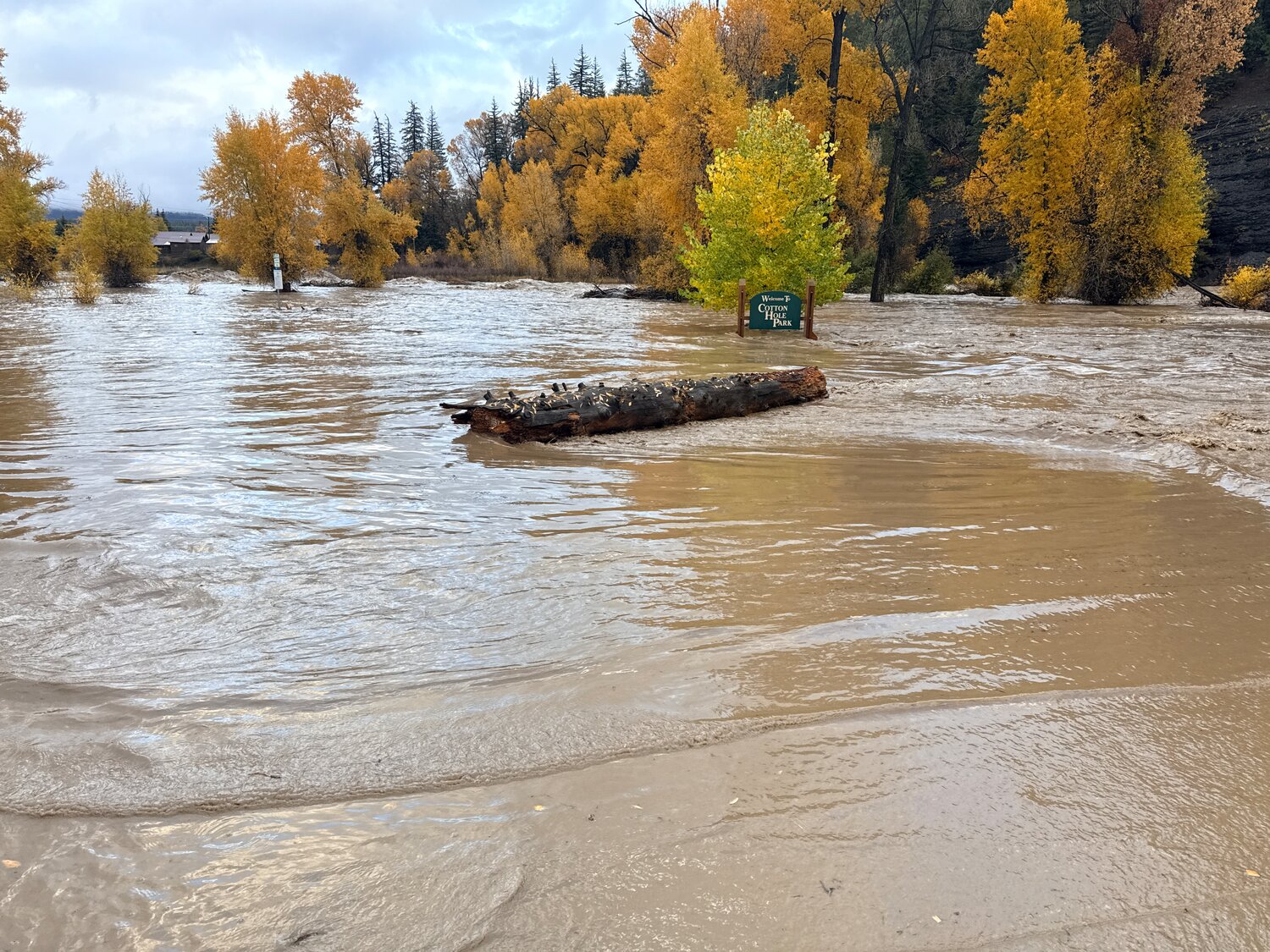

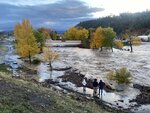
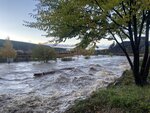
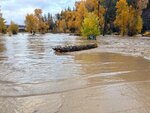
Pagosa Country experienced two historic floods in four days thanks to moisture from the remnants of a pair of tropical storms, Priscilla and Raymond.
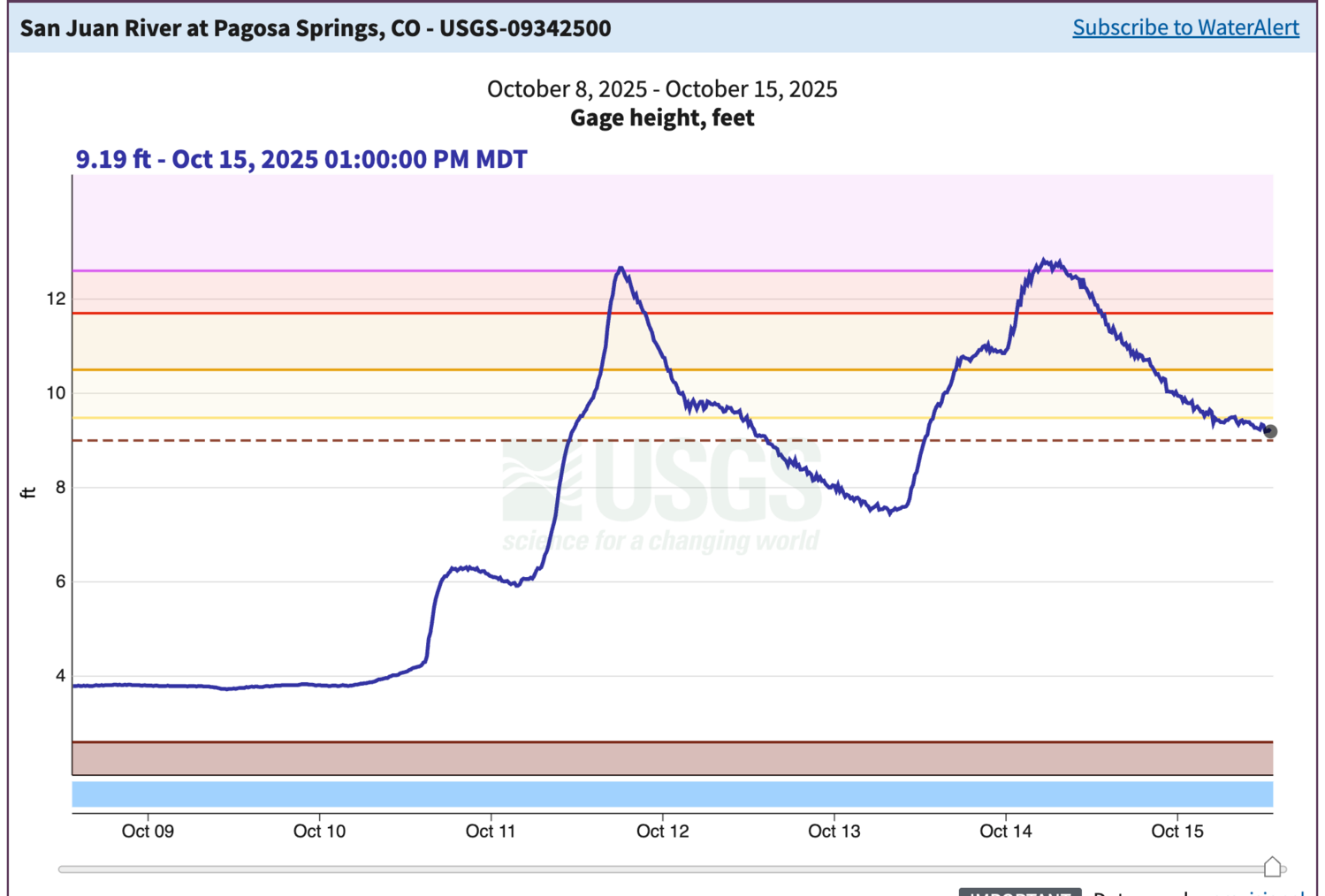
The flooding for the San Juan River at Pagosa Springs peaked at 8,270 cubic feet per second (cfs) and 12.66 feet at 6 p.m. on Oct. 11 and again at 8,560 cfs and 12.82 feet at 5:15 a.m. on Oct. 14, putting the two events as the fourth and third highest on record, behind floods in October 1911 and June 1927.
At 11 a.m. on Oct. 9, prior to the storms moving through the area, the San Juan River at Pagosa Springs was flowing at 71.4 cfs or 3.72 feet.
Then, according to Pagosa Weather’s Shawn Prochazka, the Pagosa Springs area saw 2.45 inches to 6.93 inches of rain between Oct. 10-14, with mountain SNOTEL totals ranging from 8.7 inches to 9.8 inches.
For perspective, Prochazka notes in an email to The SUN, the average October precipitation for Pagosa Springs is 2.27 inches and is 4.39 inches for Wolf Creek Pass.
Prochazka further offers that, if the system had hit in the middle of winter with colder air, the Pagosa area would have received 24 to 70 inches of snow and the mountains would have received 120-150 inches of snow.
A multiagency coordination meeting was held the morning of Sunday, Oct. 12, to discuss the Oct. 11 flood and what was coming,
“The events that unfolded yesterday, we were somewhat aware we were going to get some rainfall,” Archuleta County Sheriff Mike Le Roux said at the meeting. “I don’t know that any of us truly expected the event that occurred yesterday and is still ongoing.”
Le Roux explained that, for the most part, personnel were out during the day patrolling during the wet weather “and it was just another day and a half of rain.”
He noted things quickly changed around 4 or 4:30 p.m.
“That water came up within the space of 30 to 40 minutes,” he said, “beyond what we could have imagined at that point.”
At that point, mandatory evacuations were put in place for San Juan River Village, he explained.
He noted the trigger point for them started on the West Fork where people were stuck on Rainbow Trail, unable to cross a bridge after water began covering it.
He noted people were able to clean the bridge and get the people across safely.
He also outlined an incident on Fall Creek Road in Mineral County where people were on the other side of a washout 40- to 50-feet wide and 15 feet deep. Mineral County Search and Rescue began evacuating people across it.
“That’s really ... when the alarm bells started flashing,” he said, noting there was then a delay and the high water levels began moving down toward San Juan River Village, town, and County Road 500 was “severely inundated.”
Patrols were looking at the diversion dam, where water was flowing above the wall due to being at max capacity.
While that was happening, he explained, an emergency shelter was set up at the Ross Aragon Community Center.
Evacuation and pre-evacuation orders were then put out in low-lying areas on Hermosa Street and San Juan Street in downtown Pagosa Springs.
He added areas in the Upper Blanco, Lower Blanco and all the way to County Road 500 were affected, and that road and bridge and the town did a good job troubleshooting, berming, tending to culverts and taking care of roads.
That day, town and county personnel, in conjunction with the state, began assessing damage related to the storm and flooding prior to the next round of moisture moved in, which a state official noted would count as a separate incident.
At that time, tropical storm Raymond’s effect was unknown, though forecasters projected that river levels could again reach minor flood stage.
From the morning of Oct. 13 to the morning of Oct. 14, Prochazka outlines in the email, the Pagosa area received from .78 inches to 2.80 inches of rain, with SNOTEL reports in the mountains ranging from 3.1-3.7 inches.
That put the San Juan River in Pagosa Springs back into major flood stage and above levels reached on Oct. 11, with evacuations again ordered for low-lying locations along rivers throughout the county and public parks located in downtown Pagosa Springs again closed due to safety.
Evacuations
Mandatory evacuation orders for the second of the two floods were lifted Tuesday evening as the river receded to lower flood stages.
According to the Pagosa Springs Police Department, there were 13 mandatory evacuations on Hermosa Street and 12 on San Juan Street, with another 13 pre-evacuations on Hermosa Street and eight pre-evacuations on Cobblestone for the storms.
Pagosa Springs Town Manager David Harris noted that affected about 100 people.
According to Emergency Management Commander Roy Vega, in unincorporated Archuleta County about 124 residences were under mandatory evacuation, affecting about 250 people.
He noted that, according to Department of Human Services Director Heidi Martinez, the most checked in at the evacuation shelter was 10.
Road, school closures
The storms also led to the closure of a number of area roads, as well as Archuleta School District (ASD) schools.
Portions of U.S. 160 and County Road 500 were closed during both storms.
U.S. 160 in downtown Pagosa Springs closed for about 14 hours during the first flood due to concerns over stress to the bridge and a town sewer pipe that hung beneath the bridge.
U.S. 160 was again closed during the second flood, when debris took out a portion of the town’s sewer pipe.
A press release from the Pagosa Springs Police Department (PSPD) explains that, the morning of Oct. 14, “floodwaters and debris caused a failure in the sewer lines beneath the 1st Street Bridge on U.S. 160.”
U.S. 160 over Wolf Creek Pass was also closed during both flood events.
County Road 500 was closed due to extreme flooding conditions in lower areas.
A portion of County Road 600 (Piedra Road) was also closed to through traffic due to flooding for about 24 hours, according to Vega.
The flooding and U.S. 160 closure on Oct. 14 led Le Roux to request that Archuleta School District schools close on Tuesday, Oct. 14, with ASD explaining that conditions remained unpredictable, and safety of students, staff and families is the top priority.
After-school activities were canceled on Monday, Oct. 13.
The schools reopened on Wednesday, Oct. 15.
On Wednesday morning, La Plata Electric Association reported, three homes were de-energized as a result of the flooding.
Other area river levels
The San Juan River at Carracas was at 2.3 feet or 79.7 cfs on Oct. 9, with storm-related peaks coming at 8.25 feet and 9,440 cfs at 6:30 a.m. on Oct. 12 and 9.24 feet and 12,600 cfs at 5:30 p.m. on Oct. 14.
The Piedra River at Arboles, which was running at 1.05 feet and 79.7 cfs on Oct. 9, peaked at 5.86 feet and 4,680 cfs at 2:15 a.m. on Oct. 12 and 7.26 feet or 7,240 cfs at 1:30 p.m. on Oct. 14.
Disaster declarations
The Town of Pagosa Springs and Archuleta County both issued disaster declarations the night of Oct. 11.
The following day, Gov. Jared Polis issued a verbal disaster declaration to support response and recovery efforts following significant flooding in western Colorado, including in Archuleta and La Plata counties.
“The governor has been monitoring the situation closely, and state public safety leaders have been in close contact with local emergency management about this unprecedented weather event,” the press release states.
State resources, the press release explains, including the Colorado Department of Public Safety’s Division of Homeland Security and Emergency Management (DHSEM), Colorado State Patrol, and the Division of Fire Prevention and Control, as well as the Colorado Department of Transportation and Colorado Department of Public Health and Environment, were previously engaged in the emergency response before the verbal disaster declaration.
The governor’s declaration activates the State Emergency Operations Plan and authorizes DHSEM to take whatever actions may be required for response efforts, including up to the initial $1 million in estimated costs.
It also allowed the county, town and state to begin working toward a federal disaster declaration through the Federal Emergency Management Agency (FEMA).
“We have our paperwork there,” Harris said, “and it’s just a matter of getting it before FEMA and getting them to greenlight it.”
Archuleta County extended its declaration during a special meeting on Wednesday, Oct. 15.
Next steps
“My takeaway is that ... we’ve been very lucky so far,” Harris said. “It could have been a lot worse.”
But, both Harris and Vega noted there is a lot ahead.
Both listed debris cleanup as one of the biggest challenges facing the area in the wake of the floods.
Included in that debris were numerous trees and logs that were swept down the river.
“Debris cleanup is probably going to be the biggest challenge,” Harris said. “That, and finding a way to fast-track a sewer line repair and do it so that it’s a permanent solution and not a temporary ... that we have to do over again.”
Harris noted there will also be other infrastructure needs.
He noted they will be doing a lot of paperwork with the state to put together a debris plan, noting the town may borrow the county’s debris plan that was approved on Wednesday for the Pagosa Springs Town Council to consider.
“The debris cleanup is going to be huge,” Vega said.
Vega noted Wednesday there were personnel from the assessor’s office, fire officials and others out and about working on damage assessment.
He noted that damage assessment is also a huge challenge, seeing how much money the community is looking at in damage to homes, driveways, county transportation routes and bridges.
At a special meeting of the Pagosa Springs Town Council on Tuesday, Oct. 13, it was stated that few homes in the town may have had water intrusion, but primarily the concern was debris and outbuildings.
Vega noted that, in the county, they were seeing primarily damage to yards with debris, crawl spaces being filled up with water and outbuildings.
He noted the damage assessments are not going into houses.
One piece of debris that floated down the river was a cabin that Vega noted has history with the 1911 flood.
“It looks like it’s in tact, it just got moved,” he said, explaining he flew over it in a helicopter.
Public safety concerns
On Wednesday, Oct. 15, the town announced that standing water and debris remain in various areas, posing ongoing safety risks.
“As a precaution, all parks and the surrounding downtown areas along the San Juan River will remain temporarily closed to the public. Authorities urge all residents and visitors to avoid these areas until further notice,” the notice states.
It adds, “A decision to open the parks will be made by the Town of Pagosa Springs Parks and Recreation Department after a comprehensive safety review and completion of a debris clean-up.”
Vega noted that he was also concerned about the gusty, high winds forecast to hit the area and what that could do with the ground saturated and soft from the storms.
Vega also urged continued awareness, noting the ground is soft and the chance of trees going down and power lines being affected when the area sees wind is high.
He also noted to not approach any utilities still under water or try to drive through low bodies of water.
“It doesn’t take a lot of water for a car to start floating and get moved around,” he said.
A thanks
Harris also offered a “special thanks” to everybody who respected the barricades and closures.
He added he appreciates the community’s cooperation and that, for the most part, people were very respectful and helpful.
Harris also noted the community has a great team of public works, law enforcement, health and others who were stretched thin but persevered.
randi@pagosasun.com


 >
>