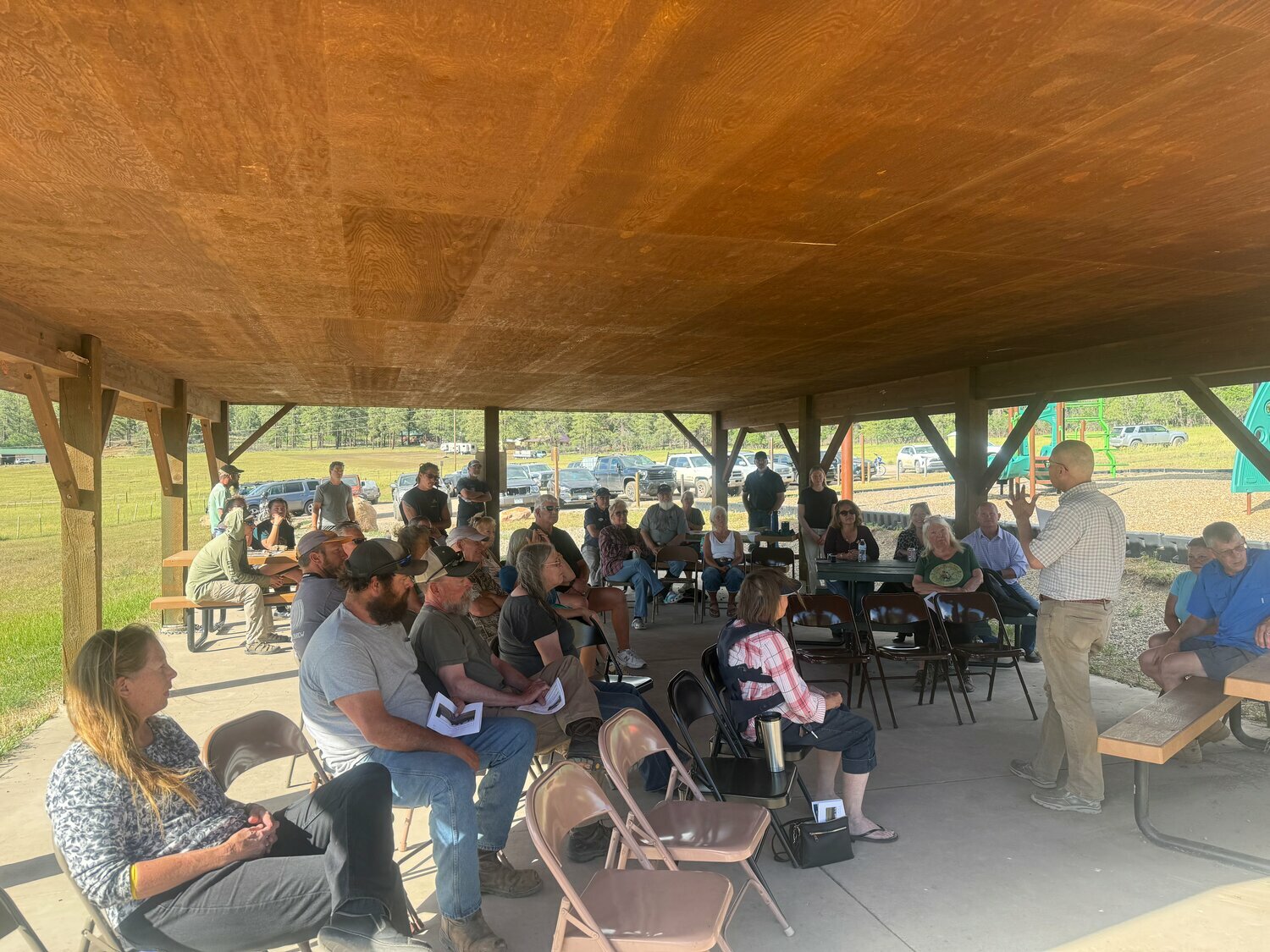
Constituents gathered for another community forum hosted by the Archuleta County Board of County Commissioners (BoCC) on Thursday, June 18, this time taking place at Ute Park in Aspen Springs, where more information on a potential ballot question to increase the county’s lodgers’ tax rate was presented.
Residents also had the opportunity to ask questions about matters pertaining to Aspen Springs, which mostly focused on funding for roads and how the Aspen Springs Metro District provides maintenance of roads in the subdivision.
The meeting began with each commissioner providing comments on the potential ballot question and their preferences for how those additional funds could be spent.
Commissioner Warren Brown indicated, “For me, the big priority is roads,” explaining that legislation passed at the state level in 2025 allows for jurisdictions to increase their lodgers’ tax rate and use those funds in more areas including roads, child care, housing and emergency medical services (EMS).
Brown noted that roads and public safety are two areas he’d prefer to have those additional funds dedicated to.
“Because I look at the impact the tourists have on our community, all of them use the roads, and you would be surprised how many people we send our law enforcement to, our EMS folks to, our fire folks to,” he said. “So, it just makes sense to me.”
Brown explained that, currently, the county has a 2 percent lodgers’ tax rate, and that if it could raise it another 4 percent, that would generate roughly an additional $1 million for the county to spend in areas other than marketing and advertising.
Brown also explained that funds the county receives from its current lodgers’ tax rate was approved by voters in the late 1980s and must be spent on marketing and advertising.
“That will not change,” he said.
Brown also commented on road conditions, specifically noting Cat Creek Road as a “big issue,” adding that he’s advocated to have it paved.
He explained that it would cost about $1.2 million per mile to pave the road, but also mentioned the county spends resources frequently for maintenance on Cat Creek Road, describing the situation as “throwing good money after bad.”
“But, to get that done, we have to have more money,” Brown said in regard to having the road paved.
Brown also noted that Cat Creek Road is not within the Aspen Springs Metro District.
He went on to explain that the county currently spends about $2 million a year that “is really applied to roads” of actual work, with the rest of the Road and Bridge fund covering salaries.
Brown brought up the sentiment expressed to him that the county “should have more money than ever” with more people moving into the county, explaining that his question back to that is if people are making more than ever, which seems to not be the case.
“So, it’s all relative,” he said, noting the cost of living has also been increasing.
Brown then explained that of the taxes paid by county residents, the county receives “one of the smallest fractions of those dollars.”
He provided an example of a $500,000 home that pays $1,500 in property tax to the county, explaining that over the past four years the county’s gotten an extra $15 a year with increases.
“The money’s not going where you think, but that doesn’t mean we still don’t need to get stuff done,” he said.
Brown described the potential lodgers’ tax rate increase as an opportunity to have people who do not live here who stay at lodging establishments contribute to funding the community’s resources, such as roads.
Commissioner Veronica Medina followed Brown’s comment, stating, “Roads are definitely our priority.”
Medina also explained that state legislation allowed jurisdictions to increase its lodgers’ tax rate last year, but that the county wanted to get information out and feedback from the public to “have you decide” on where these additional funds would be best spent.
Medina noted that it would not be a complete solution for the county’s roads, calling it “just a drop in the bucket” if a ballot measure is approved.
Medina commented that she believes the county also has other ways it can reduce spending and be more efficient with the dollars it already has.
“But, it’s gonna be a collaborative effort,” she said.
She added, “You have three great commissioners right now; we definitely work well together.”
Medina noted the BoCC discusses these matters in open meetings, trying to be more creative and doing more things “in house.”
Medina compared it to working on a home in that most people will try to do as much as they can themselves before hiring a contractor, which is likely more expensive.
“So, we’re trying to do a lot of things in house, but with that we stretch our staff and sometimes we are not able to do other things,” Medina said.
Medina also mentioned that it’s a “slow process” with roads, although she expressed that her opinion is that the county “has put more money to roads and been able to do more” in the past two years than what was done in the 10 years prior to that.
Medina spoke about funds the county receives from property tax, stating that “does not cut it” for the county to keep up with road maintenance and projects.
She also explained that the Aspen Springs Metro District receives Highway Users Tax Fund (HUTF) money, noting that is usually just enough to blade the roads once a year.
Commissioner John Ranson spoke next, stating, “I don’t think we as a county do enough out here,” in regard to Aspen Springs.
Ranson commented that the county does “so much” for the Town of Pagosa Springs and the Pagosa Lakes Property Owners Association (PLPOA), and that he’s “really pushing to start doing whatever we can to help out here.”
Ranson noted that residents of the Aspen Springs Metro District pay for their own roads, and also pay for other county roads.
“We need to start working more out here. You guys are an important part of our community,” he said, commenting on his fellow commissioners and saying, “I think we work really well together.”
Ranson mentioned that he believes all of the commissioners are in agreement to pay attention to all areas of the county and not just the town and PLPOA.
“The town’s always asking us for money,” he said, noting the county doesn’t ask that of the town.
He added, “We can do better with our funds and spread it out amongst everybody.”
Ranson noted that he’s an advocate of using the “tourism tax” to help with roads.
Ranson also mentioned the community forums held over the past few months have been helpful in getting community feedback.
“A big one of mine is child care,” Ranson said in regard to areas where he’d prefer to have additional lodgers’ tax funds spent.
Ranson added that he’s not a “believer that the government can cure affordable housing ... but if we can provide money for these parents … and we can help pay for their child expenses, I think that’s a really good way to help for some affordability in Pagosa Springs.”
He added, “I do hope we can move along with this tourism tax.”
Following a breakout activity where residents were asked to give their input on where they believe growth should take place across the country, County Manager Longinos Gonzalez reviewed input the county has received so far, explaining that the county has reached out to lodging representatives “and generally they’re OK with the 5 to 6 [percent]” lodgers’ tax rate.
Gonzalez reviewed feedback that the county’s received so far from the community forums, with 89 percent of 44 sticky note responses indicating support for a 6 percent lodgers’ tax rate.
Gonzalez also explained that the county is preparing to do a complete comprehensive community plan update over the next 10 months, with certain aspects of that, such as a water and growth report, being mandated by the state.
He noted the last community plan update occurred in 2016 and that this version will be a “full rewrite of the land use code because we’ve seen a lot of contradictory information.”
Gonzalez explained that, over time, different BoCCs would make changes and that, after a while, all of those changes start contradicting each other.
The meeting concluded with a Q-and-A portion, with one resident asking if there would be specific wording on the potential ballot measure about exactly how much of the additional funds would go to certain areas such as roads.
Gonzalez indicated that there would be specific wording in the ballot measure, providing the example of having 80 percent of additional lodgers’ tax funds dedicated to road projects and maintenance.
One resident asked if the Aspen Springs Metro District would receive any additional funds for roads projects from the potential ballot measure.
Gonzalez indicated that funds for certain projects could be dispersed, but that the metro district would still be “mill levy dependent.”
“You could always go to the commissioners and request something,” Gonzalez said.
One resident commented that the road conditions in Aspen Springs are “not due to a lack of effort.”
“Every road out here needs a lift of gravel,” he added, noting that the metro district could “definitely use help with funding for that, especially if we pay for some of the roads” around the county.
One resident asked how to get more money specifically for Aspen Springs, with another resident encouraging people to attend BoCC meetings and give public comment.
“All of the roads in the county are bad,” Medina said, explaining that one of the biggest drivers of expense is hauling gravel, noting that hauling it is more expensive than the gravel itself.
“So, one of the things the commissioners are working on right now, is where can we get gravel in our own community,” Medina said.
She noted that the county usually has to pay for gravel to be hauled in from Arboles or even Farmington, N.M.
“One year we paid over $2 million dollars in just hauling fees,” she said, “so we need a gravel pit in Archuleta County.”
Medina explained that the “plan is to share the wealth on the gravel” once the county comes up with a better solution.
“But, we got to have the community support to allow us to do a gravel pit,” she said.
Other questions in regard to Indian Land Road came up, with residents asking what the county can do about enforcing things like weight limits, no trailers and four-wheel-drive requirements on the road.
Some comments from residents suggested that Indian Land Road is not a “platted road” and was only developed as a utility easement that crosses Southern Ute Indian tribal land.
Brown commented that the county’s sheriff’s office is not able to enforce a weight limit restriction on the road, although four-wheel-drive requirements and trailer restrictions could be enforced.
Other questions centered on specific projects the county has funded in Aspen Springs and concerns over the bridges used to access the subdivision, with Ranson addressing those questions by explaining that is part of why the commissioners wanted to host a forum in Aspen Springs.
“The three of us really do work well together,” Ranson said again in reference to the BoCC.
“We all believe y’all do pay for your own roads and more,” he said, adding, “We want to start having a better relationship out here where we can help.”
Ranson mentioned that there are a “handful” of metro districts within the county that pay for their own roads and more.
“We thank you guys for that,” he said.
Gonzalez noted that the county plans to keep these community forum-type meetings going, likely on a quarterly basis.
clayton@pagosasun.com


 >
>