On Sept. 30, Colorado Parks and Wildlife (CPW) announced that, after evaluating the current status of translocation efforts, survival rates of wolves in the state and other biological factors, it would be temporarily suspending its chronic depredation directive, which provides guidance for gray wolf lethal removals.
“CPW will evaluate any future removals of wolves on a case-by-case basis using a very conservative approach to address the concern that population growth may not occur this biological year, which ends March 31, 2027,” a press release on the matter states.
The same day, a group including some of the state agricultural organizations — Colorado Farm Bureau (CFB), Colorado Cattlemen’s Association (CCA), Colorado Livestock Association (CLA), Colorado Wool Growers Association (CWGA), and Rocky Mountain Farmers Union (RMFU) — formally condemned the announcement and “unconscionable action.”
“This reprehensible decision directly contradicts direct stakeholder input that was painstakingly gathered over years of good faith dialogue between the Department, sportsmen, wildlife advocates, farmers, ranchers, biologists, and more,” states Carlyle Currier, president of the CFB and a fourth-generation Western Slope rancher, via the press release. “It’s nearly unfathomable that CPW intends to abdicate their obligations to our farming, ranching, and rural communities after so many strides in rebuilding trust on conflict mitigation, non-lethal tool employment, fair-compensation structures, and broader reintroduction success.”
In its press release, CPW discusses population counts, survival rates, human-caused wolf mortality, efforts taken to address population challenges and future translocations of wolves.
Archuleta County wolf activity
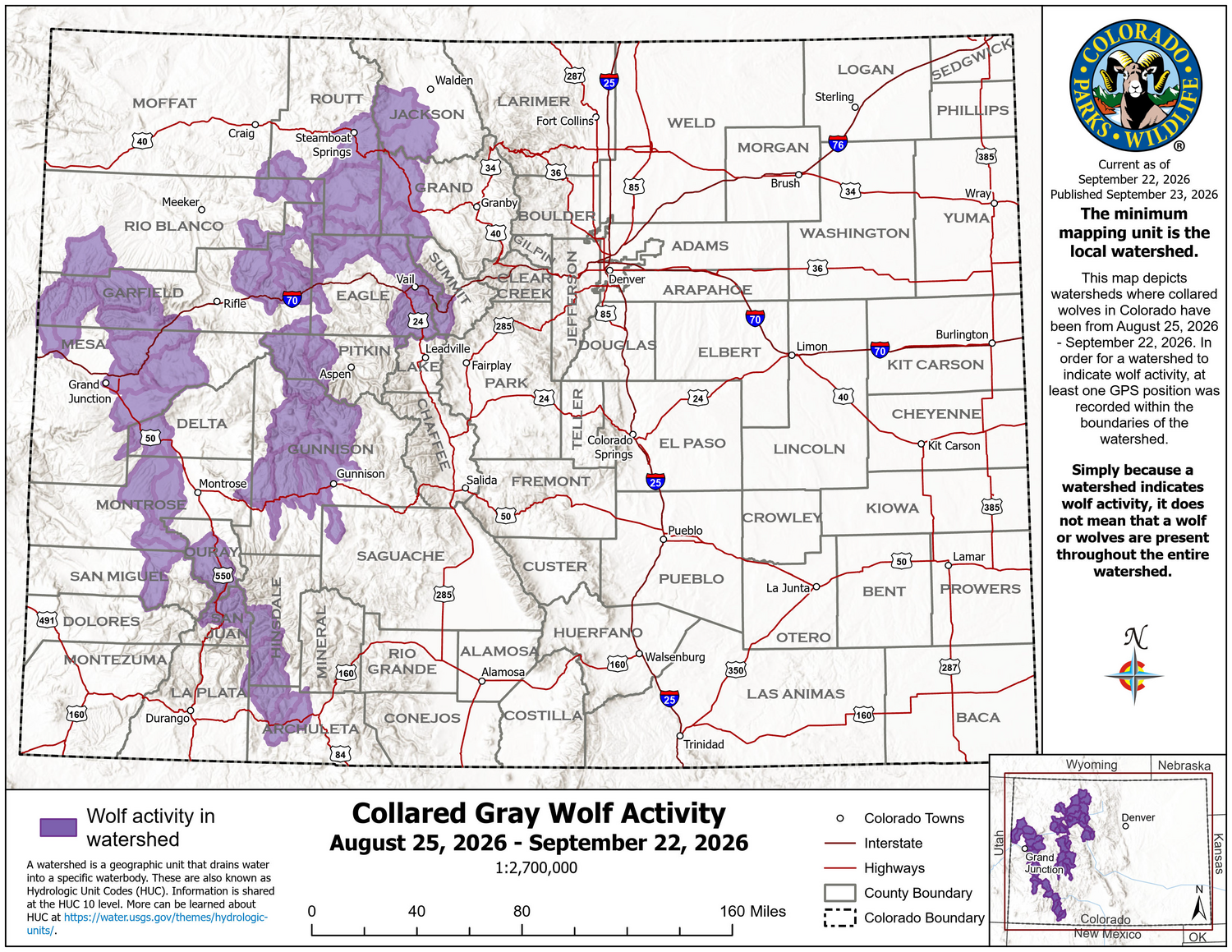
Archuleta County has periodically seen collared wolf activity, with the agency reporting lone wolves have made their way in and out of Archuleta County watersheds.
The most recent collared wolf activity map released by CPW, which covers Aug. 25 through Sept. 22, shows watersheds in Archuleta County with collared wolf activity.
According to John Livingston, CPW Southwest Region public information officer, Archuleta County again saw a lone wolf that “continues to travel all over the state” and, as of Sept. 24, had moved out of the county.
Livingston explains in an email to The SUN, “As it continued to move, it lit up a few watersheds in our area but has since already moved out of Archuleta County. We did make a few notifications to presidents of the local Cattleman’s Association, the Archuleta County Sheriff’s Office, county commissioners and the National Forest supervisors. But the wolf remained in the high country in really remote areas.”
Population counts and survival rates
“The CPW team works tirelessly to monitor reproduction and recruitment through camera traps, staff observations of wolves, and other methods,” the CPW press release states.
The press release further explains that, while minimum population counts reflecting the number of wolves CPW can confirm are typically shared once per year in the spring when the Colorado Gray Wolf Annual Report is published, CPW is sharing a mid-year population county, including pups born this year, to address recent public concerns about the state’s wolf population.
According to the CPW release, Colorado is now home to four reproducing wolf packs, a fifth pack of four siblings that travel together, and several wolves that do not live in packs that could potentially pair this winter.
Wolf program staff have identified breeding adults, other adults (if present), yearlings and pups born in each of the packs and had detected 45 gray wolves as of Sept. 24, it states.
This count, the agency notes, includes a high count of 20 pups born in Colorado this year. Typical survival rates of pups range between 50 percent to 60 percent in western wolf populations, so this number will likely fall by the end of the biological year in March 2027.
Pup survival in Colorado in 2025-2026 was high, it notes, with 82 percent of detected pups surviving their first year.
Adult survival during the last biological year (April 1, 2025, through March 31, 2026) was 61 percent, which is below the 75 percent survival rate more typical of an unharvested wolf population, the press release explains.
“Additionally, CPW staff biologists and veterinarians are investigating evidence of hair loss in multiple wolves in two packs in Northwest Colorado, which could be associated with an infectious skin parasite and, if so, could impact wolf survival,” it states. “No final diagnosis has been confirmed at this time. The agency will share further details when the investigation is complete.”
Human-caused
mortalities, management actions
According to CPW, to address chronic depredation, the agency has lethally removed five wolves this biological year (April 1, 2026, through present) and is investigating one additional wolf mortality.
The agency’s removal efforts were conducted under CPW’s statutory and regulatory authority as well as the agency’s current administrative directive concerning chronic depredation, it notes.
“Up to this point, CPW has carefully followed the adaptive management framework called for in the wolf plan, our chronic depredation directive, and has conducted the appropriate consultations in every action we have taken this season,” said CPW Director Laura Clellan via the CPW press release. “Each decision to lethally remove a wolf is painstakingly evaluated and considered, and this option has only been pursued when all other viable options have been exhausted.”
Efforts to address
population challenges
Due to the challenges with the current population, and in alignment with the Colorado Wolf Restoration and Management Plan’s direction to use an adaptive approach to wolf management, CPW explains it will evaluate additional requests for lethal removal on a more conservative basis.
The wolf plan states that when evaluating the use of lethal control on a context-specific basis, CPW must consider the trade-offs among many competing factors, including “wolf reproductive and recruitment success, wolf population size and listing status,” the agency explains.
The plan also states that CPW will monitor and, if necessary, adjust the extent of lethal removals to meet conservation and management needs, noting that “excessive levels of lethal removal can inhibit the recovery of wolf populations.”
The press release notes CPW will work with stakeholders to revisit its chronic depredation directive and the conditions under which removals may take place.
It adds those revisions will be in place by April 1, 2027, and the start of the new wolf biological year in coordination with the release of the Gray Wolf Annual Report.
In the interim, the agency explains, CPW staff “will continue to work diligently with producers to deploy all reasonable non-lethal tools and methods.”
Concurrent with the suspension of the current chronic depredation directive, the press release notes CPW commits to the following actions:
• CPW will continue to work with stakeholders on the two petitions concerning wolf depredation (wolf damage compensation and wolf chronic depredation petition) submitted to the Parks and Wildlife Commission.
• CPW will extend the range riding season in select locations based on conflict and producer willingness.
• CPW will continue to support livestock producers through non-lethal tools, technical assistance, site assessments and issuing Injurious Non-lethal Hazing permits.
• CPW will continue to review Retroactive In The Act permit applications.
• CPW will continue to apply the standards of the current compensation regulations and ensure compensation for losses to wolves as defined within those regulations in a timely manner.
• CPW will continue to explore options for further translocations of wolves.
“We’re doing everything we can to meet our objective of a sustainable population while working with livestock producers and continuing to follow the adaptive guidance provided in the Wolf Restoration and Management Plan. Right now, we’re in a critical moment for wolf restoration in Colorado,” Clellan said.
She added, “Our current genetic analysis demonstrates that the wolf population has high diversity, indicating that inbreeding is not a hurdle to wolf recovery. While this is promising news for the program, achieving a successful reintroduction effort and a self-sustaining population of wolves will require doing everything we can to ensure the survival of existing wolves in the state.”
Future translocations
CPW also continues to explore options for future translocations with a goal of meeting the recommendations laid out in the Colorado Wolf Restoration and Management Plan, according to the agency’s press release.
That goal is 30-50 total translocated wolves over a 3- to 5-year period.
“This is the number experts agreed provided the best chance to establish a self-sustaining wolf population in Colorado, however, right now the agency must consider all options based on the current population,” the press release states.
“CPW is proud of the work that has been done in meeting the complex and challenging goals and requirements outlined in Proposition 114 to restore a self-sustaining population of gray wolves in the state,” Clellan said. “CPW staff have worked to resolve technical, social and political challenges with professionalism while balancing the diverse human interest groups impacted by wolf restoration. At this time, CPW is leading with the central tenets of sound, science-based wildlife management by looking first at the biological and population success of wolves.”
Opposition
In their press release, the agricultural organizations accuse the reintroduction effort of failing, suggesting mismanagement of the effort, and accuse CPW of abandoning landowners.
Bonnie Eddy, executive director of CWGA, expressed additional frustration, adding, “Since the inception of the wolf recovery planning process, the Colorado Wool Growers Association (CWGA) has strongly pushed for a reasonable definition of ‘self-sustaining’ wolf population. It’s shocking to see CPW abandon its landowner partners to capitulate to politics and jerk the rug out from under livestock producers that are experiencing ongoing wolf attacks on livestock. It’s been very obvious since the first wolf release that the efficacy of non-lethal deterrents is very limited.”
The press release adds, “These drastic steps serve as the capstone to an introduction effort that has unilaterally failed to date. While voters narrowly approved the program in 2020, the implementation proved to be woefully mismanaged, as the political interference rises. Notwithstanding CPW’s initial efforts alongside producers in seeking the 10(j) designation—today’s measure to desert that effective management tool signals broad disdain for the public-private partnership long championed and threatens further abandonment of rural Colorado.”
“This is the latest example of this administration’s failure to adhere to the Wolf Management Plan. The reintroduction has been an ill-advised effort that places a burden on the Western Slope. The failure to follow the Wolf Management Plan has made the issue worse. This political interference has placed CPW in the position of being forced to disregard best practices and it harms their relationship with the public” said RMFU President Chad Franke via the press release.
The ag organizations suggest the effects of CPW’s action will be seen quickly.
“As we quickly approach the 2026/2027 calving and lambing session, the repercussions will be immediately felt as we concurrently navigate the remaining 6 months of the biological wolf year that continues to reflect an unfavorable ecosystem trajectory for a sustainable population,” the press release states.
“Colorado’s livestock producers have worked in good faith, invested in nonlethal tools, and done what this administration has asked of them. In return, we expect this administration to uphold its commitment to act when wolves repeatedly kill livestock,” said Mark LeValley, president of the CCA. “Lethal removal is a necessary part of wolf management and conflict management, and it must be used when wolves become chronically depredating. Suspending that tool leaves ranching families to bear the consequences and undermines the accountability this administration owes rural Colorado.”
The press release notes the organizations “will continue to advocate for state wildlife management that equips farmers and ranchers with reasonable conflict mitigation tools, mirrors the realities on the ground, and provides a realistic avenue to bridge the disconnect between the state and our rural communities.”


 >
>