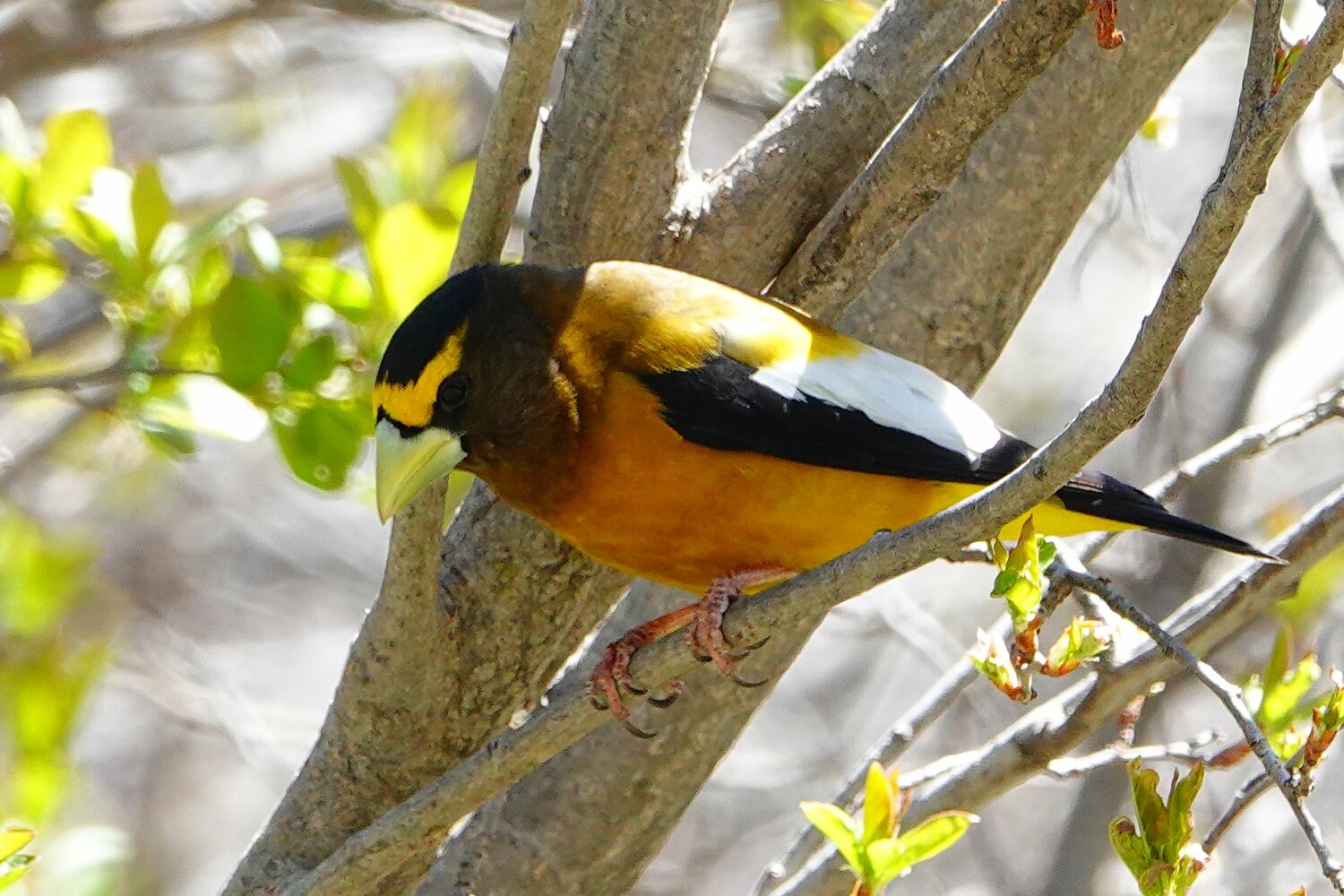
This week’s Bird of the Week, compliments of the Weminuche Audubon Society and Audubon Rockies, is the evening grosbeak.
It’s hard to predict when these nomadic birds might show up, but it’s easy to tell when they are around. Except during breeding season, these social birds travel in flocks. They don’t sing like other songbirds, but they keep up a constant chatter of cheeping calls that makes the trees come alive.
Adult males are colored mustard yellow below, have a yellow eyebrow and large patches of white and black on the wings. Females and immatures are gray with white and black on their wings. Both sexes are heavyset birds with a thick neck and a large, ivory-colored bill which turns green during breeding season.
The word grosbeak, meaning large bill, is derived from French. Five different grosbeaks spend some time here, but not all are closely related. Grosbeaks in the cardinal family, including the blue, black-headed and rose-breasted, are seen only in spring or summer. Pine and evening grosbeaks, members of the finch family, are resident birds.
Evening grosbeaks use their enormous bills and strong jaw muscles to crush seeds too large or tough for smaller seed eaters. They consume a variety of seeds, including those of pine and other trees. Seeds from last winter’s bumper crop of ponderosa pine cones fed them well. They also feed on chokecherries and other small fruits like cherries, crab apples, snowberries, hawthorn fruits, Russian olive fruits and juniper berries.
Anyone who hosts these birds at backyard feeders knows what voracious appetites they have. A flock can consume hundreds of pounds of sunflower seeds over the winter. After grabbing a seed, the grosbeak rolls it over in its bill until the seed lies along the bill’s sharp edge with the peaked end pointing inside the mouth. In quick motion, it cracks the shell, spits out the hull and swallows the seed. They are regulars at the birdbath.
In summer they also consume caterpillars, aphids and the tiny destructive spruce budworm forest pest. In winter they are often irruptive migrants, traveling outside their normal ranges in search of food. Sadly, since 1970 their numbers have plummeted by over 90 percent, the most dramatic decline of any North American songbird.
For information on events, visit www.weminucheaudubon.org and www.facebook.com/weminucheaudubon/.
Photo courtesy Charles Martinez


 >
>