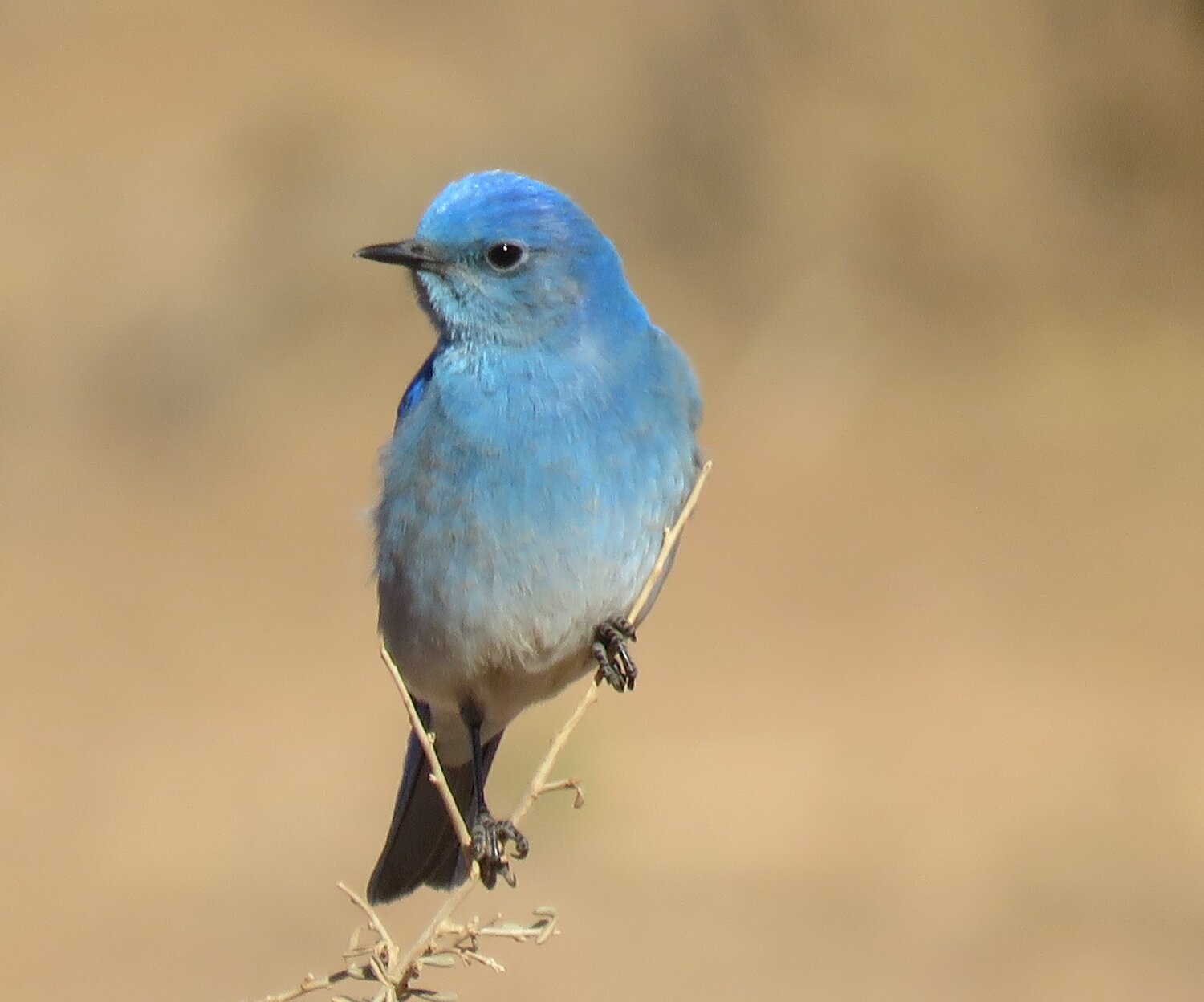
This week’s Bird of the Week, compliments of the Weminuche Audubon Society and Audubon Rockies, is the mountain bluebird.
Skiers relish those bluebird days, ones with cloudless skies the color of this western bird. Sky blue, paler on the underside than on the back, is the color of the adult male mountain bluebird. Gray-brown females and immatures are a little trickier to identify. Their blue shows up only in the wings and tail.
In summer, mountain bluebirds inhabit much of western North America that has open areas with grasses, shrubs and some trees. They are found up to 12,500 feet in elevation and breed as far north as Alaska. In our area, their range overlaps that of the western bluebird, whose males have rusty-orange color on the breast and flanks, and who are typically found in more wooded, lower-elevation habitats.
Like other bluebirds, mountain bluebirds are ground feeders, foraging for a variety of insects and spiders. They watch from perches for food on the ground or on vegetation, and will fly out to snatch prey in mid-air. Unlike others, they also hover over the ground like mini kestrels while watching for movement below. This energy-intensive hunting style is used when food is scarce.
Secondary cavity nesters like this one compete fiercely for nest sites. Tree swallows, western bluebirds, house wrens, chickadees, house sparrows and European starlings are among the other species all looking for a similar spot to nest. Female mountain bluebirds are thought to choose a mate solely on the location and quality of the nesting site that a male shows her. Constructed nest boxes have provided a population boost for this and other cavity-nesting birds.
Mountain bluebirds arrive on breeding grounds early, which confers an advantage in claiming a suitable cavity. The downside of this strategy is the danger of arriving when they may encounter late snow storms and freezing temperatures. They can withstand short spells of winter weather, but risk starvation and freezing during prolonged ones.
As breeding season ends, these birds gather in flocks. In winter they depart from high-elevation and northern areas for warmer temperatures, where they feed on a variety of small fruits and seeds, including those of juniper, mistletoe, currants, cedars and sumac. Their winter range varies from year to year depending on food supply.
For information on events, visit www.weminucheaudubon.org and www.facebook.com/weminucheaudubon/.
Photo courtesy Byron Greco


 >
>