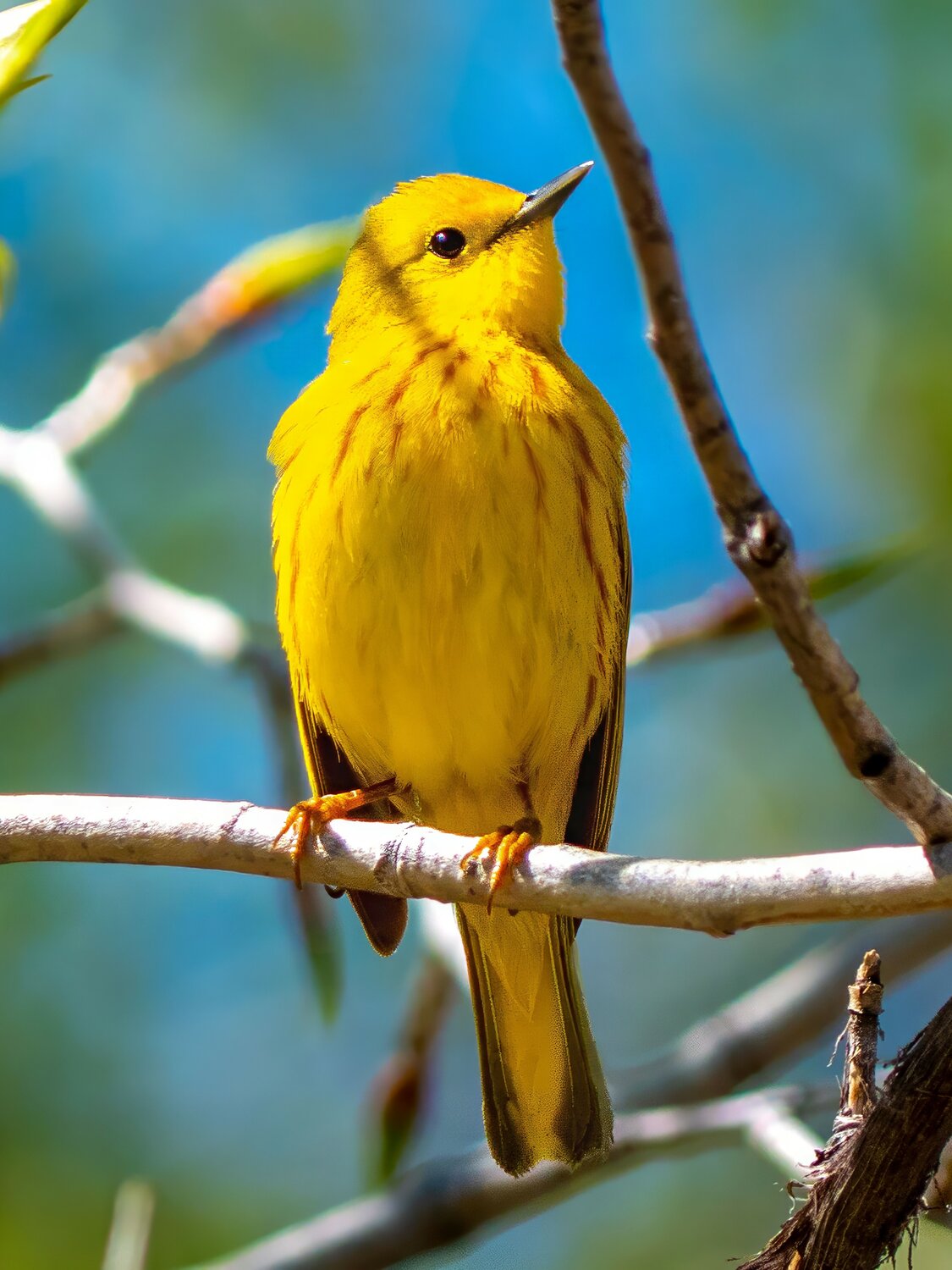
This week’s Bird of the Week, compliments of the Weminuche Audubon Society and Audubon Rockies, is the yellow warbler.
Several superlatives are attached to the description of this bird. In Colorado it is the most widespread warbler, it has the greatest geographical range of warblers, it is the yellowest of wood warblers in North America, and is one of the most commonly heard warblers in spring and summer.
Black, beady eyes and a stout bill are prominent features of this small, round-headed, bright yellow bird. Males are distinguished by chestnut-colored breast streaks which are not present in females. Both have green-yellow backs.
Despite being common and bright, it can be a difficult bird to spot. Rarely staying still for long, it actively forages along the slender branches of trees and shrubs. It plucks insects from foliage, makes short flights to nab an insect flying by or hovers among leaves to pick insects from the undersides. It may eat a few berries, but it is not a feeder bird.
In the dry western part of their range, they are most often associated with wet woods and found in streamside willow thickets. They are long-distance migrants that nest throughout Canada, Alaska and the northern two-thirds of the United States. They winter in Central and South America.
Many hear the recognizable song of the male yellow warbler as a version of “sweet, sweet, sweet, sweeter than sweet.” A singing male perches near the tops of bushes or trees to announce his territory. To attract a mate, a male may sing his short song more than 3,000 times in a day.
These birds also communicate in a variety of calls with short, chip notes. A particular one, the “seet” call, is specifically made as a brown-headed cowbird alert. Upon hearing it, a female rushes back to her nest to prevent the parasitic cowbird from depositing an egg. Red-winged blackbirds also recognize this warbler call as a nest danger alarm and respond to protect their own nest.
These warblers begin fall migration relatively early and many move south during August. Here their numbers start dropping in early September and most are gone by the end of the month, leaving us to wonder where summer has gone.
For information on events, visit www.weminucheaudubon.org and www.facebook.com/weminucheaudubon/.
Photo courtesy Jeffrey Reichel


 >
>