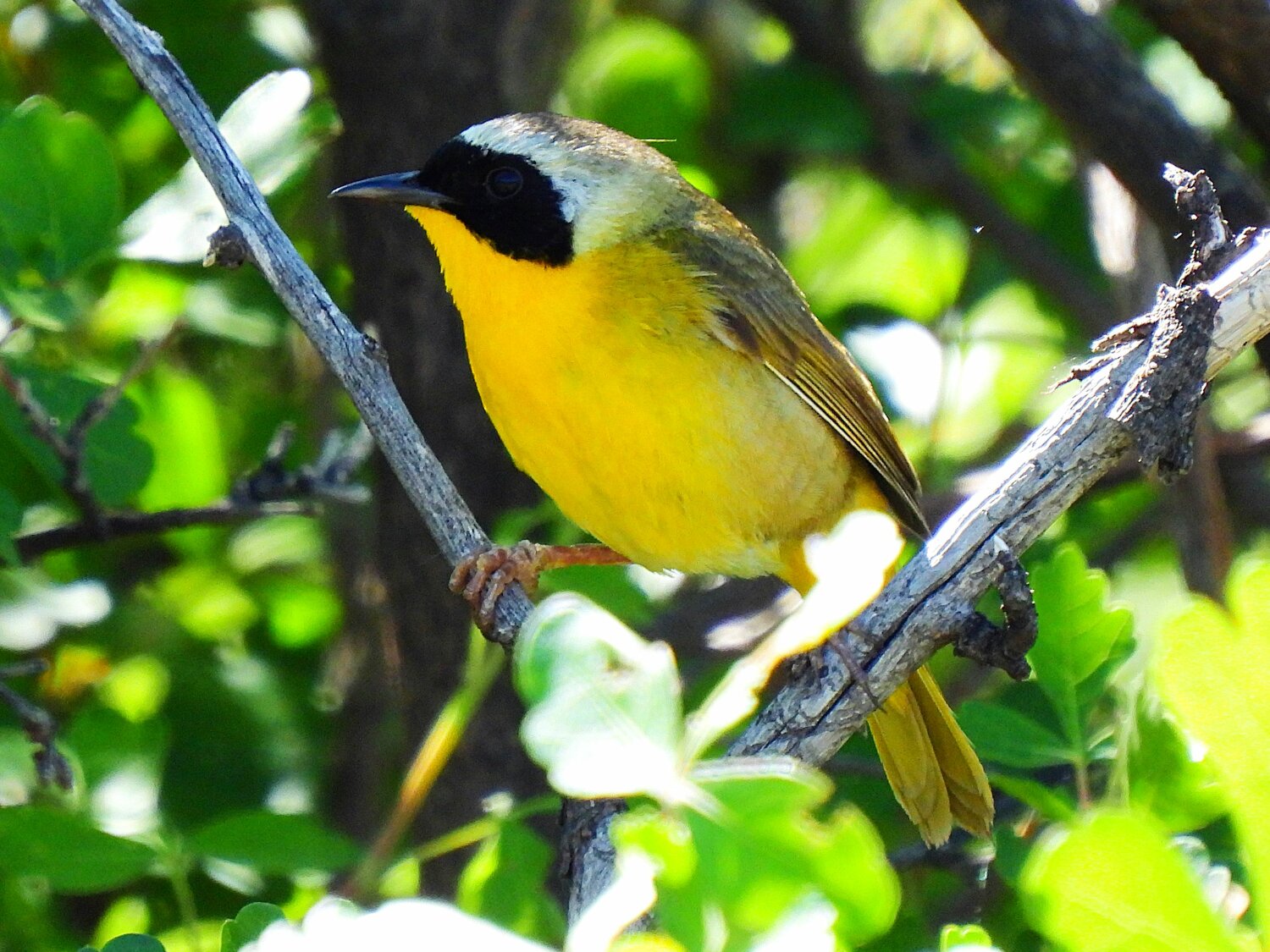
This week’s Bird of the Week, compliments of the Weminuche Audubon Society and Audubon Rockies, is the common yellowthroat.
Across most of the United States and Canada, these birds are common summer denizens of thick, tangled vegetation habitats. They are one of the most abundant warblers in North America. Although the central part of Colorado is not within their normal range, our southwestern corner of the state is. They are most often found at the edges of marshes and wetlands where dense vegetation extends low to the ground, but will also show up in drier brushy fields, shrub-covered hillsides, prairies and pine forests.
Unlike most of its warbler relatives, the yellowthroat does not spend its time up in the tree canopy. Instead it is a skulker that keeps itself hidden in thick foliage close to the ground. Here it forages for insects and spiders, bouncing around and on the move, much like a wren.
Hearing this vocal bird is much easier than spotting it. The male’s “witchety-witchety-witchety” song is distinctive and given frequently in summer. In attracting a mate and defending territory, he may repeat his short song as many as 300 times in an hour. They are inquisitive birds and often will pop out in the open briefly in response to pishing noises that attract their attention. Persistence and patience may be required to track this bird and be rewarded with a sighting.
The small male common yellowthroat wears a black bandit mask that extends through his eyes and across his face. A thin line of white separates his mask from his olive upperparts. A bright yellow throat patch is the source of his name. Females lack the black and white head markings but do have a yellow throat. Several subspecies of this bird, mainly differing in male facial patterns and the brightness of yellow, are recognized.
Most common yellowthroats are migratory, moving from summer breeding territories to winter in southern parts of the United States, Mexico, Central America and the Caribbean. By the end of September most will have left our area.
For information on events, visit www.weminucheaudubon.org and www.facebook.com/weminucheaudubon/.


 >
>