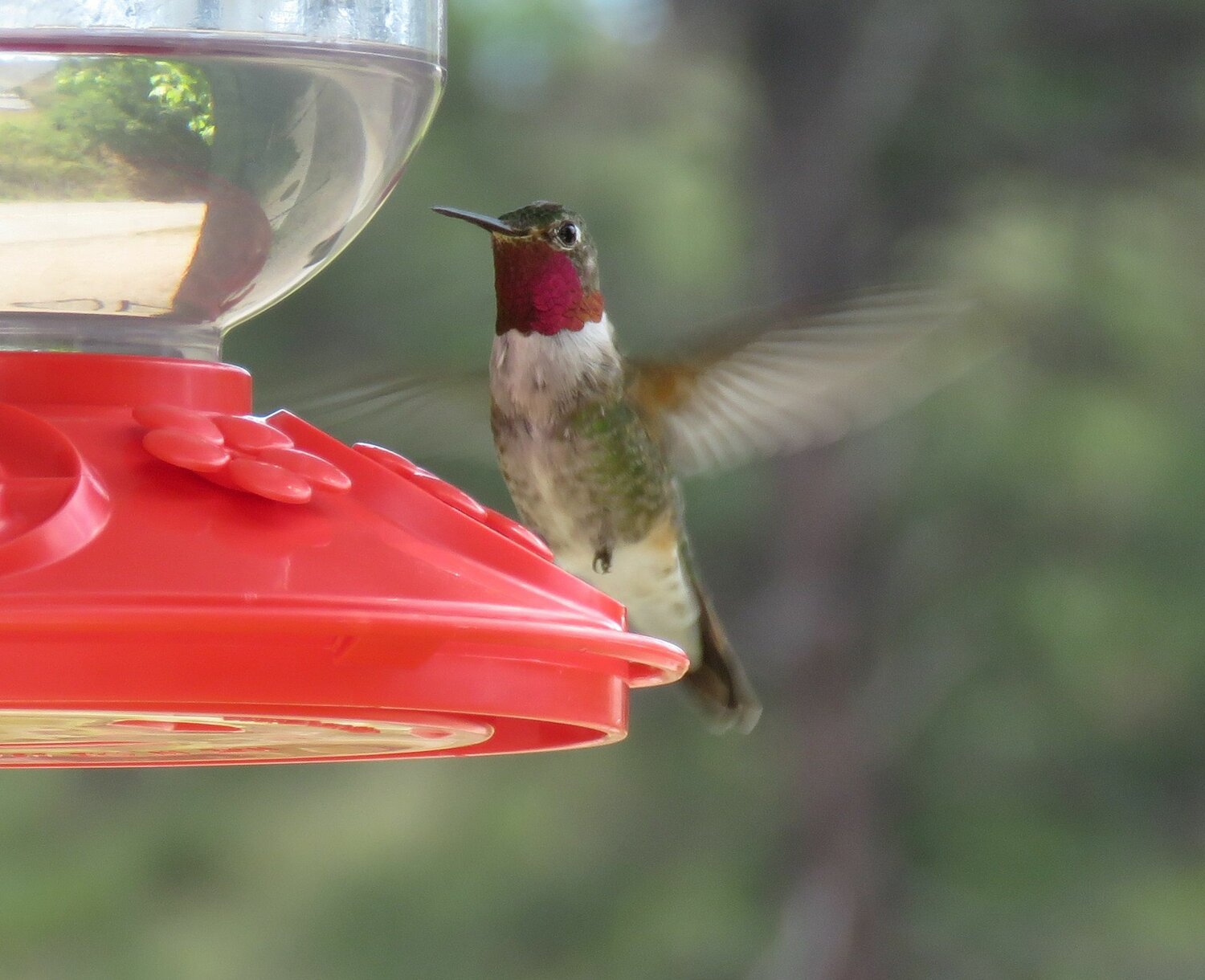
This week’s Bird of the Week, compliments of the Weminuche Audubon Society and Audubon Rockies, is the broad-tailed hummingbird.
With the earliest males typically arriving in mid-April, this is one of the two hummingbird species that breed in our area. These tiny birds fly from as far south as Mexico or Guatemala to spend the summer here. Broad-tailed hummingbirds search for flower nectar in high mountain meadows of the West and build their nests in open woods up to 10,500 feet in elevation.
In courtship flights, a male climbs as high as 100 feet in the air and hovers before descending in a dive at speeds up to 50 mph to pull up in front of a female. He angles his flight to catch the sun and flash his brilliant purple-red gorget. These birds do not form pair bonds. Males may mate with several females and leave them to raise their young alone.
Using gossamer and spiderwebs, a female builds a tiny, well-insulated nest on a tree branch with overhead cover. The outside is camouflaged with lichen, bark and moss. The inner diameter can be less than 1 inch, but the nest is designed to stretch as the chicks grow. When temperatures dip at night, these hummingbirds can enter a state of torpor by slowing their heart rate and dropping their body temperature. Males may move upslope to escape the colder mountain valleys at night, but nesting females have to stay.
Hummingbirds have the fastest wingbeats and heartbeat of any bird. They are the only birds that can fly backward and straight up and down. They are also the most colorful family of birds on Earth, with tiny feather structures that create shiny, reflective iridescence.
The throat of a broad-tailed hummingbird is rose-colored in an adult male and white with green spots on a female. Their tail feathers are broad and rounded with rusty colors tipped in white, but these details can be difficult to see. In flight, the wings of a male produce loud, metallic trills.
A warming climate, which causes plants on their breeding grounds to flower earlier, causes a mismatch in nectar availability for these high-elevation hummingbirds. Populations have declined by around 45 percent in the last 50 years.
For information on events, visit www.weminucheaudubon.org and www.facebook.com/weminucheaudubon/.


 >
>