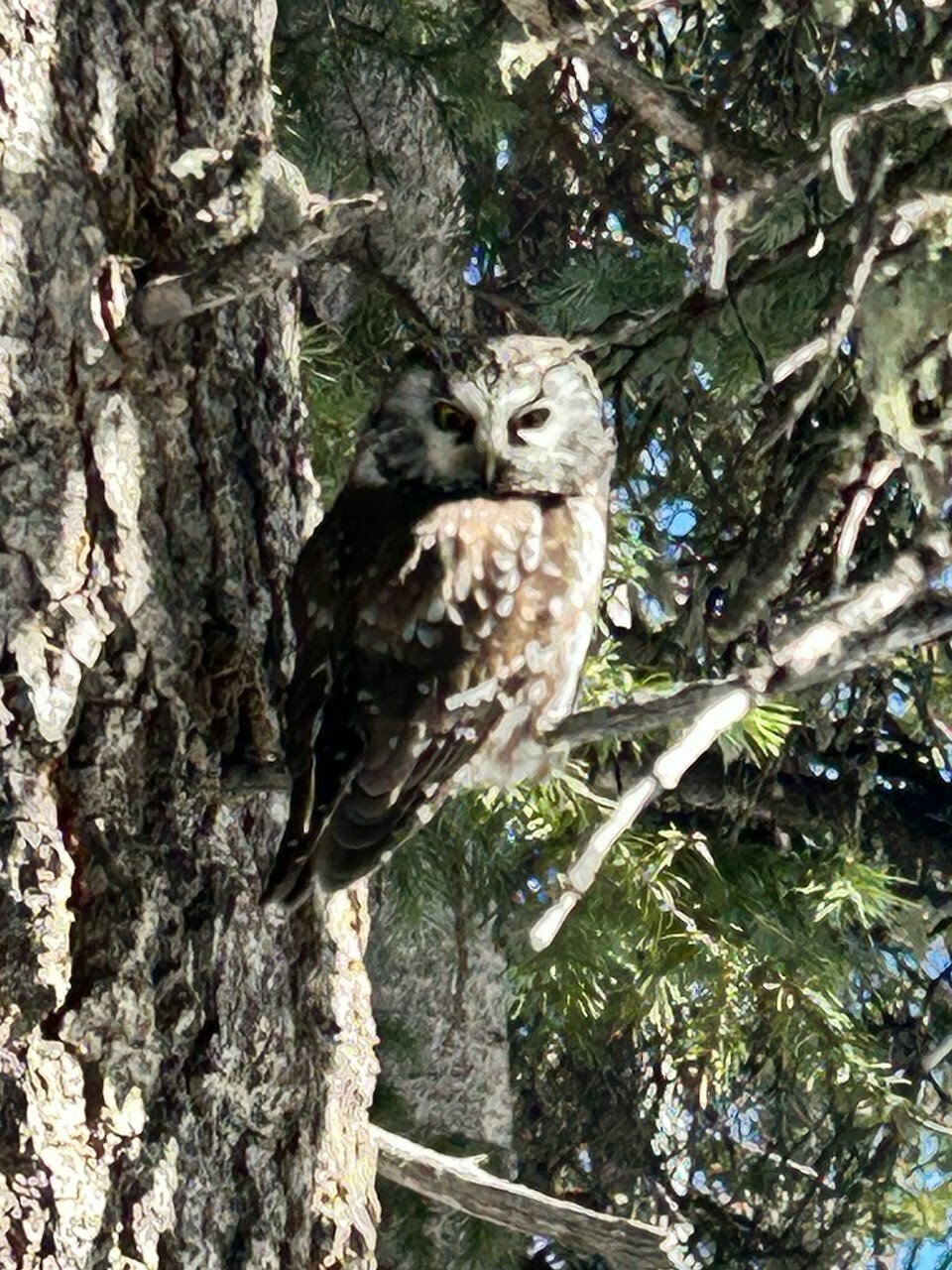
This week’s Bird of the Week, compliments of the Weminuche Audubon Society and Audubon Rockies, is the boreal owl.
Hiding is how small owls stay safe from larger predators. Dressed in camouflage, this one roosts quietly during the day close to the trunk, usually 15-20 feet from the ground and often hidden in dense coniferous vegetation.
The boreal owl has a circumpolar distribution, inhabiting forests of spruce, fir, aspen, poplar and birch across northern North America and Eurasia. Its range also includes high-elevation mountain forests in Canada and the western United States. This owl is typically nonmigratory, although in years when vole populations crash, or very deep or crusted snow makes hunting difficult, populations irrupt in areas south of its normal range.
The boreal is a small, square-headed owl with a pale bill, spotted crown, white spots on its back and brown streaks on its belly. Large yellow eyes peer out from its whitish facial disk with a dark border.
These solitary nocturnal owls most often hunt in early morning and late evening hours for voles, mice, shrews, squirrels, small birds and some insects in summer. Living where the ground is often snow-covered, the boreal uses its exceptional hearing to locate small mammals tunneling beneath the snow or scurrying across the ground. In winter, it listens from a perch before diving into the snow to grab its unseen prey in sharp talons.
When hunting is good, the boreal owl stores its excess food, which then often freezes. Before it can be consumed, the owl thaws it by sitting on it.
From mid-February to April, the male boreal owl calls at night to attract a mate to a potential nest cavity. He may furnish it with the bodies of dead prey to show her that he is a good provider. His call may be heard up to 1.5 miles away but he stops calling once he has a mate and otherwise is fairly silent.
Boreal owls change roost sites every day, adding to the difficulty of finding one. What a treat for a local skier who looked up and found this rarely seen owl perched on a tree at Wolf Creek ski area.
For information on events, visit www.weminucheaudubon.org and www.facebook.com/weminucheaudubon/.
Photo courtesy Jeff Greer


 >
>