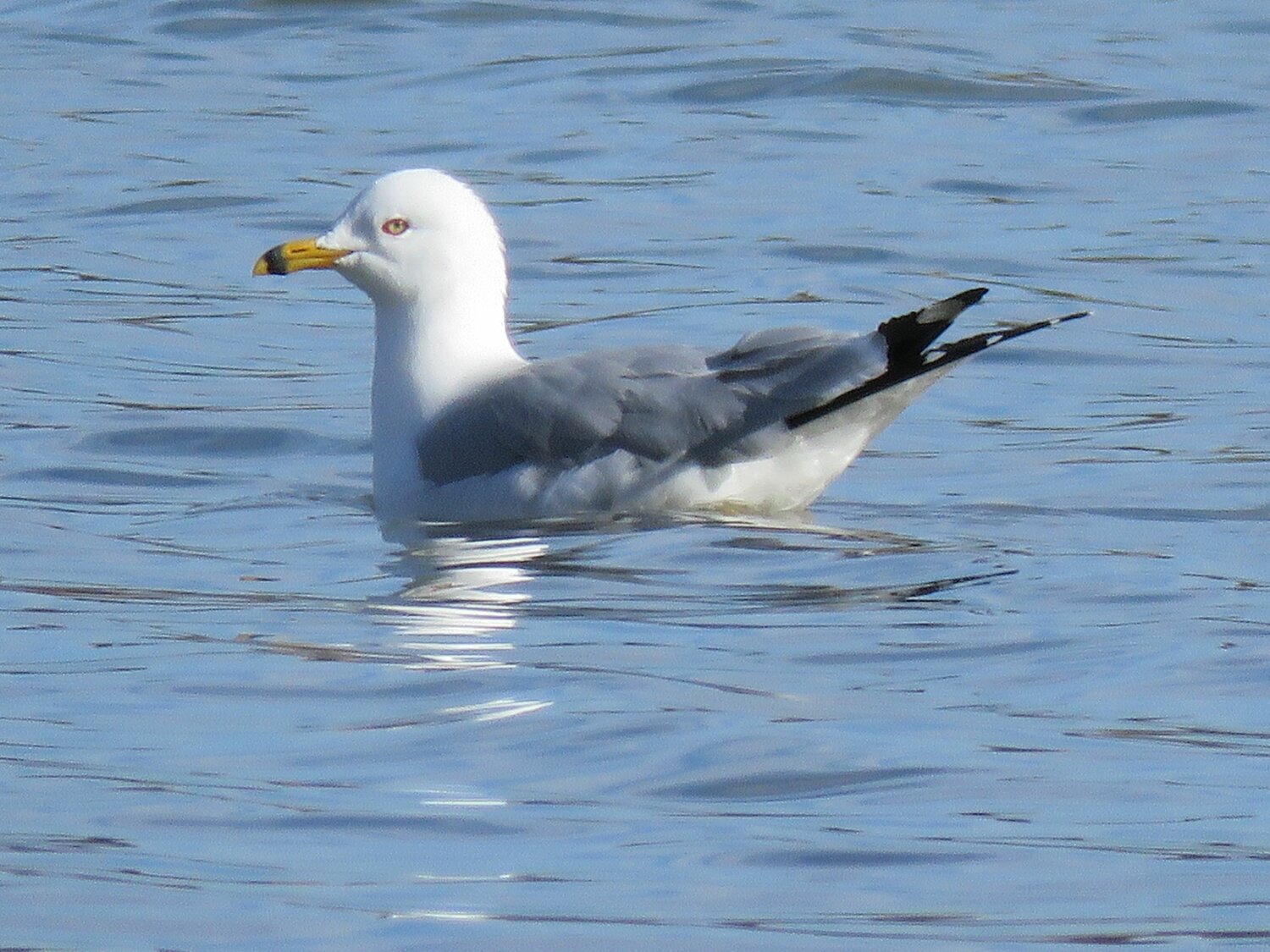
This week’s Bird of the Week, compliments of the Weminuche Audubon Society and Audubon Rockies, is the ring-billed gull.
Referring to this bird as a seagull is misleading. Of the more than 50 gull species worldwide, this is the one most likely to be seen far from coastal areas. In fact, many individuals can go their whole lives without visiting salt water. They are comfortable around humans and can be found in parking lots, dumps, beaches, fields, reservoirs, lakes and ponds.
Ring-billed gulls are short- to medium-distance migrants. In winter they are found in southern states, along the coasts, and south through Mexico and Central America. In our area, they are often seen feeding along the shorelines of Navajo Lake and may also show up at lakes and ponds like Pinon, Pagosa, Echo, Hatcher and others.
Ring-billed gulls often breed in large, noisy colonies which can number up to thousands of pairs. Their calls are described as a raucous scream. Most return to breed at the colony where they hatched in areas across Canada and the northern states. Nests are built on the ground, often on low-lying islands in freshwater areas.
These birds are generalists, adept at flying, running and swimming. They can thrive on almost any available type of food, including fish, insects, earthworms, rodents, grain, garbage and french fries. They forage by walking on the ground through fields, skimming the surface of water for fish, grabbing insects in the air, scavenging at dumps and stealing from other birds.
The National Audubon website calls gulls “the most difficult group of birds to identify. All the different species are just variations on the same basic theme: a gray back on a white body.” To complicate matters, gulls may take up to four years to display full adult plumage and go through many different variations from juvenile to adult. Even eye color changes as these birds age.
Adult ring-billed gulls display the black band for which they are named around a yellow bill. Other white-headed gull species which have been recorded in our county are the herring and California gulls. When you see gulls at a local water body, spend some time and see if you can spot the differences which separate these species.
For information on events, visit www.weminucheaudubon.org and www.facebook.com/weminucheaudubon/.
Photo courtesy Charles Martinez


 >
>