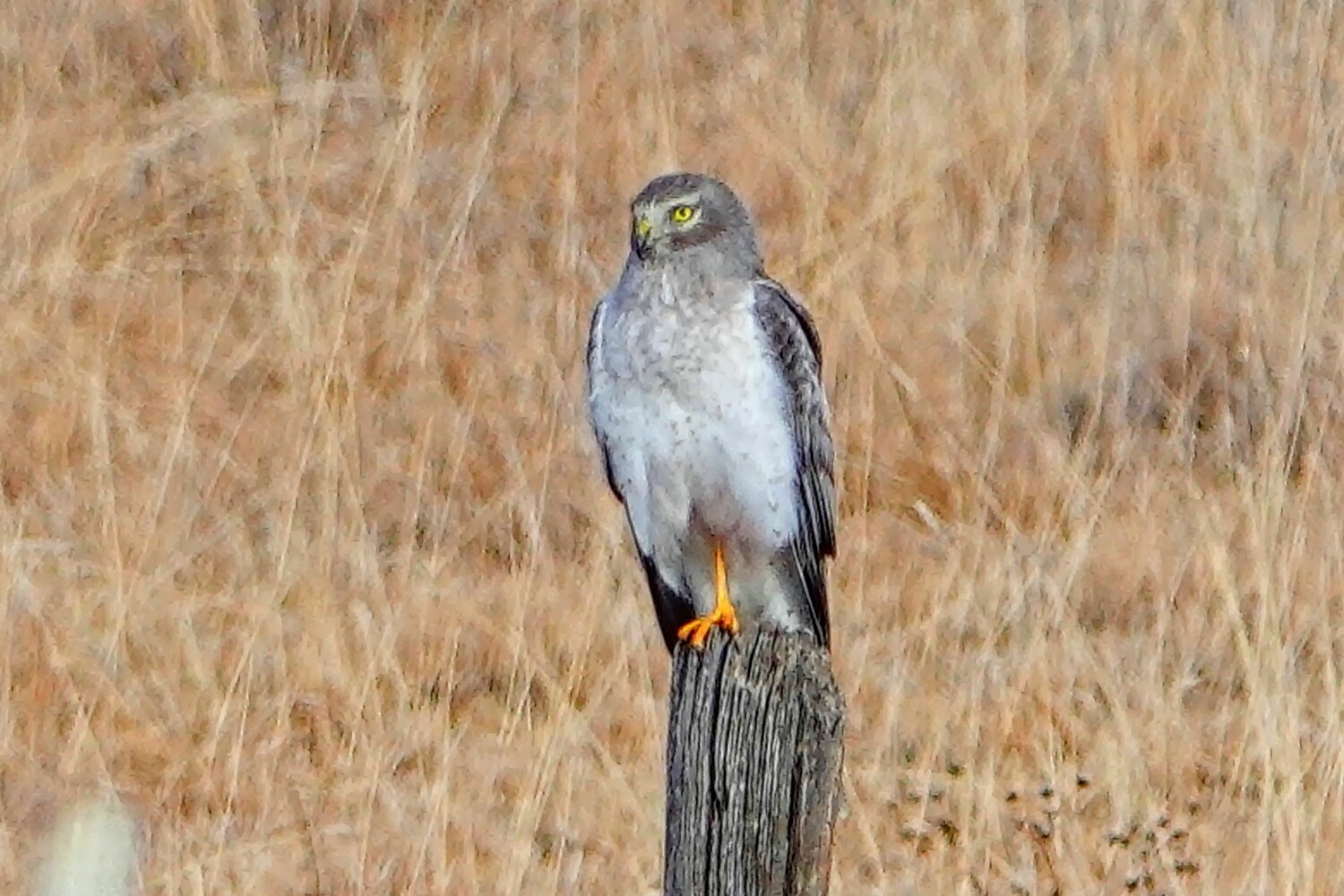
This week’s Bird of the Week, compliments of the Weminuche Audubon Society and Audubon Rockies, is the northern harrier.
Northern harriers are described as being owl-like raptors. Much like owls, these harriers have round facial disks — stiff feather patterns that direct sound to their ears. These feathers work in the same manner as cupping your hands behind your ears does to intensify and pinpoint sounds.
Like owls, northern harriers rely on their enhanced hearing ability to help locate prey both by sound and by sight. They forage on the wing, able to fly nonstop for hours, coursing low over the ground to hear and spot mice and voles moving beneath the vegetation. In addition to taking small mammals, they hunt small birds, large insects, snakes, lizards, frogs, and even larger prey like ducks and rabbits.
Unlike most owls, northern harriers hunt during the day, pouncing to grab spotted prey in their talons. They may stop to rest on low posts or on the ground and less often are in trees. In winter, groups may spend the night in the company of short-eared owls roosting on the ground.
These harriers build nests hidden in a clump of dense vegetation on the ground. The male mates with one or two females after advertising his territory in aerial sky dances. When food is abundant, he may have up to five mates. During incubation and the nestling period, the male provides food for the females and young. Young raised in monogamous relationships are provided more food and better protection from nest predators than those relying on a male providing for several broods.
Their distinctive low, rocking flight with wings held in a shallow V shape and patch of white rump feathers are identifying traits of northern harriers. They have slender builds and long rounded tails. The male is bluish-gray above and whitish underneath, earning him the nickname “gray ghost.” Females are 10-20 percent larger and 50 percent heavier than males, and have brown upperparts and brown-streaked whitish undersides. Immatures resemble females but have buffy-colored undersides with less streaking.
In our area, northern harriers may show up year-round in many types of open terrain with good ground cover and rodent populations.
For information on events, visit www.weminucheaudubon.org and www.facebook.com/weminucheaudubon/.


 >
>