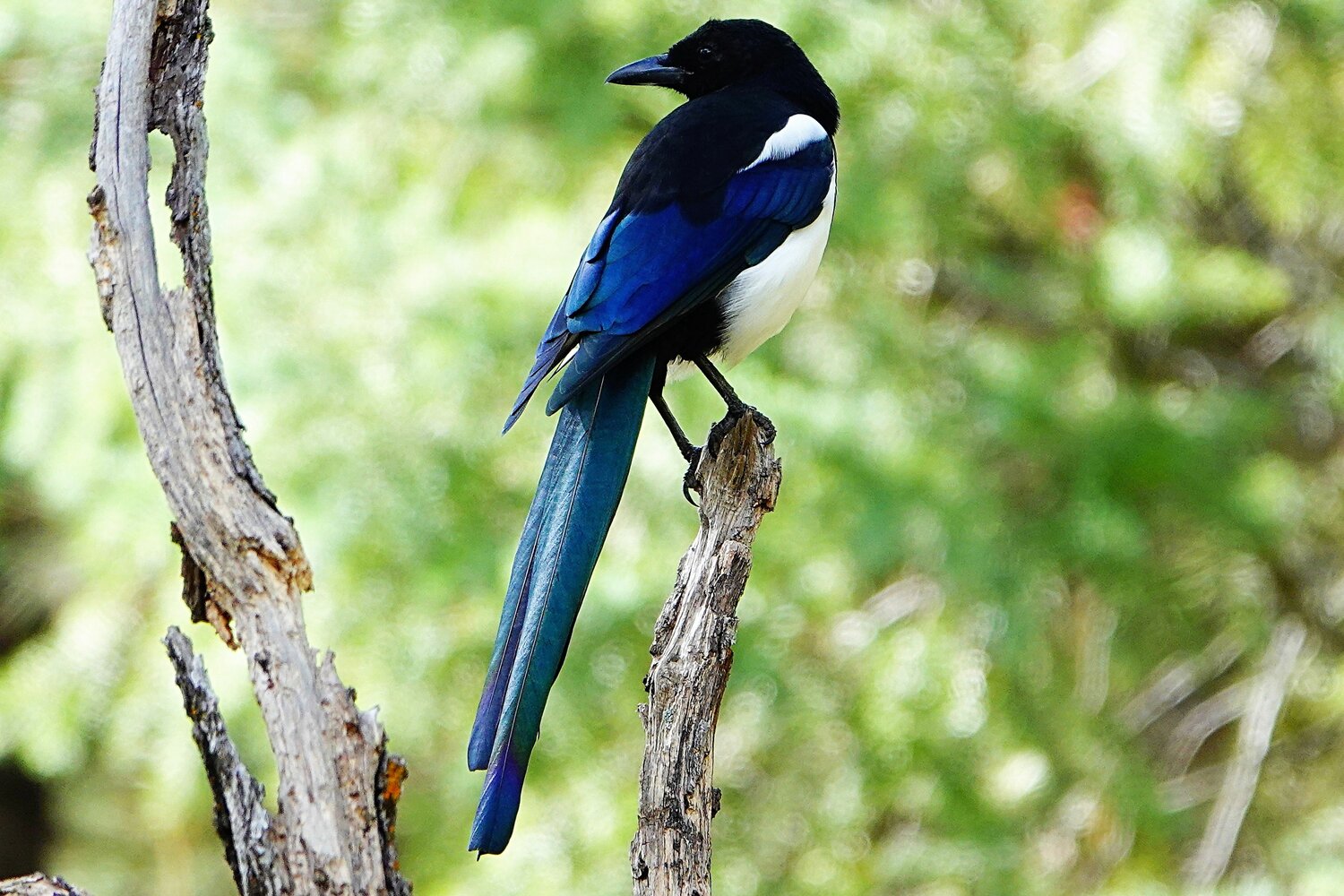
This week’s Bird of the Week, compliments of the Weminuche Audubon Society and Audubon Rockies, is the black-billed magpie.
Magpies are familiar birds. In their western range in North America, black-billed magpies have associated with people for centuries. They are common resident birds in cities, agricultural areas, grasslands and open forested habitats.
We are so used to seeing them that we sometimes fail to appreciate just how beautiful these large birds are. The upperparts are mostly black and the belly is white. In sunlight, feathers in the wings and tail reflect blue-green iridescence which makes them shine. Their extra-long tails and white wing patches make them identifiable in flight.
Black-billed magpies are entertaining. They may work together to steal food, with one bird sneaking up behind a victim and pulling its tail to distract it while the other sneaks in and flies off with its dropped food. Tail pulling by magpies seems to include an element of fun, and they also do it for no apparent reason.
Black-billed magpies love to get in the birdbath and splash around, even in winter, and will follow the bath with a roll in the snow. They walk with a swagger and on the ground mix short flights with hops. Try to feed your dog or cat outside and from out of nowhere fearless magpies will show up and empty the bowl one piece at a time, right under the nose of your pet.
Magpies are social. Outside of breeding season they tend to live in colonies. The discovery of a dead magpie attracts a gathering of others that call loudly and take turns circling the body. These “funerals” may last 10-15 minutes until the birds quietly disperse.
Black-billed magpies are vocal. They don’t produce what we would call a pleasing song, but have a repertoire of recognizable harsh calls. They can also fool you by producing a variety of squeaks, murmurs and musical sounds that make you wonder who is there. People that talk too much to the point of being bothersome are referred to as “chattering like a magpie.”
Look at these birds through the lens of a visitor who has not seen one before and you will see just how remarkable black-billed magpies are.
For information on events, visit www.weminucheaudubon.org and www.facebook.com/weminucheaudubon/.


 >
>