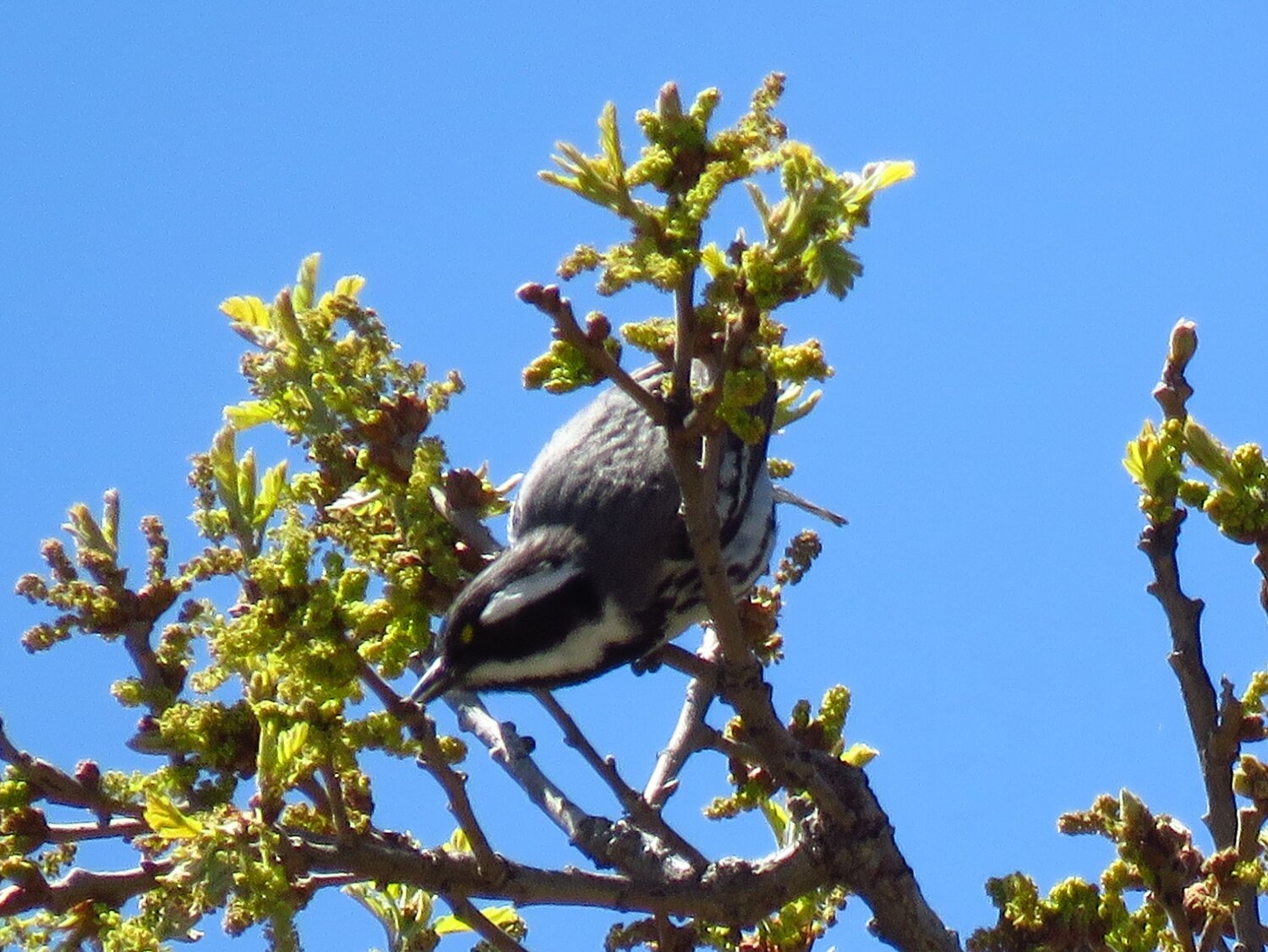
This week’s Bird of the Week, compliments of the Weminuche Audubon Society and Audubon Rockies, is the black-throated gray warbler.
Roger Tory Peterson, known as a pioneer of illustrated field guides that make bird identification accessible, referred to wood warblers as the “sprightly ‘butterflies’ of the bird world.” These are active birds — small with slender, pointed bills — that seem to feed constantly. Their migrations north in spring are timed to coincide with the emergence of the insects that serve as their primary food source.
Where they feed and how they forage allows warblers to find their own niche and coexist in a forest. Some feed high in the canopy, others at the mid level or in the shrubs and undergrowth. Different foraging styles allow them to feed on different insects. Some glean insects from the backs of leaves or crevices in the bark. Some feed close to the trunk, while others search the outer clusters of needles. Some flit from branch to branch, others move methodically and a few take insects on the wing.
This warbler forages primarily in the lower and middle levels of trees with slow, deliberate movements and hops between branches. Its diet has not been well studied, but it is known to feed especially on oakworms and other green caterpillars that are forest pests.
While the term warbler brings to mind the color yellow, which appears in many of our summer visitors, the black-throated gray warbler wears only a tiny spot of yellow, found just above and in front of each eye. Its back is gray and its face is striped in black and white. Males have a black throat patch that is smaller in females, who are paler overall.
The black-throated gray warbler breeds in semi-arid country west of the Rocky Mountains. In Colorado it is found primarily in open pinon-juniper and pine-oak forests. It is a short- to medium-distance migrant that winters in Mexico and nests as far north as southern British Columbia, and east as far as south-central Colorado. In Colorado spring migration peaks in early May, with most leaving between late August and mid-September.
For information on events, visit www.weminucheaudubon.org and www.facebook.com/weminucheaudubon/.


 >
>