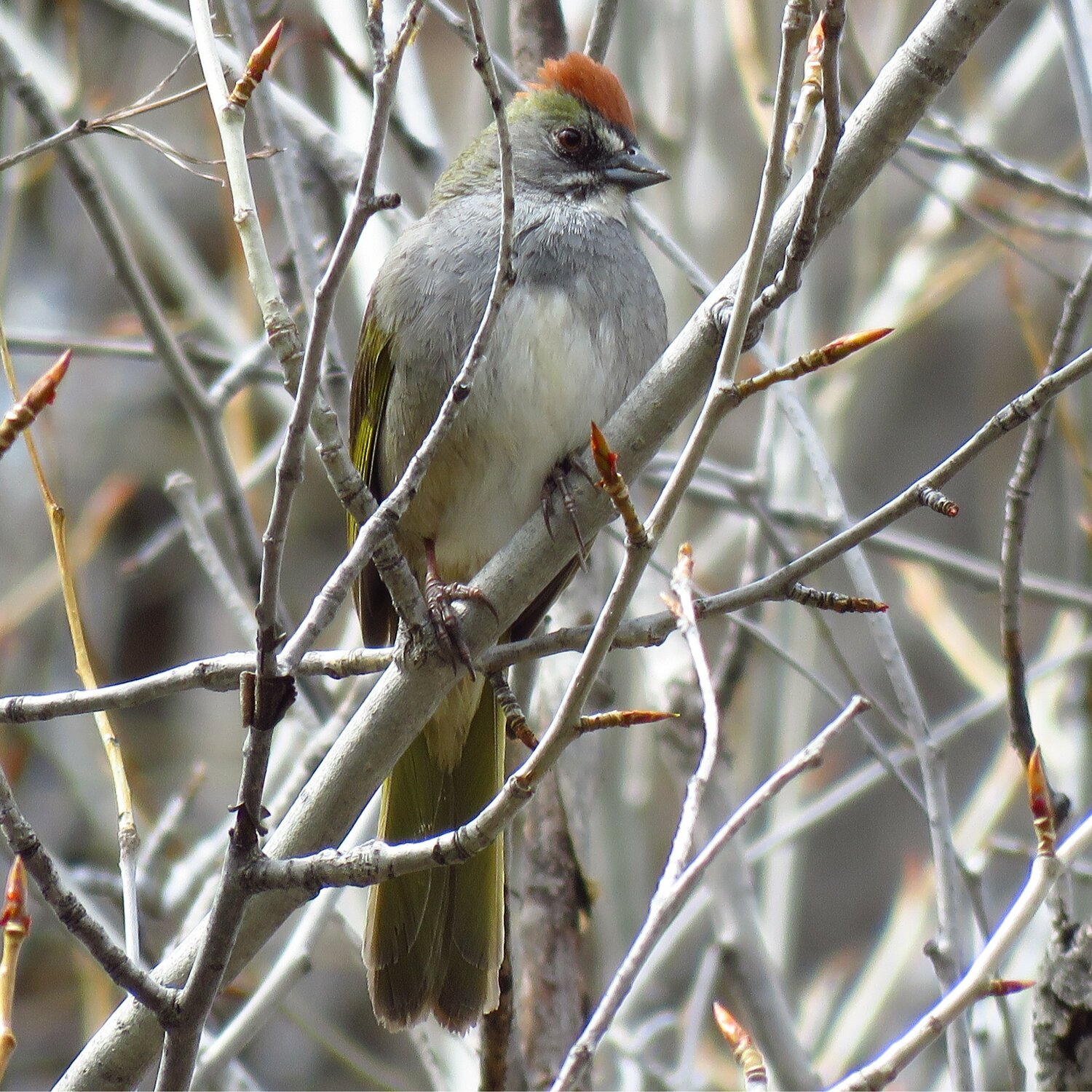
This week’s Bird of the Week, compliments of the Weminuche Audubon Society and Audubon Rockies, is the green-tailed towhee.
The best time of year to catch sight of these birds in our area is late May and early June, when males perch at the top of shrubs to sing. His song, all about defining his territory and attracting a mate, is described as a jumbled mix of clear whistles followed by trills. He may repeat it up to 12 times per minute.
At other times, these are secretive birds hiding in dense, thick habitat. From late spring through early fall, they are found in the West on shrubby mountainsides up to 10,000 feet in elevation and in sagebrush that is intermixed with shrubs and trees. Regrowth that occurs following fire or some types of logging provides good towhee habitat.
Green-tailed towhees forage for insects low among the foliage or on the ground, using the double-scratch method to stir up leaf litter and peck at what is uncovered. They feed on a variety of seeds, and insects including beetles, bees, wasps, caterpillars, moths and grasshoppers.
The female conceals her cup-shaped nest in low branches of very dense vegetation. Despite being well hidden, their nests are often prone to predation by jays, magpies, squirrels, weasels, skunks and snakes. If a predator approaches the nest area, the female may raise her tail and run, mimicking a chipmunk in an attempt to lure danger from the nest. Both sexes produce a mewing call from deep within the brush to stay in contact.
The green-tailed towhee is a large grayish sparrow with olive-yellow wings and tail, white throat and rufous cap. Despite being fairly common across its range, its secretive nature in thick brushy habitats have made it one of North America’s least well-known birds. They share many characteristics with the related spotted towhee, which is a year-round resident here, but the green-tailed migrates to the southwestern United States and Mexico for the winter.
For information on events, visit www.weminucheaudubon.org and www.facebook.com/weminucheaudubon/.
Photo courtesy Charles Martinez


 >
>