This week’s Bird of the Week, compliments of the Weminuche Audubon Society and Audubon Rockies, is the lark bunting.
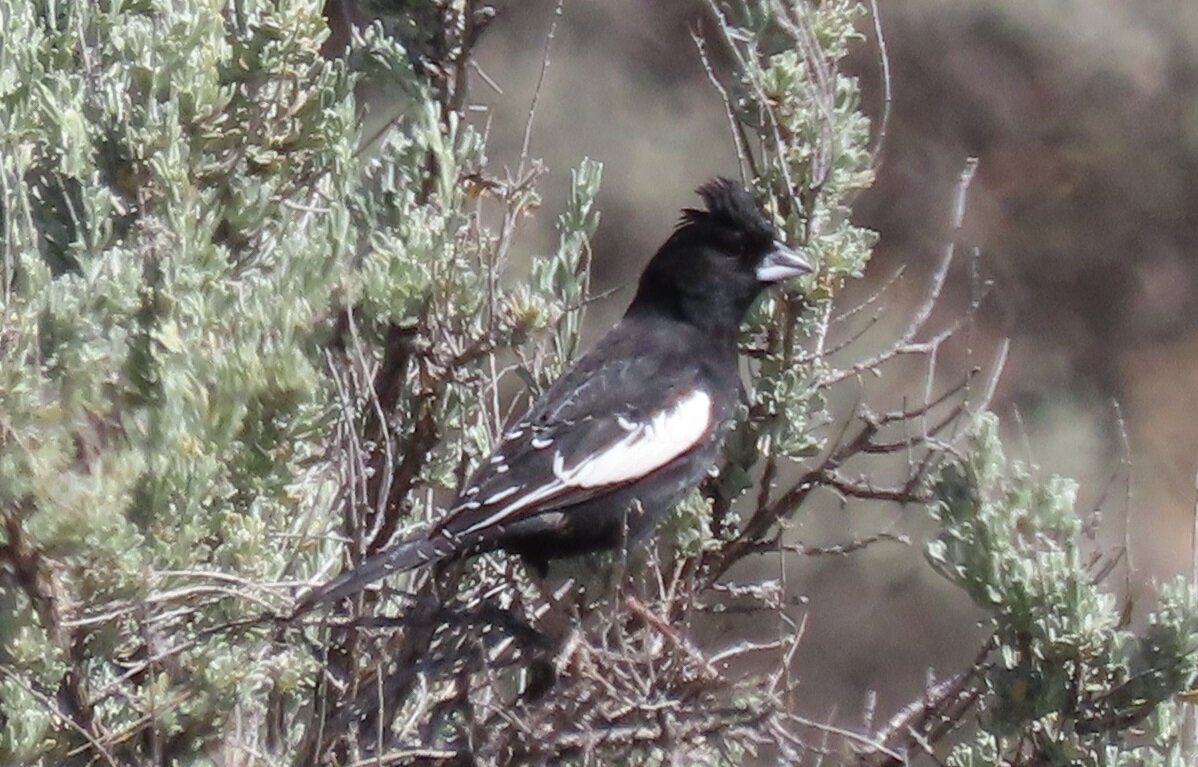
Lark bunting is a misleading name choice for this bird that is unrelated to the brilliantly colored birds of the cardinal family that share the common bunting name. Renowned avian expert Kenn Kaufman said of the lark bunting, “It’s just an American sparrow that’s a little fancier.” Indeed, for most of the year lark buntings wear the brown, streaky colors that we associate with sparrows. They are large and chunky and have thick, bluish-gray bills. Only for part of the year are breeding males colored silky black with large white wing patches.
Similarly confusing, this bird is also not a lark, but acquired this part of its name from resemblances to the Eurasian skylark familiar to early ornithologists. Breeding male lark buntings perform a courtship display known as skylarking in which they ascend up to 20 or 30 feet above ground and sing a canary-like song while slowly descending. They also sing from perches to defend a breeding territory.
Lark buntings are endemic to the windswept grasslands and shrub-steppes of North American Great Plains. For nesting they prefer shortgrass and taller grass areas that have some small shrubs, grass clumps or cacti that provide shade and shelter for their ground nests. Spring through autumn their primary food source is invertebrates, which they hunt by stalking and chasing on foot and in flight, or glean from vegetation. They supplement with seeds and some fruits.
In Colorado, this bird is found from May to September almost exclusively on the Eastern Plains. Pawnee National Grassland protects the threatened grassland ecosystem that these birds need to survive. In migration one may show up here, like this bird photographed in the Navajo Lake area. In winter, lark buntings are found in Texas, Arizona and the high plateaus of northern Mexico. Here they wander nomadically in large flocks until they locate a place where late summer rains have produced a good food supply.
The story of how a relatively unknown bird that only spends part of the year was chosen as the Colorado state bird in 1931 came down to impassioned arguments for the meadowlark, bluebird or lark bunting. The winning factor for the lark bunting was that no other state had chosen it.
For information on events, visit www.weminucheaudubon.org and www.facebook.com/weminucheaudubon/.


 >
>