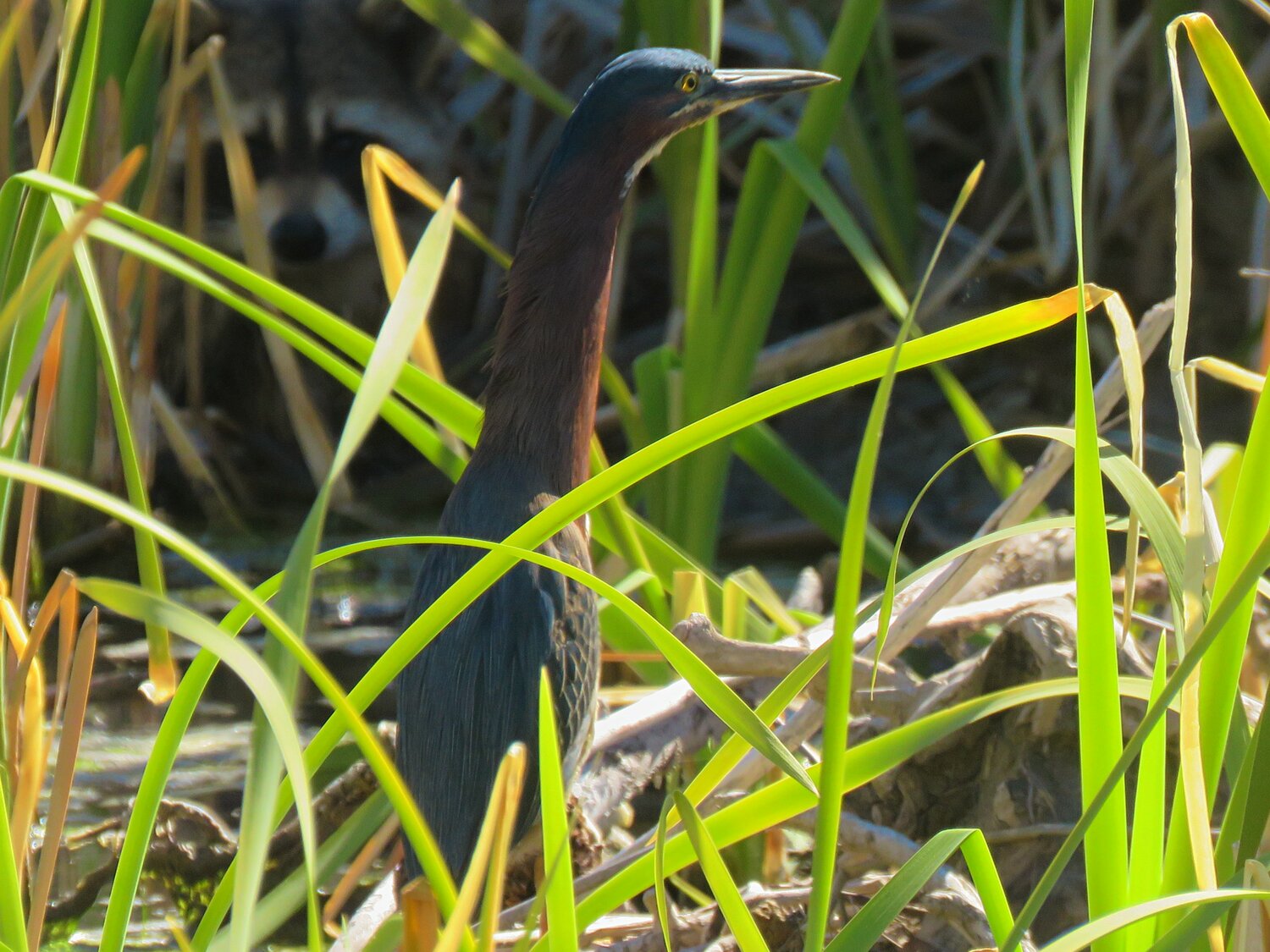
This week’s Bird of the Week, compliments of the Weminuche Audubon Society and Audubon Rockies, is the green heron.
Several fortunate people have been able to see this rare visitor to our area hiding in the shadows of the Riverwalk wetlands recently. The photo reveals someone else with eyes on this beautiful bird. This heron’s breeding territory is primarily found in the eastern half of the United States, and winter finds them in the extreme southern coastal areas of the United States, through Mexico and Central America and in northern South America.
One of the smallest members of the heron family, in good light this short, stocky bird shows iridescent colors of deep green on its back and crown, and chestnut colors on the neck and breast. Sometimes its crown feathers are raised into a short crest, and its thick neck is often retracted into the body.
In most seasons this is a secretive, solitary bird found at the edges of wooded, quiet streams, shaded riverbanks and shallow wetlands, where it blends into the dense vegetation. Its harsh calls are distinctive and difficult to describe.
Hunting at all times of day and night, the green heron eats mostly small fish but also takes crayfish, insects, frogs and small rodents that cross its path. Known to some as symbols of patience and quiet strength, most often they forage by standing still or stalking slowly. They often pose horizontally in a crouched position, ready to employ lightning-fast strikes with a long dagger-like bill to capture prey.
They are also known to hunt by watching from a branch over water and lunging forward while holding on with their feet, even hanging upside down to nab a fish. When prey is spotted out of reach they may dive or jump into deeper water, but the fishing style that sets these herons apart from others is their use of tools as bait to lure fish into striking range. They have been observed dropping a variety of objects — including bread, popcorn, fish pellets, feathers, twigs and plastic — onto the water for fish to investigate. They have even been documented digging up earthworms and using them for bait.
These resourceful birds are still fairly common, but are listed by Partners in Flight as “Common Birds in Steep Decline” due to concerning long-term population declines.
For information on events, visit www.weminucheaudubon.org and www.facebook.com/weminucheaudubon/.
Photo courtesy Keith Bruno


 >
>