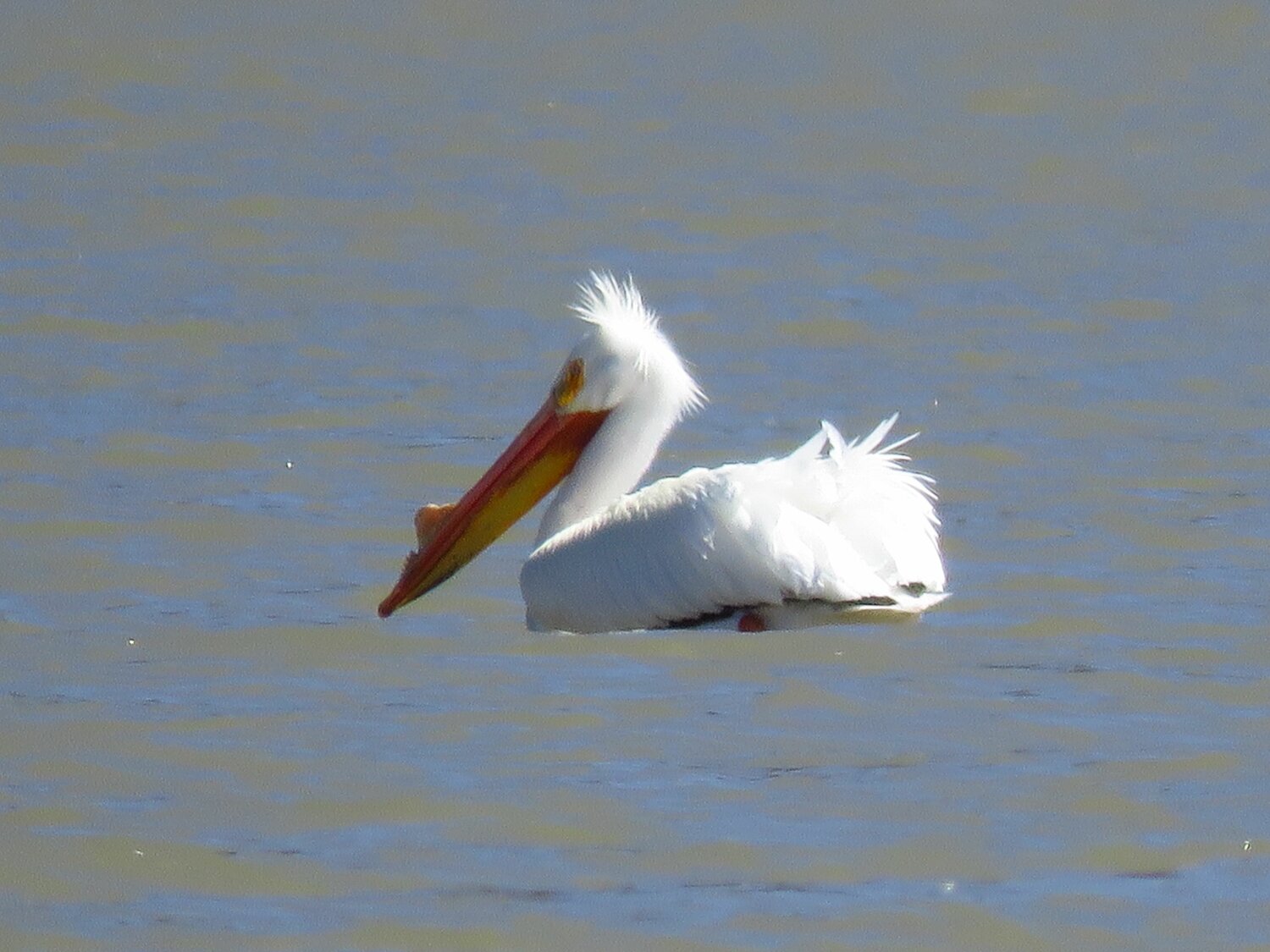
This week’s Bird of the Week, compliments of the Weminuche Audubon Society and Audubon Rockies, is the American white pelican.
One of the largest birds in North America, the American white pelican has been spotted fishing at Navajo Lake recently. From winter grounds along the coast, these birds are headed to colonial nesting sites primarily located on islands of inland lakes in midwestern and western states and western Canada.
Adults are snowy white with black flight feathers that are visible when the wings are spread. Their bills, legs and webbed feet are yellow-orange. Although they are ungainly on land, they are strong swimmers and graceful in flight. With a wingspan measuring 9 feet, they are spectacular fliers. A squadron of pelicans glides across the sky in V formation, each bird with its neck folded back.
A pelican is all about its beak, captured in an old limerick written by Dixon Lanier Merritt: “A wonderful bird is the pelican. His bill will hold more than his belican.” The pelican’s bill is the longest in the avian world, its means of survival and is responsible for its prehistoric look. Breeding white pelicans develop a bony projection near the tip of the upper bill that wears off later in summer. The bill’s pouch, full of blood vessels, is opened and fluttered to cool off on hot days.
Unlike the brown pelican, the American white pelican does not dive for fish. Instead, while swimming it uses its large expandable pouch, capable of holding 3 gallons, for scooping fish from shallow water. Before throwing its head back to swallow its catch whole, it tilts forward to strain water from its pouch. Each bird consumes more than 4 pounds of food daily.
Flocks of pelicans often feed cooperatively, lining up and driving fish ahead of them to shallow water. In movements described as a ballet on water, they will encircle a school of fish and dip their heads underwater in synchrony to scoop up fish. They are also known for stealing food, especially from other pelicans or from cormorants. While generally their typical prey are fish species with little commercial value, they can be pests at aquaculture ponds.
Spring migration season is a great time to get out and spot birds like these passing through. You never know what you might find.
For information on events, visit www.weminucheaudubon.org and www.facebook.com/weminucheaudubon/.


 >
>