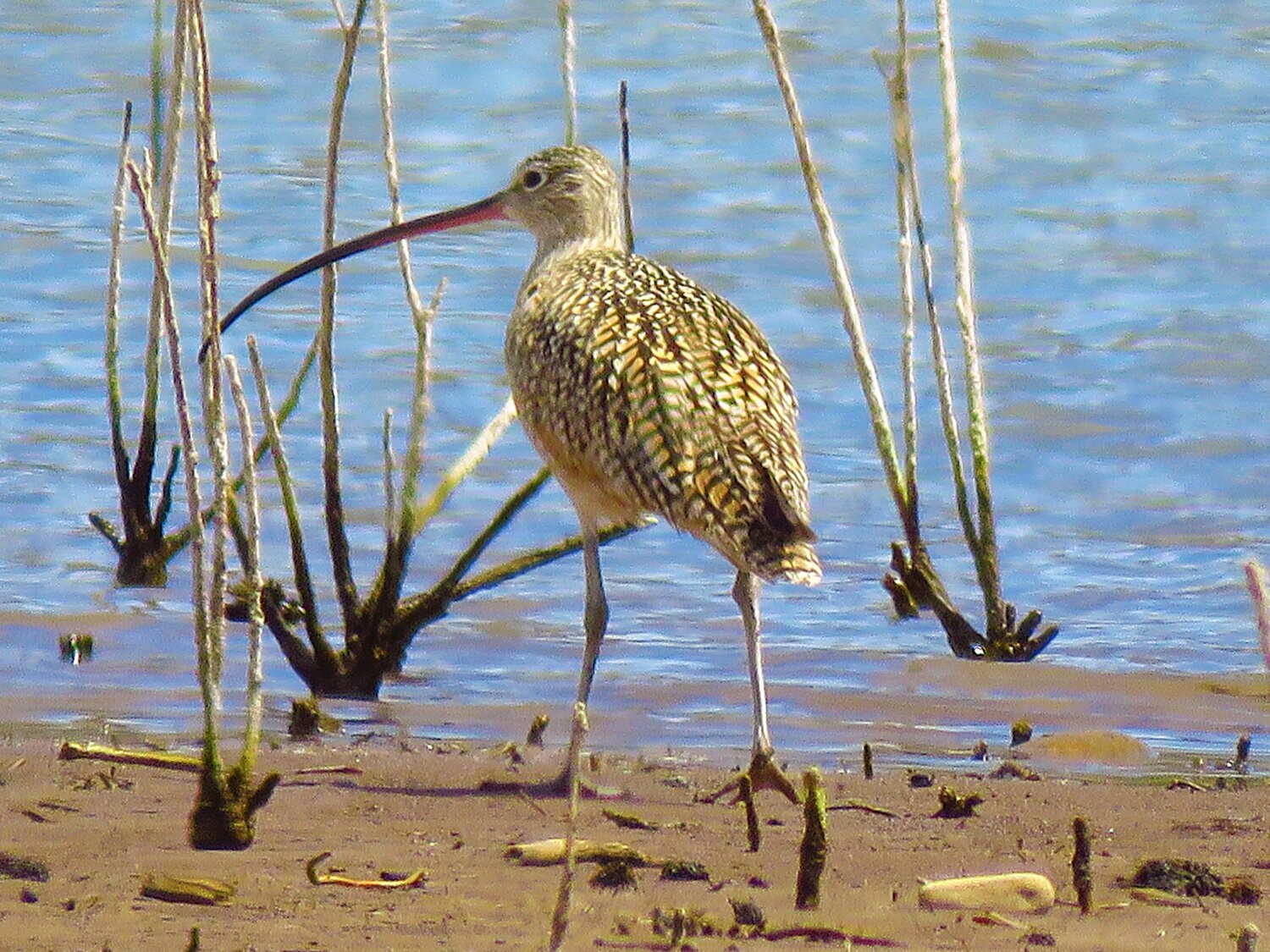
This week’s Bird of the Week, compliments of the Weminuche Audubon Society and Audubon Rockies, is the long-billed curlew.
In our area, the best opportunities to find shorebirds stopping over on their migratory journeys occur in April. As a group, shorebirds are highly migratory and one of the most threatened bird groups in North America. We don’t usually find many shorebirds here for long, or in big numbers, making it a treat when we do.
North America’s largest shorebird is the long-billed curlew. Its long, down-curved, sickle-shaped bill was the inspiration for its genus name, Numenius, taken from the Greek word meaning “of the new crescent moon.” Atop long legs, its football-shaped body is speckled and barred in browns above with a pale cinnamon wash, and its belly is plain cinnamon.
The curlew uses its long bill both to probe into the mud for deep burrowing prey like crabs and shrimps, and to peck at the ground. They eat a variety of insects and other invertebrates, especially grasshoppers, and also some fish, amphibians, bird eggs and nestlings. They often forage in groups, moving side by side through the grass to flush insect prey.
The long-billed curlew is considered a grassland species, but they are rarely far from shallow water. Their preferred breeding habitat is a blend of short grasslands, meadows, agricultural fields and wetlands. They nest in parts of western United States (including in eastern Colorado) and in southwestern Canada. Winter finds them in coastal areas and inland parts of California and Mexico.
On the shortgrass prairie, they nest in large, flat expanses where they are so well camouflaged that adults are nearly impossible to spot sitting on eggs. Despite prairie dog colonies being predator magnets, curlews choose to nest near them. Prairie dogs sound distinct alarm calls when a threat appears that even convey whether the threat is aerial or terrestrial. Studies have demonstrated that curlews further reduce their chances of detection by a predator when they respond to these messages by flattening themselves over the nest.
Look for shorebirds like this one when they stop to rest and feed during arduous migrations to northern breeding areas. Shallow water bodies including Vista pond, wetland ponds near Piedra Road, and wetlands and shorelines at Navajo State Park are places to search.
For information on events, visit www.weminucheaudubon.org and www.facebook.com/weminucheaudubon/.
Photo courtesy Charles Martinez


 >
>