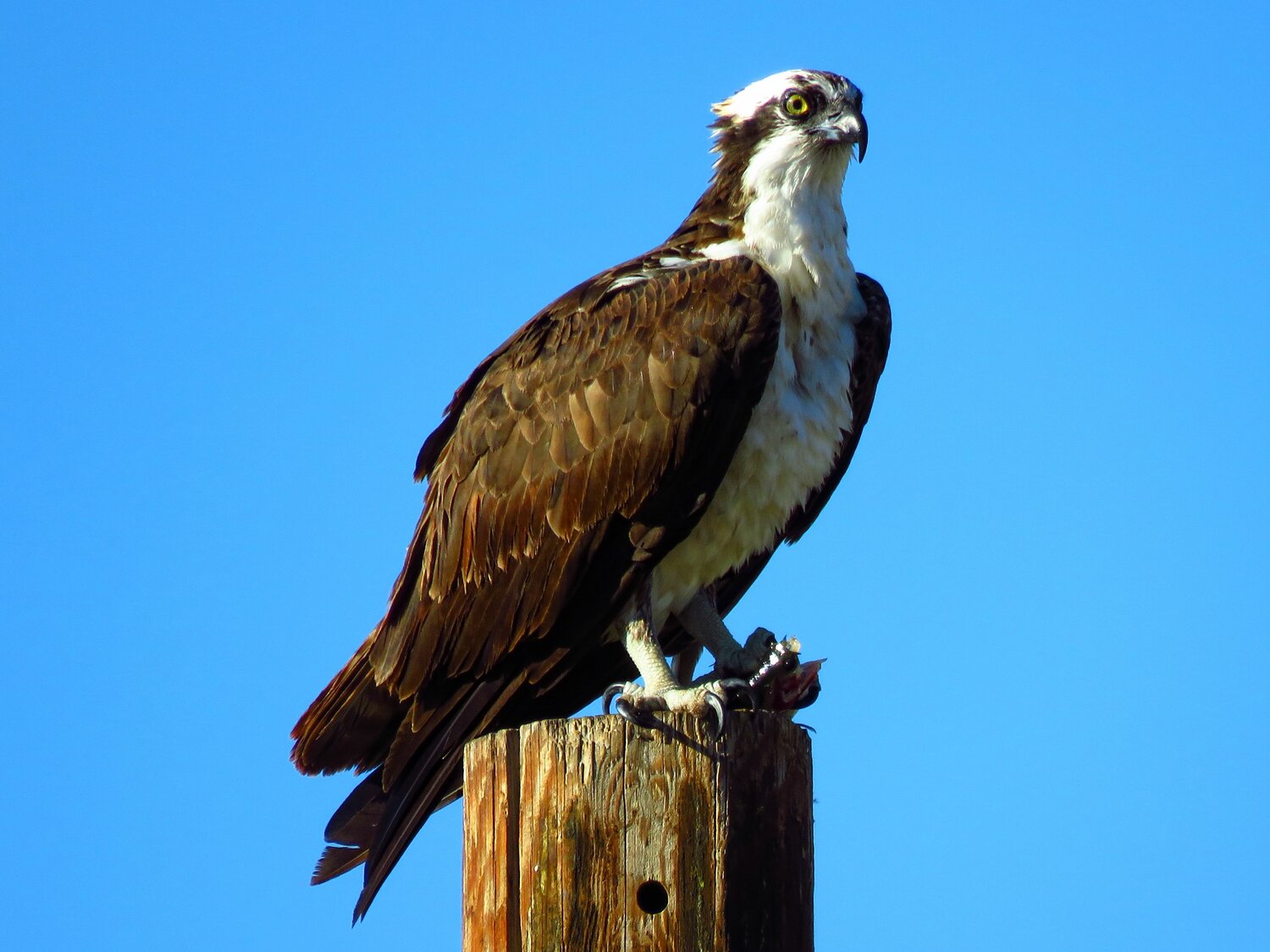
This week’s Bird of the Week, compliments of the Weminuche Audubon Society and Audubon Rockies, is the osprey.
Osprey sightings are a sign of spring in Pagosa country. These majestic raptors migrate long distances to and from breeding grounds, with most western ospreys in North America wintering in Mexico or Central America and eastern ones traveling as far as South America and the Caribbean.
Ospreys are large, slender hawks with brown backs and white undersides. The white head appears small, has a brown stripe through the eye and a dark, hooked bill. They are vocal birds that communicate with chirps and whistles. You can view them at the nest on the Lake Capote website’s osprey cam.
Ospreys almost exclusively eat live fish, which they snare with enviable prowess. They fish by sight while flying slowly over the water or hovering briefly to spot a fish near the surface. Upon seeing their prey, they plunge feetfirst into the water to grab the fish in their powerful talons. Barbed pads on the soles of their feet help them hold onto their slippery prey, which they position headfirst before flying off.
Pairs return year after year to the same nest site and often remain together for many years. The nest is built atop a pole, a snag or a manmade platform in open surroundings within 12 miles of fish-filled water. Material is added to the untidy stick nest year after year and it may become huge. To provide an alternative to nesting atop electric poles, utility companies, including La Plata Electric Association, often erect nest platforms like the ones at Echo Reservoir, the U.S. 160/U.S. 84 intersection and the one just west of Walmart.
From the arrival of a parent at the nest site to the departure of the first fledgling from it takes around four months. Eggs do not hatch all at once, and typically the oldest hatchling dominates its siblings. Younger ones may starve if food supply is poor.
A growing cause of osprey death is from the entanglement of chicks and even adults at the nest when discarded fishing line and twine is picked up and added by the parents — a sad reminder of the importance of “Leave No Trace” principles when recreating outdoors.
For information on events, visit www.weminucheaudubon.org and www.facebook.com/weminucheaudubon/.


 >
>