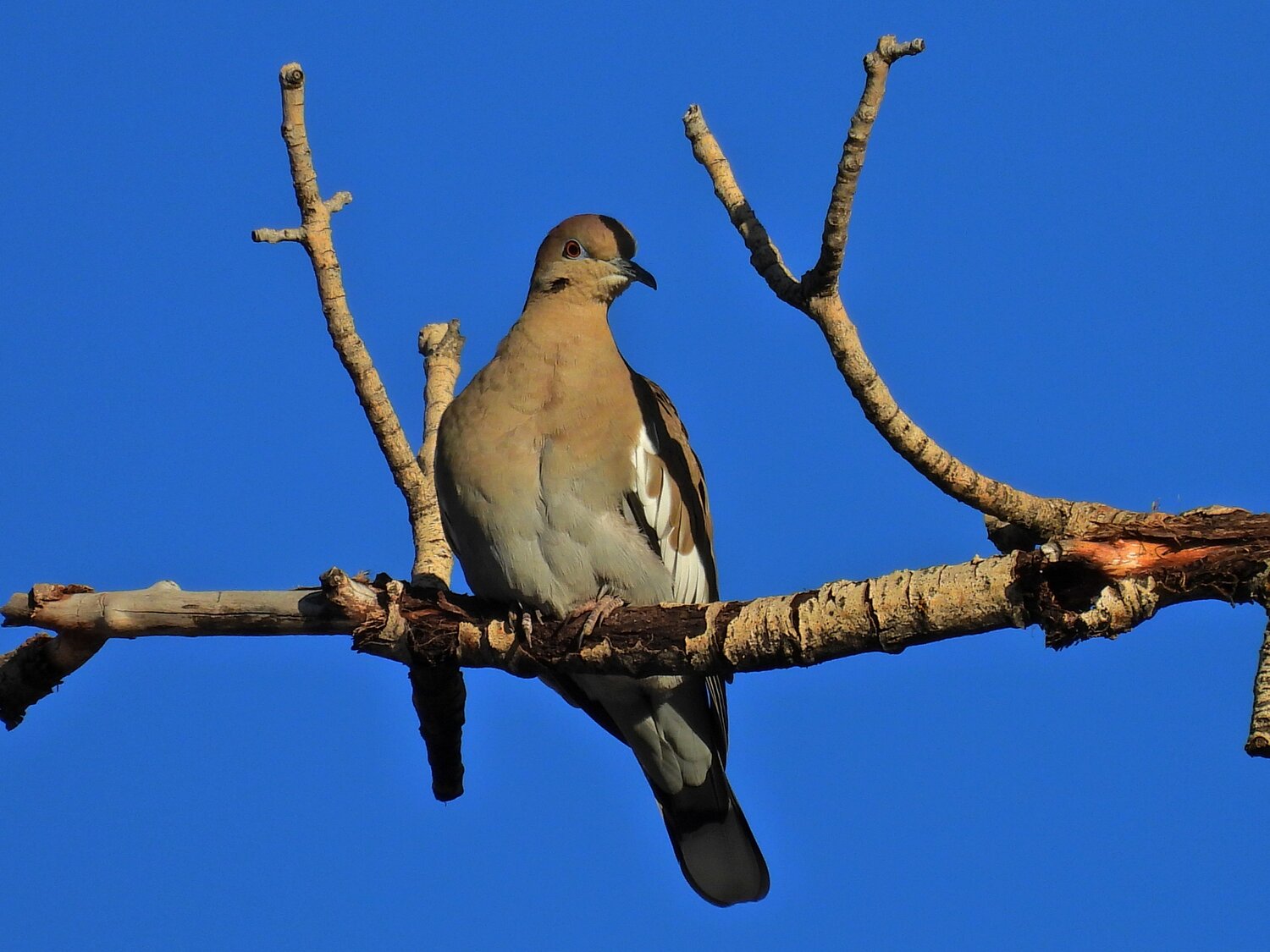
This week’s Bird of the Week, compliments of the Weminuche Audubon Society and Audubon Rockies, is the white-winged dove.
Recently, nine similar looking doves were perched in a tree in Town Park, eight Eurasian collared-doves and a single one whose wings were edged in white. When a single bird like this one shows up outside its normal range, it is cause for speculation. Was this change in course accidental or a sign of shifting populations?
White-winged doves were originally warm-weather birds of desert thickets. In the Sonoran Desert of northwestern Mexico and parts of Arizona and California, desert doves breed during the driest and hottest time of year. They time their migration and nesting season to match the fruiting cycle of the saguaro cactus, which produces flowers from late April to mid-June in Arizona. Its fruit is ripe from mid-June through July.
White-winged doves act as important pollinators and seed dispersers of the giant saguaro cactus. During nesting season they eat the nectar, pollen, fruit and seeds of these desert plants. Saguaro cacti provide crucial water and nutrient sources for a variety of desert animals, including these doves.
Outside of desert areas, these doves eat mostly grains, fruits and large seeds. They consume some small stones to help crush plant matter in their gizzards, and snails and bone fragments for a source of calcium. Like other doves, they can suck up and swallow water without having to tilt their heads back.
While the Eurasian collared-dove is a familiar bird in our area year-round, the white-winged dove is a rare visitor. Both are pale brown in color, but a close look will reveal some striking differences. Taken together, the white stripe along the wing, black streak on the cheek, red eyes outlined in blue and lack of a black neck collar are identifying marks of the white-winged dove.
Since the 1980s, white-winged doves have been expanding their range northward, taking advantage of bird feeders and heat sources in cities. They have become a common city bird in parts of the southern United States, but, in winter, most white-winged doves migrate south into Mexico and Central America and as far as South America. It would be interesting to know the story behind this bird’s winter appearance in the mountains of Colorado.
For information on events, visit www.weminucheaudubon.org and www.facebook.com/weminucheaudubon/.
Photo courtesy Charles Martinez


 >
>