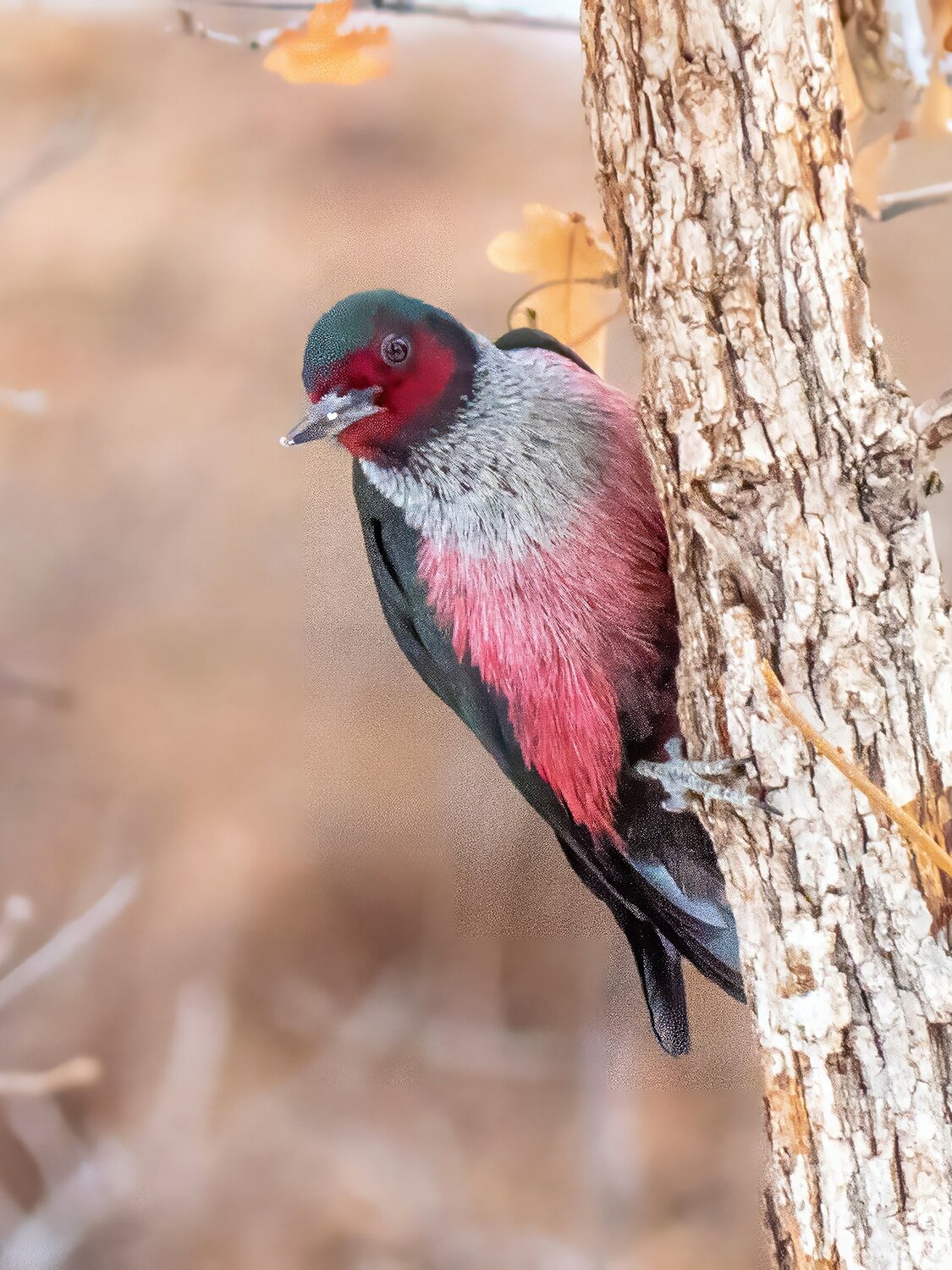
This week’s Bird of the Week, compliments of the Weminuche Audubon Society and Audubon Rockies, is the Lewis’s woodpecker.
This western woodpecker utilizes five main habitat types for breeding, open ponderosa pine forests, oak woodlands, oak-pine forests, riparian cottonwood galleries and naturally burned forests. Loss or degradation of these habitat types is the likely cause of the population decline which has placed the Lewis’s woodpecker in the category of birds in need of continued conservation efforts for recovery.
The patchy distribution of this species extends from southern New Mexico to the middle reaches of British Columbia and from California to eastern Colorado. Pagosa Springs has attracted birders looking to find these birds in summer.
In the past, naturally occurring, slow-burning wildfires had increased habitat for the Lewis’s woodpecker by opening up the forest canopy. This in turn promoted an increased shrub layer and a subsequent increase in insect food. Lewis’s depend on the softer wood of dead or decaying trees and snags, or the abandoned cavities of other species for nesting.
The Lewis’s brilliant coloration is unusual in a woodpecker. Its back is a dark, glossy green and its belly is pinkish. It wears a broad, gray breastband and collar, and its face is colored deep red. Lewis’s employ feeding methods that are also unusual for a woodpecker. In summer, using wide, rounded wings that give them buoyant flight, they feed primarily on flying insects. Like a flycatcher, they watch from high perches and dart out to snag an insect, or they feed while circling high in the air like a swallow. They aren’t designed to excavate wood-boring insects, but will glean them from bark. They are the rufous hummingbirds of suet feeders, guarding this food source and aggressively chasing other birds off.
In fall, Lewis’s woodpeckers switch to harvesting nuts, fruits and grains, which they cache in bark crevices for winter. When the acorn crop is poor, like ours was this year, they must leave in search of food. In 2023, we counted more than 100 Lewis’s woodpeckers on our Pagosa Christmas Bird Count, an unusually high winter count of these birds. They seemed to be everywhere. This year, despite reports of numerous sightings in the summer, it will be interesting to see if we find any in December.
For information on events, visit www.weminucheaudubon.org and www.facebook.com/weminucheaudubon/.
Photo courtesy Jeffrey Reichel


 >
>