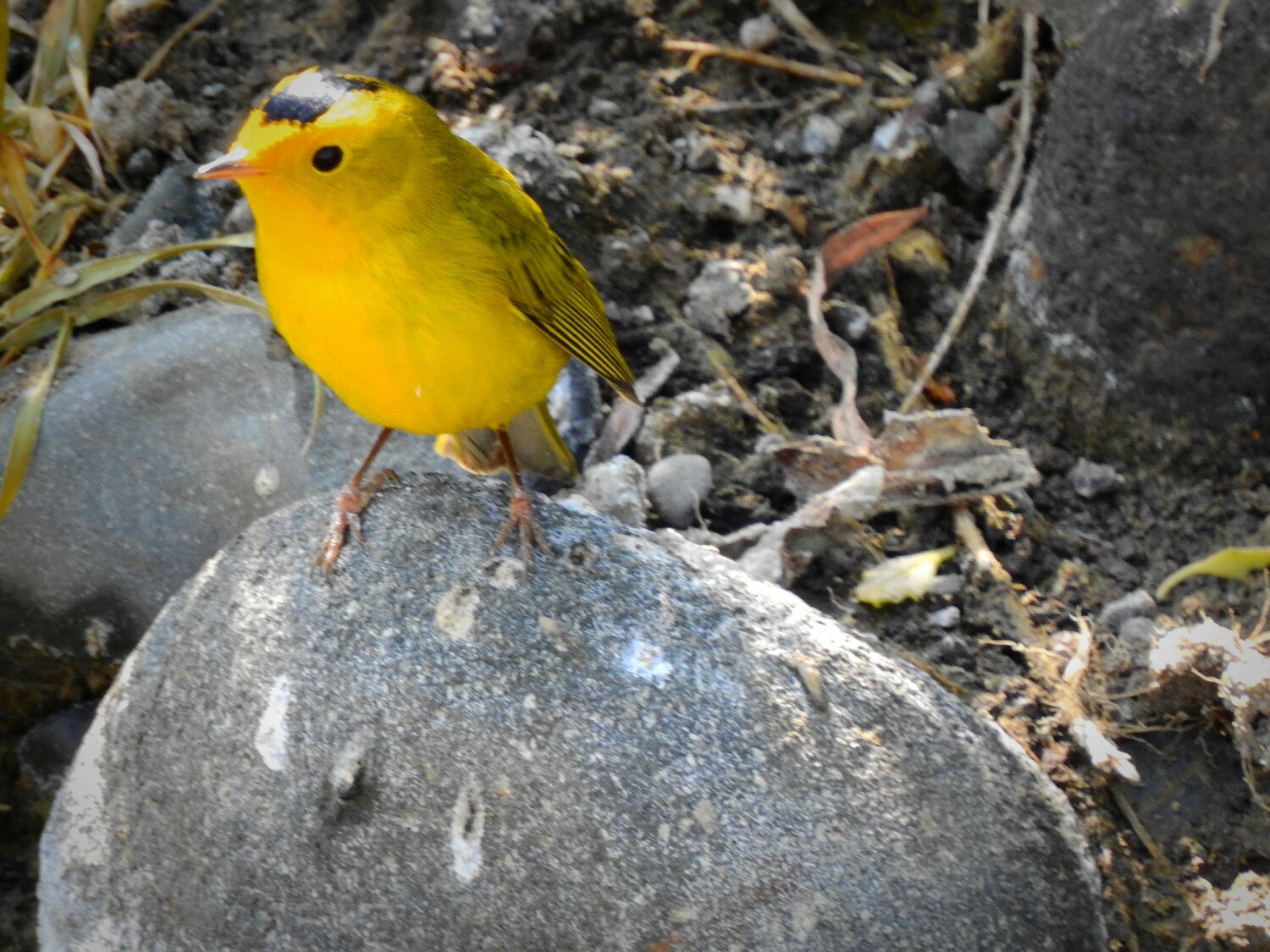
This week’s Bird of the Week, compliments of the Weminuche Audubon Society and Audubon Rockies, is the Wilson’s warbler.
By this time of year, most of our summer wood warblers have departed for warmer winter ranges, but this one sticks around a little longer. Its breeding range extends farther north than others, and includes areas throughout Alaska and across Canada, south through the Rocky Mountains, and down ranges of the west coast. In Colorado, it breeds at higher elevations than other warblers.
Unlike warblers that spend their time high in the canopy, this one forages at lower levels and doesn’t require neck contortions to spot. In the high country, it favors willow habitats that support abundant insect life like the ones bordering mountain streams, ponds and wet meadows. The majority of these warblers nest on the ground in low, dense stands of willows, alders and shrubs.
This is primarily an insectivorous bird that feeds on adult and larval forms of insects and spiders. It is an active forager seemingly always in motion, flicking its wings and waggling its tail as it hops within a shrub. It will also dart out to nab an insect flying by.
On their winter range in the highland oak forests of Mexico, Wilson’s warblers also feed on the sugar rich secretions of scale-insects. These sap-sucking insects pierce plants to feed on the food-transporting phloem layer and excrete excess sugar and water in a sticky mixture known as honeydew.
The Wilson’s is one of North America’s smallest warblers. They are bright yellow below, have olive-colored backs and black, beady eyes. Adult males wear a beret-like black cap of feathers. Some females show a small black cap, but most have an olive-colored crown.
Wilson’s warblers were the test species used in developing a program that compares DNA differences in a single feather between populations to determine the breeding origin of birds encountered along their migratory pathways. This research has evolved into the Bird Genoscape Project, whose goal is to target limited conservation resources to areas where they are needed for North America’s most threatened birds.
For information on events, visit www.weminucheaudubon.org and www.facebook.com/weminucheaudubon/.


 >
>