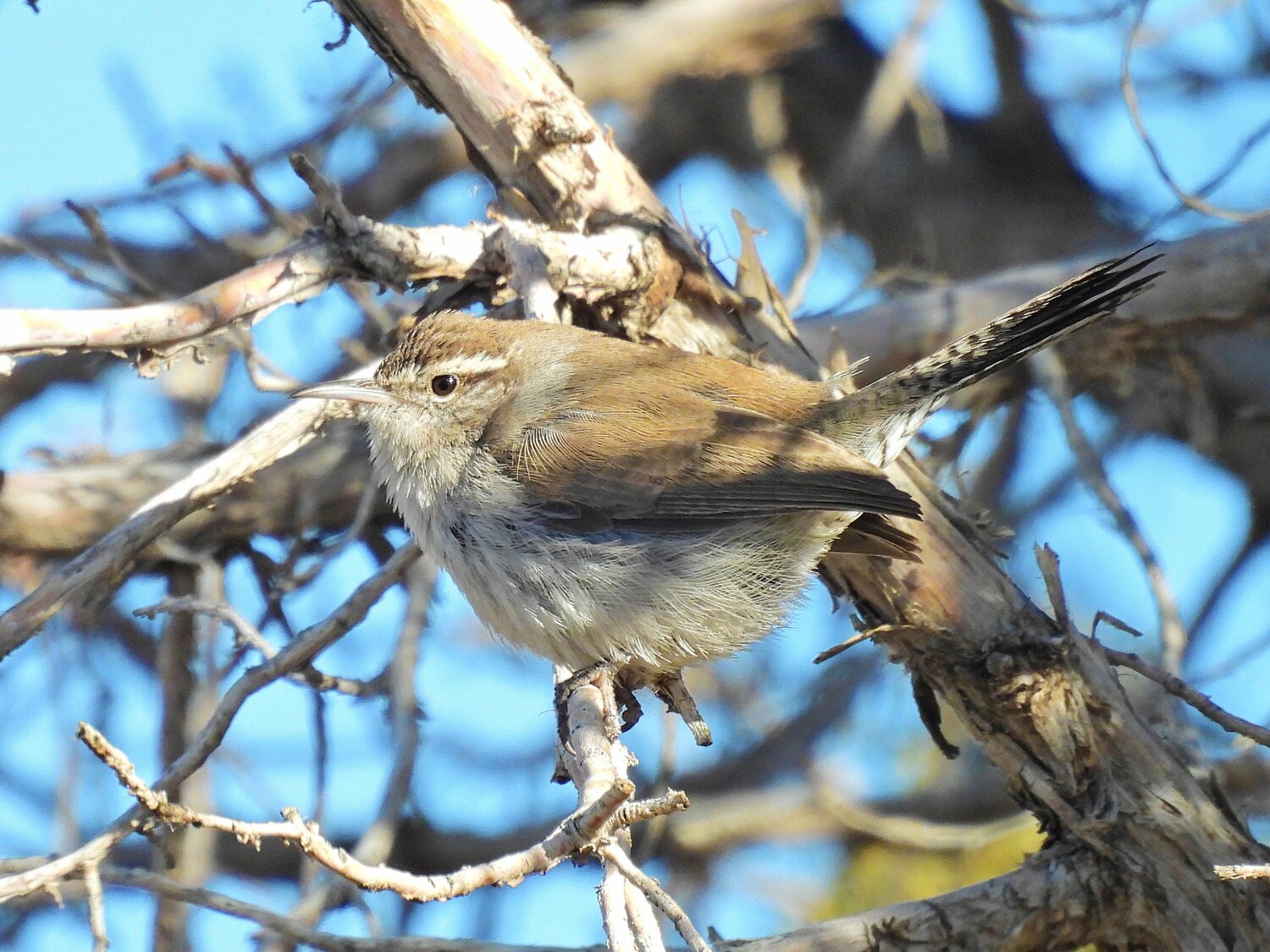
This week’s Bird of the Week, compliments of the Weminuche Audubon Society and Audubon Rockies, is the Bewick’s wren.
This bird’s preference for dry, brushy or scrubby open country habitats is the reason why most often in Archuleta County it is found in the Navajo Lake region. Although it is reported year-round, it doesn’t spend much time in the open and can be difficult to spot unless its voice gives it away.
The song of the Bewick’s wren is described as loud and melodious with similarities to that of the song sparrow. Year-round, song is the territorial defense of the male. A young male develops his unique song between the ages of 1 and 2 months. You might also hear harsh scolding calls from deep within the vegetation if you venture too close.
Spotting a small, hyperactive, noisy bird with a barred and uplifted tail suggests that you are seeing a wren. Most have a long, decurved bill and subtle colors that blend into their habitat. Bewick’s have brownish or grayish upperparts, and whitish throat and undersides. Here they are distinguished from other wrens by a distinct white eyebrow stripe. They often spread their tail feathers and wag them side to side.
Bewick’s wrens eat the eggs, larvae, pupae and adult forms of insects and other small invertebrates. They are acrobatic birds that hang upside down while gleaning prey from the trunks, branches and leaves of vegetation, generally feeding less than 10 feet from the ground. Before swallowing prey whole, they may subdue it by crushing, shaking or bashing it against a branch. Especially in winter, they supplement their invertebrate diet with seeds, fruits and other plant matter.
Bewick’s wrens have become primarily birds of western parts of North America. It is perhaps not a coincidence that their severe decline in regions east of the Mississippi River, where they have all but disappeared, has coincided with the range expansion of the house wren. The more aggressive house wren is known to destroy the eggs and nests of Bewick’s wrens where both compete for cavity nest sites.
For information on events, visit www.weminucheaudubon.org and www.facebook.com/weminucheaudubon/.


 >
>