Join us for the kickoff screening of the five-part film series “Thinking Like Water,” which follows “water wizard” Bill Zeedyk and his collaborators as they transform degraded watersheds into resilient ecosystems by working with nature.
The first in the series, “Willing to Try Things,” is coming up Oct. 8 at Liberty Theatre.
The event will also feature a highly demanded second screening of the film “Reviving Our River-The Pagosa Gateway Project” by Christi Bode.
The doors will open at 6:30 p.m., and the films will begin at 7 p.m.
The five-film series is sponsored and hosted by a collaboration of local organizations: Upper San Juan Watershed Enhancement Partnership, Audubon Rockies, San Juan Mountains Association, Chama Peak Land Alliance and Confluence Collective.
The five-film series explores the use of Zeedyk’s structures, used to restore “broken” creeks in the Southwest.
Monica Nigon, of Confluence Collective, used these Zeedyk structures to address a particularly incised channel in Pagosa Springs as part of a master’s thesis. She had no idea how truly beneficial these structures could be.
That is, until it started to rain.
In the case of this particular incised channel, she chose Zeedyk structures (usually made predominately of rocks) because the drainage is ephemeral, meaning water only flows through it during high rain or snowmelt events. These structures work like other low-tech process-based restoration (LTPBR) interventions: slow the water down, spread it out and allow water to reconnect with its historic floodplain.
She chose this site due to the fact that it drains into Hatcher Reservoir that stores drinking water and that the incising channel was beginning to erode the trail.
Likewise, a quick look into the time lapse feature on Google Earth and referencing historic U.S. Geological Survey maps showed that the drainage was once a thriving wet meadow. Images from just 15 years ago show a vibrant green expanse; a modern photo shows mostly brown with a deep incision down its middle.
She hoped that an increase in water storage in the soils at Turkey Springs would encourage the growth of native wet meadow species, such as the corn lily, quaking aspen and Western blue flag.
The effects of LTPBR on biodiversity are even more broad-ranging than just plants.
For example, surveyors noted an increase in the population of native cutthroat trout in the Comanche Creek Watershed in northern New Mexico after installing Zeedyk structures. The filtration of sediment and water temperature control offered by the Zeedyk structures allowed the fish to thrive.
In Gunnison, habitat for the threatened Gunnison sage grouse improved as a result of Zeedyk structures, increasing lek size.
Researchers in Colorado, Oregon and Nevada utilized satellite imagery to monitor vegetative growth across three LTPBR sites in riparian and wet meadow zones, showing a 25 percent increase in the production of native vegetation, which persisted annually.
The increase in moisture and vegetation provides shade, habitat, and forage for birds, amphibians, insects and mammals. The increase in moisture in the soil creates a natural haven for wildlife during severe disturbances like droughts and wildfires.
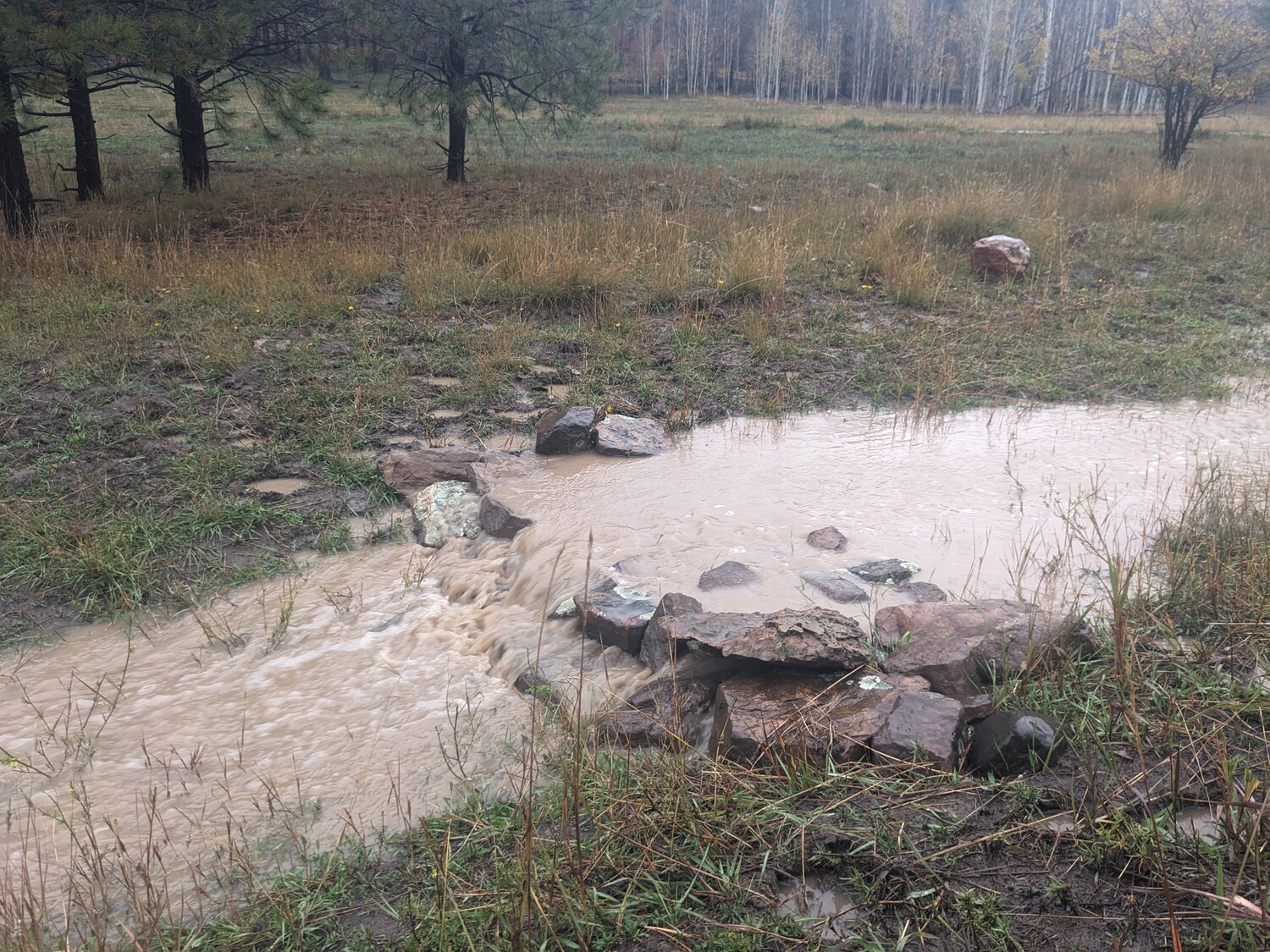
As part of her master’s project, Nigon recruited friends and strangers to help, and they ultimately succeeded in building a Zuni bowl, designed to armor a headcut against further erosion and a one-rock dam (ORD), a grade-control structure below it. The two structures are usually built in tandem.
Two weeks after the installation day, on Oct. 11, 2025, the remnants of Tropical Storm Priscilla hit Pagosa Springs, turning creeks into torrents and sending the San Juan River over its banks. The river surged to 8,270 cubic feet per second (cfs) overnight.
There was a two-day reprieve, and then Tropical Storm Raymond visited the area, dropping several more inches of rain in Southwest Colorado, and the river broke another record at 8,560 cfs, becoming the third highest on record and causing more devastating damage due to the already-saturated soils from Priscilla.
All told, the two storms dropped 12.5 inches of rain in the region over a span of five days, while average precipitation for the entire month of October is normally less than 2 inches.
Nigon anxiously checked on the Zuni bowl and ORD throughout the flooding, and found they were doing exactly what they were supposed to be doing: The water was slowing down, spreading out and filtering out sediment. There could be no better test of a restoration project’s success than a 98-year flood.
The structures had survived and live on to this day. This spring, she noticed the Zuni bowl and ORD have filtered out so much sediment that there is vegetation growing in what has been captured. There’s even a Western blue flag.


 >
>