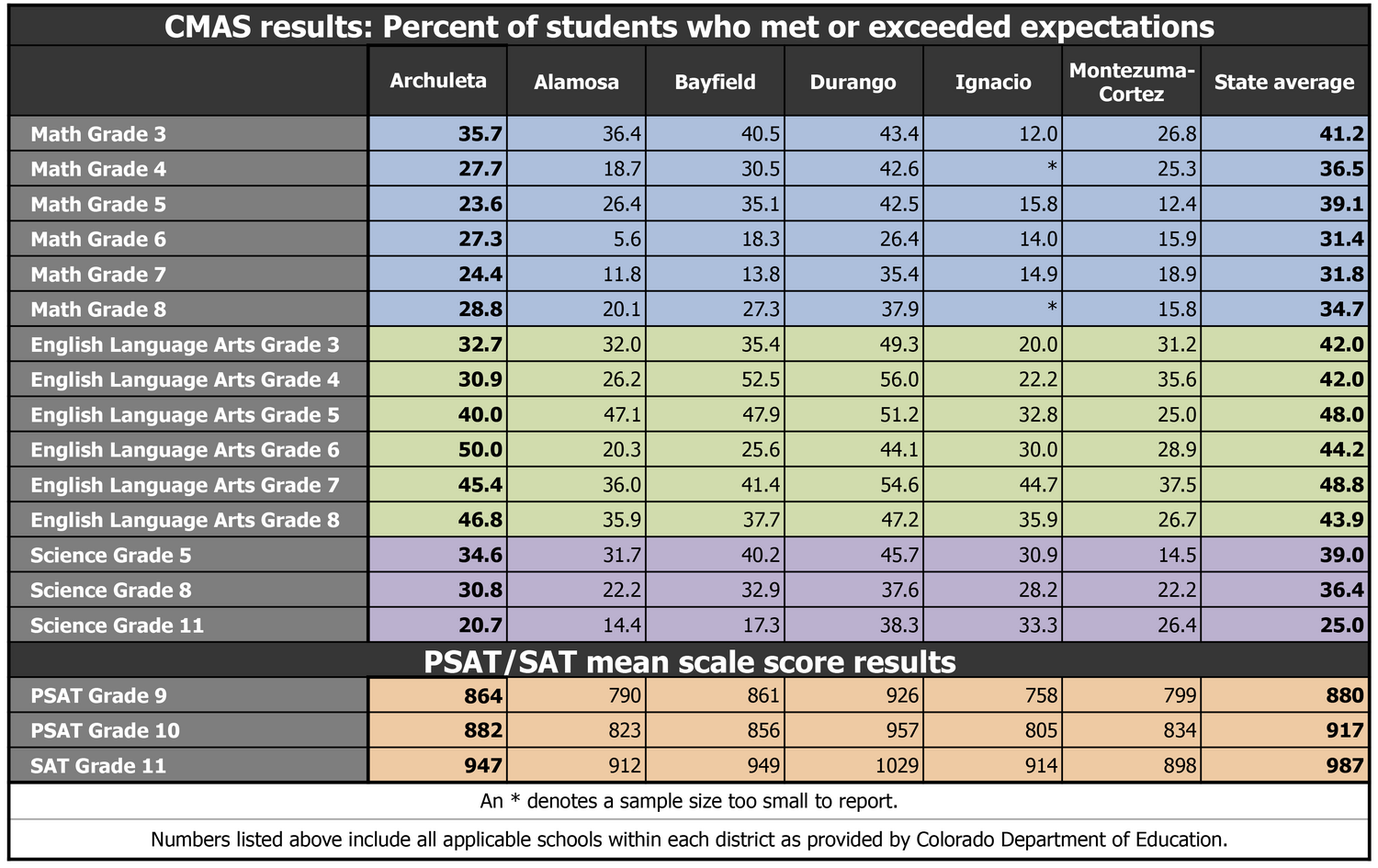
The staff and boards overseeing Archuleta County’s public schools recently discussed the district’s and schools’ spring 2025 standardized assessments.
The Archuleta School District Board of Directors and Superintendent Rick Holt discussed the district’s results on the Colorado Measure of Academic Success (CMAS), PSAT and SAT on Sept. 9, with the Pagosa Peak Open School (PPOS) Board of Directors and School Director Emily Murphy discussing PPOS’s CMAS results on Sept. 17.
ASD
At the Sept. 9 meeting, Holt presented the assessment data as part of a larger strategic initiative update.
He highlighted that the number of students who have met or exceeded standards has continued to grow in English language arts (ELA).
Overall for grades three through eight in ELA, 42 percent of students met or exceeded standards on the CMAS test during the 2024-2025 school year, even with 2023-2024, though the percentage of students in the category for exceeding standards increased from 6 percent to 7 percent.
During the 2022-2023 school year, 32 percent of students met or exceeded expectations, while in 2021-2022, that number was 28 percent.
“That number has continued to grow over time,” Holt said. “We didn’t see the kind of growth that we had seen from [2023] to [2024], but, frankly, that was such a big step that I was really please to see that we were, yeah, consistently making small growth there.”
Holt added the goal is to keep the number of students in the lowest category, not yet meeting expectations, closer to 10 percent, but that that is something the district is working on.
For 2024-2025, 17 percent of students fell into that category, up from 14 percent in 2023-2024. In 2022-2023, that figure was 18 percent, and in 2021-2022, it was 21 percent.
Holt noted the district was in a similar situation with its math performance.
In 2024-2025, 29 percent of students met or exceeded expectations, with 3 percent falling into the exceeded category. The year prior, 28 percent of students fell into the top two categories, with 2 percent exceeding expectations. In 2022-2023, 21 percent met or exceeded, with that figure being 18 percent in 2021-2022, with both years having 1 percent of students in the top performance tier.
“We held onto the growth we made,” Holt said. “I was very encouraged.”
For 2024-2025, 19 percent of students fell into the not yet meeting expectations category, compared to 16 percent in 2023-2024, 24 percent in 2022-2023 and 25 percent in 2021-2022.
Holt then presented on proficiency trends in the district, calling it “pretty remarkable” that ELA and math were both increasing by roughly the same rate each year, with equal growth in both areas.
He noted the growth was a little flatter last year, but that the district is still headed in the right direction.
He added that the state proficiency level has gained at a slower rate than the district’s.
Holt then noted it isn’t just about the district’s performance, but that it wants to be a value-add program that sees students growing.
He noted the district’s 2024-2025 CMAS ELA growth was in the 55th percentile, with math growth falling at the 50th percentile.
He added the goal is to stay between the 55th and 63rd percentiles.
“We need to keep that number up so that we continue to make growth towards state averages and that eventually exceed state averages,” he said.
Holt then transitioned to discussing the PSAT and SAT, which he explained are looked at in terms of a mean scale score, or the average score students are receiving.
Students take the PSAT in ninth and 10th grade, while students take the SAT in 11th grade.
Holt indicated there were slight increases in the PSAT and a slight decrease in the SAT, but nothing to be concerned about.
Holt noted the district’s minority students are performing closer to the state average in reading and writing than its nonminority students.
Holt acknowledged there’s more to growth and performance than the academic side and later explained that the schools can see the diagnostic results and make adjustments to what they are teaching.
PPOS
At the Sept. 17 PPOS board meeting, Murphy began by explaining there were a one-year, two-year, multiyear and 2025 CMAS report to review.
She noted the focus of the school is the current year CMAS results.
“What I’d like to focus on for this year is increasing the number of students who are meeting expectations” instead of focusing on certain percentile marks, she said.
Murphy explained that one of the main focuses of the school’s major improvement strategy is its math interventionist programs.
She noted that the first challenge to focus on is achievement in ELA, and then the math growth goal.
Murphy noted that when looking at percentages of students who met or exceeded expectations, it grew from 24.5 percent in 2023-2024 to 32.1 percent in 2024-2025.
In regard to growth in math, Murphy commented that “what is actually interesting about this” is that 75 percent of students who met or exceeded expectations were returning students at PPOS, while only 25 percent of students who have not met or exceeded expectations were returning students.
Murphy commented that there “has to be more to this,” but mentioned that it indicated to her that if the school can hold onto its students, achieving the math growth goal is realistic.


 >
>