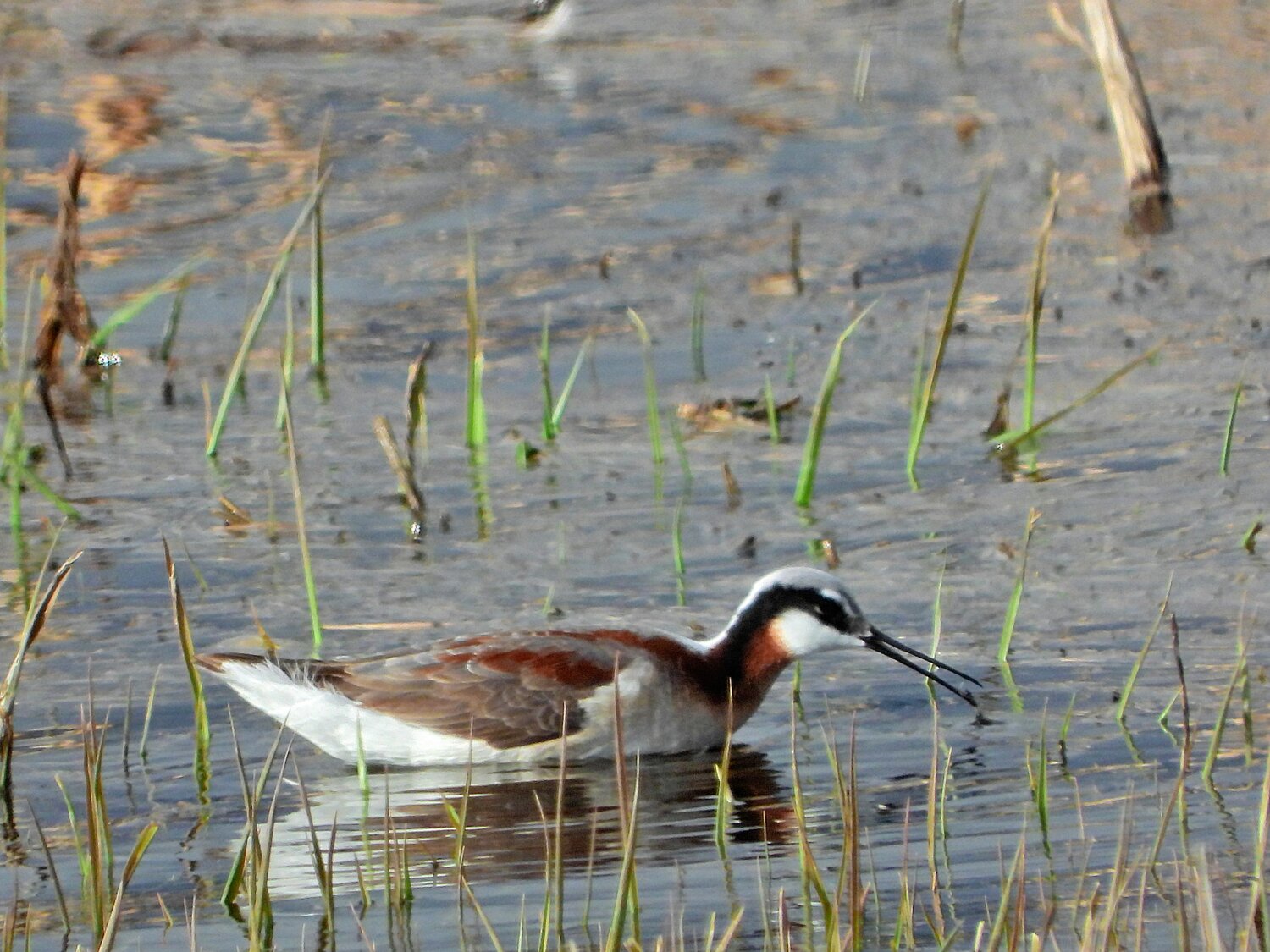
This week’s Bird of the Week, compliments of the Weminuche Audubon Society and Audubon Rockies, is the Wilson’s phalarope.
This is another remarkable migratory bird that stops in our area at this time of year. The small Wilson’s phalaropes complete one of the longest migrations in the world, traveling 4,000 miles in spring and in fall between winter grounds in South America and the places they seek for nesting, wetland areas in north-central United States and south-central Canada.
The typical gender roles are reversed in Wilson’s phalaropes. Females are the larger, more colorful sex and it is they that seek to impress potential mates with courtship displays. In breeding plumage, both sexes have long, dark legs; a slender neck with peachy colors; blue-gray backs; a dark line through the eyes; and a long, thin bill.
Female colors are brighter than males’ and they have a dark stripe down the neck.
In a practice termed polyandry, after laying her eggs, a female may leave almost immediately and look for other males to mate with. Male phalaropes assume the primary role of caretakers for young. They incubate the eggs and stay with their chicks until they can fly. By then, the females have left for the saline lakes of the West.
Small aquatic invertebrates make up most of the phalaropes’ diet. Spinning in tight circles on the water creates a whirlpool that brings this food to the surface. They also feed by chasing and pecking insects floating on the water, or by walking along the shoreline and probing in the mud with their long bills.
In late summer, Wilson’s phalaropes gather in the hundreds of thousands at saline lake staging areas to gorge on brine shrimp and flies, and molt their feathers. They sometimes eat so much that they double their body weight, temporarily getting too fat to fly.
Up to 60 percent of the world population of Wilson’s phalaropes congregate at Great Salt Lake, where water levels dropped to record low levels in 2022. Drought, climate change, water diversions and pollution from agriculture threaten the saline lake habitats these birds need both in the United States and on winter grounds. In an effort to save these critical habitats, a petition to seek protection for Wilson’s phalaropes under the Endangered Species Act was filed in March of this year.
For information on events, visit www.weminucheaudubon.org and www.facebook.com/weminucheaudubon/.


 >
>