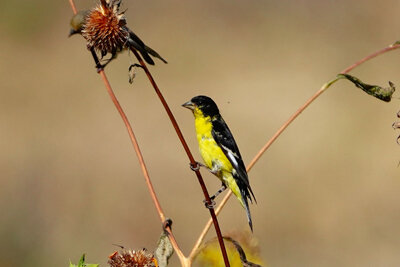
Photo courtesy Charles Martinez
This week’s Bird of the Week, compliments of the Weminuche Audubon Society and Audubon Rockies, is the lesser goldfinch.
When the colorful warblers, tanagers and orioles have left us for the winter, goldfinches provide the splash of yellow that brightens our trees, shrubs and feeders. This goldfinch is “lesser” only in comparison to the American goldfinch, which is heavier, brighter yellow, more abundant with a wider range and better studied.
In the United States, the lesser goldfinch is common only in California, Arizona, and parts of New Mexico, Colorado and Texas, but it does appear in areas in between and as far south as South America. They are found in patchy, open habitats as long as water is available. At this time of year they are often spotted along the road feeding on rabbitbrush, thistle and flowers in the sunflower family.
Even when insects are abundant these birds primarily consume the seeds, buds, flowers or fruits of plants. They feed in small groups with individuals clinging to the seed heads of tall plants, often bending the stem down and hanging upside down to eat. At feeders, nyjer thistle is the preferred seed.
This dry diet dominated by seeds means that a water source is crucial in their habitat and they drink frequently. Unlike most passerines that rely on insect protein to nourish young during breeding season, lesser goldfinches feed a regurgitated mix of seeds into the beaks of their nestlings.
The male lesser goldfinch does not undergo seasonal changes in coloration. He is yellow below and wears a glossy black cap. However, the amount of black color in his back varies within his range from mostly black to mostly green. Colorado birds often display mixed green and black upperpart coloration. Females and immature males are olive above and yellow below.
Reports suggest that milder winters and an increased availability of bird feeders may be allowing the lesser goldfinch to overwinter farther north than in the past.
For information on events, visit www.weminucheaudubon.org and www.facebook.com/weminucheaudubon/.


 >
>