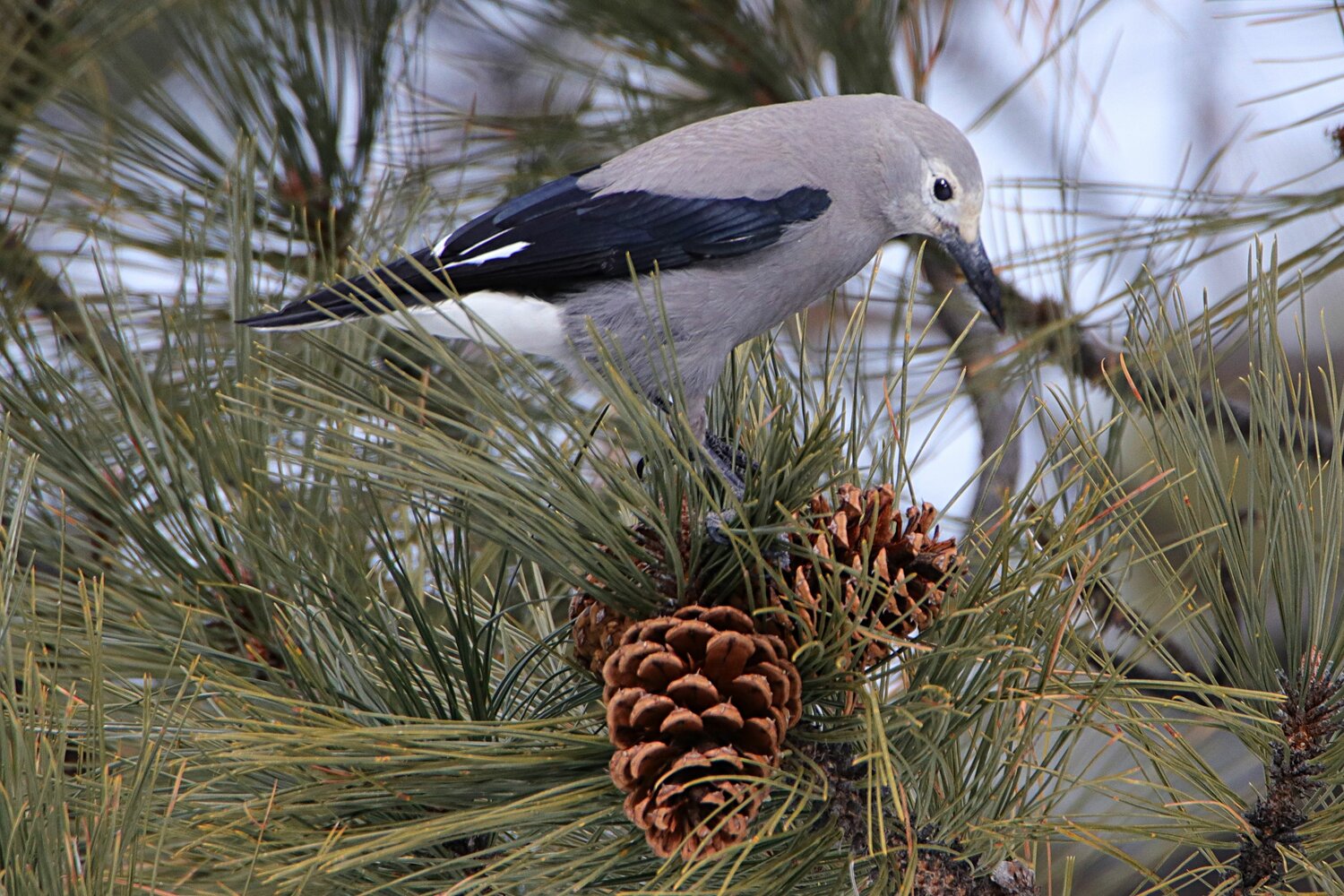
This week’s Bird of the Week, compliments of the Weminuche Audubon Society and Audubon Rockies, is the Clark’s nutcracker.
Harsh calls, made to keep flock members in contact, signal the presence of this fascinating western bird. In elevations ranging to 12,000 feet, it is a bird of open subalpine zones near treeline that also occurs in middle-elevation conifer forests. Its travels in response to cone crops are nomadic rather than migratory.
The Clark’s nutcracker is a dark gray, jay-sized bird, with white-edged black wings and white outer tail feathers. It flies like a woodpecker, alternating flapping with holding wings to the sides.
This “winged forester” is responsible for dispersing the seeds too heavy for the wind to carry of many tree species. Pine trees including whitebark, limber, pinyon, and southwestern white all benefit from seed harvesting by the nutcracker. Between September and December, Clark’s nutcrackers are busy caching seeds for their winter food supply. Yearly each bird hides thousands and thousands of seeds, and while it retrieves a remarkably high percentage for food, those that it misses may provide seedlings for forest growth.
Using its dagger-like bill, the nutcracker extracts seeds from cones and stashes up to 150 at a time in a special pouch under its tongue. It may hide seeds up to 15 miles away, burying them in the soil or, at higher elevations, storing them in needle clusters or under bark in trees. Using visual landscape clues, the bird remembers the locations of its hidden food stores for up to nine months, even locating them under the snow.
A special mutualistic relationship exists between the Clark’s nutcracker and the long-lived whitebark pine, a threatened keystone tree species that provides food for wildlife and stabilizes ground and snowpack in subalpine zones. The trees provide the birds with highly nutritious seeds loaded with fat, protein and calories, and in turn are primarily dependent on nutcrackers to harvest and bury their seeds for forest growth.
Whitebark pines suffer from attacks of blister rust and pine beetles, and from high-intensity wildfires, all of which have been made more severe in a warming climate. Efforts to harvest seeds and plant seedlings from trees with natural resistance to the rust fungus are providing hope for the continued existence of these high-elevation forests.
For information on events, visit www.weminucheaudubon.org and www.facebook.com/weminucheaudubon/.
Photo courtesy Charles Martinez


 >
>