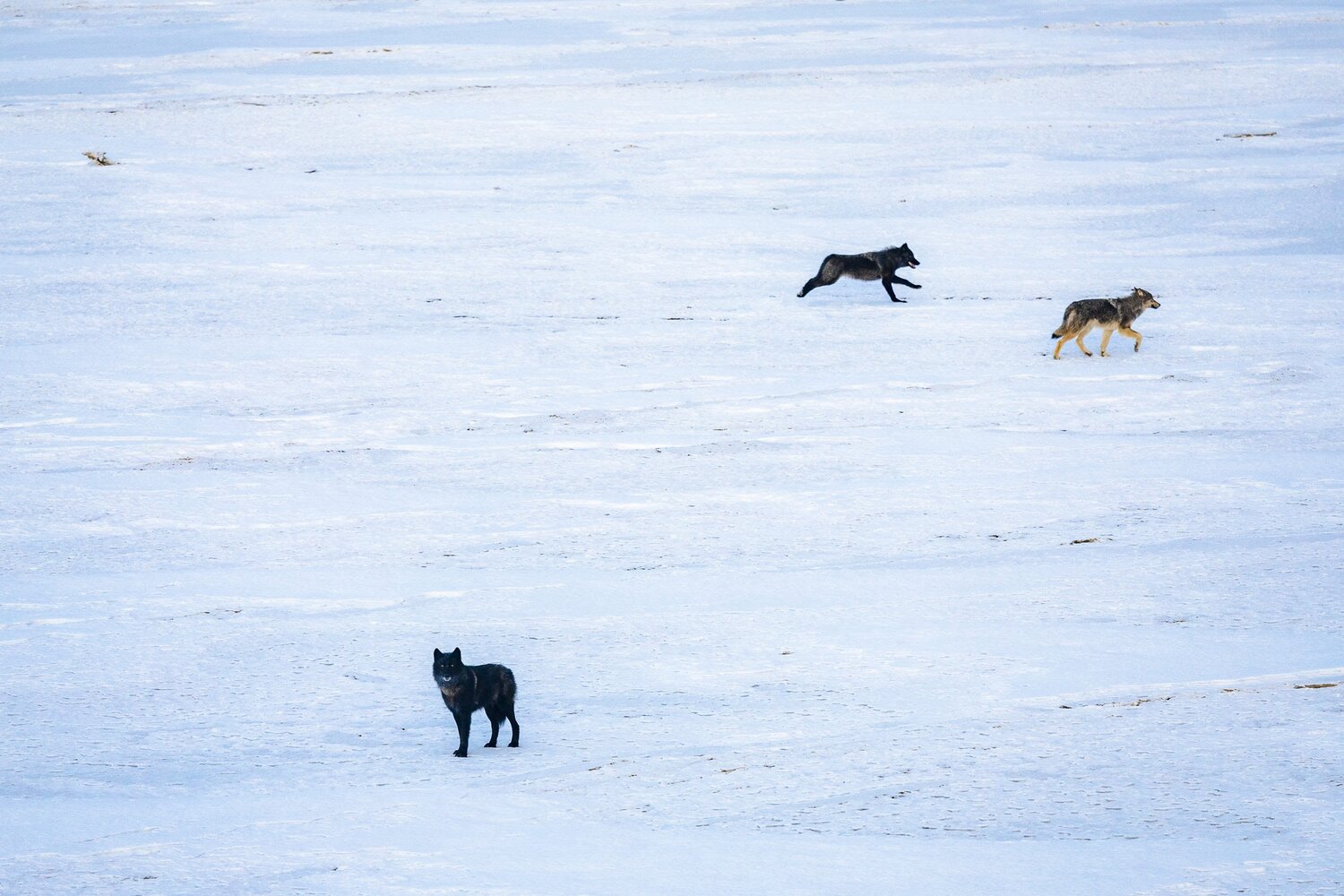
A male gray wolf felt a pinching sensation in his upper left hind leg and shortly after the world went dark. Number 2305 lay near his mate, a female gray who had likewise been darted, the two breeding adults of the King Mountain Pack in Routt County put to sleep in a routine collaring operation by Colorado Parks and Wildlife (CPW) on Jan. 28.
The process was reported as “short” and “benign” by members of the capture crew, but, unlike his mate, when the tagging squad got close enough to check vitals on the two Rocky Mountain wolves, 2305’s temperature had spiked.
The responding CPW members attempted to cool down the wolf, but following CPR and emergency drugs from the agency’s wildlife veterinarian, who arrived on scene 20 minutes later, no pulse was reported and 2305 was pronounced dead.
While a necropsy was performed, there wasn’t a clear reason why the male wolf experienced such a high level of distress in what was a standard part of the state’s wolf management efforts.
“We have a top-notch professional team, and this situation has been tough on everyone involved,” Laura Clellan, then CPW’s acting director, said following the incident. “I have the utmost confidence in our staff, and we will continue to work hard to achieve our mandate of restoring a sustainable population of gray wolves in Colorado.”
The death of No. 2305 brought the mortality tally of Colorado’s translocated gray wolves up to 13 since the voter-approved reintroduction of the canids to the Rocky Mountain state got off the ground in 2023.
Additionally, a pup from a breeding pair of translocated wolves was lethally removed by CPW, and an uncollared female was caught in a lawfully set foothold trap.
The latest death means half of the state’s translocated wolves have passed away. Two years into the reintroduction effort, Colorado’s wolf population stands at roughly 20 adult or yearling gray wolves, with a handful of pups born to four breeding packs this year.
The plan recommends the state wildlife agency release 30 to 50 wolves over the course of three to five years, with a total of 25 animals relocated to Colorado since December 2023.
The translocation goal is critical for the species’ long-term survival, as Luke Perkins, CPW statewide public information officer, noted there has to be enough individuals on the landscape for wolves to locate one another, pair and breed in order for a self-sustaining population with enough genetic diversity.
“This translocation goal provides a buffer in case there are animals that do not contribute to the population because of movement out of the area, mortality or other reasons that cause some individuals to not contribute to a growing population,” Perkins said.
Interpreting survival
As wolf reintroduction plans in other areas of the country reported high survival rates of translocated wolves (Idaho at 85 percent and Yellowstone at 70 percent), Colorado’s anticipated survival rates for the first years of reintroduction followed suit.
However, Perkins noted that an above 70 percent anticipated survival rate for early stages of introduction is not a target, but rather an evaluation of other existing programs. The only survival rate benchmark in the Colorado Wolf Management Plan, a survival rate of less than 70 percent, triggering a protocol review, is only applicable to the first six months post-release.
Perkins explained this guideline was established to address circumstances similar to reintroduction efforts of the Canada lynx, which saw high mortality in the first six months of the program as many of the animals struggled to hunt in Colorado’s rocky terrain, leading to an adapted release program.
“This survival rate is not meant to be used as a goal for annual wolf survival,” Perkins said. “Because Colorado’s wolves have been on the landscape for more than a year, using this statistic as a benchmark for the program is misleading.”
Using the 70 percent survival rate of translocated wolves as a benchmark for the program’s success is also ultimately unachievable, as Perkins notes, because all translocated wolves will eventually drop to zero.
“Additionally, most survival rates are reported on an annual basis, and it has been over two years since the first translocation in December 2023,” he said.
A high rate of wolf mortality does not necessarily indicate reintroduction has been marred by failure. Rather, it highlights just how difficult it is to reintroduce a predator, particularly on a landscape dramatically altered by human activity from when wolves roamed through the alpine slopes of Colorado.
Several reported fatalities within the state have resulted from interactions with humans, such as a male hit by a car in northwestern Colorado, and yet another female passed away after getting tangled up in a coyote trap.
Reintroduced wolves have also been caught up in policies surrounding crossing state lines and livestock depredation.
CPW shot and killed an offspring of an introduced wolf in Rio Blanco County that was responsible for six depredations, while another wolf that traveled into Wyoming was lethally removed by the U.S. Department of Agriculture after it was linked to several livestock attacks.
Across western North America, average wolf life expectancy is low. Outside of protected areas like national parks, wolves in the Rocky Mountains often only live to 3 years old, even though some can live until 10, due to the challenges inherent in living in the wild. Wolves that don’t live in packs have an even higher risk of death.
“Since many of the mortalities in Colorado were amongst translocated wolves who were essentially ‘dispersers,’ we can see that the amount of mortality we observed in Colorado in 2024 and 2025 is not surprising,” Perkins said. “As the wolf population shifts from primarily dispersers to territorial wolves in packs, we may see a shift in patterns of mortality. I would also say that with the current wolf population being fairly small, each mortality event has a large effect on overall survival. CPW recommends caution while interpreting any survival and mortality metrics in the light of this small population.”
Signs of success
CPW reported several wolf pups joined the state’s population last summer, squirming and tumbling around under the watchful eyes of the state’s established packs. Both the new pups and the reported formation of packs have been encouraging indicators of a growing population.
While the number of offspring successfully recruited into the adult wolf population has yet to be seen, Perkins said “pairing and reproducing is a crucial part of program success.”
“This reproduction is really key,” Eric Odell, wolf conservation program manager for CPW, said in a public meeting in July. “Despite some things that you may hear, not all aspects of wolf management have been a failure. We’re working towards success.”
Reproduction will also be essential for the program, as a third wave of gray wolf releases scheduled for this winter in the southwest corner of the state was put on pause. The impending winter release faced delays as recently updated federal guidelines stated wolves could only be sourced from northern Rockies states where they are not listed as endangered, complicating a prior agreement to source the canids from British Columbia, which since fell through.
CPW announced the decision on Jan. 21, noting they would continue to explore options for translocations next winter.
“During this intermediate time, CPW will continue to meet with producers and other stakeholders, including the U.S. Fish and Wildlife Service, to explore how to maximize the restoration effort and achieve our plan of establishing a self-sustaining gray wolf population in Colorado,” Clellan said in a statement announcing the pause.
As for how the pause in reintroduction will impact population numbers, Odell explained it’s impossible to predict without knowing what will happen within the next year.
“When populations are small, the contributions of each individual are especially significant,” he said. “If mortality remains high, as observed in 2025, the risk of failing to achieve a self-sustaining wolf population in Colorado increases, potentially requiring additional resources to address.”
In addition to pursuing additional translocations, CPW will continue to implement conflict-minimization strategies across the state and increase public awareness of ongoing efforts.
“We continue to explore options for translocations in winter 2026-2027 and have every intention of fulfilling the translocation goals laid out in our plan,” Perkins said. “Once we’ve achieved that goal, we will be able to evaluate if additional resources, which could include additional translocations, are needed to ensure that we have a solid population to manage going forward.”


 >
>