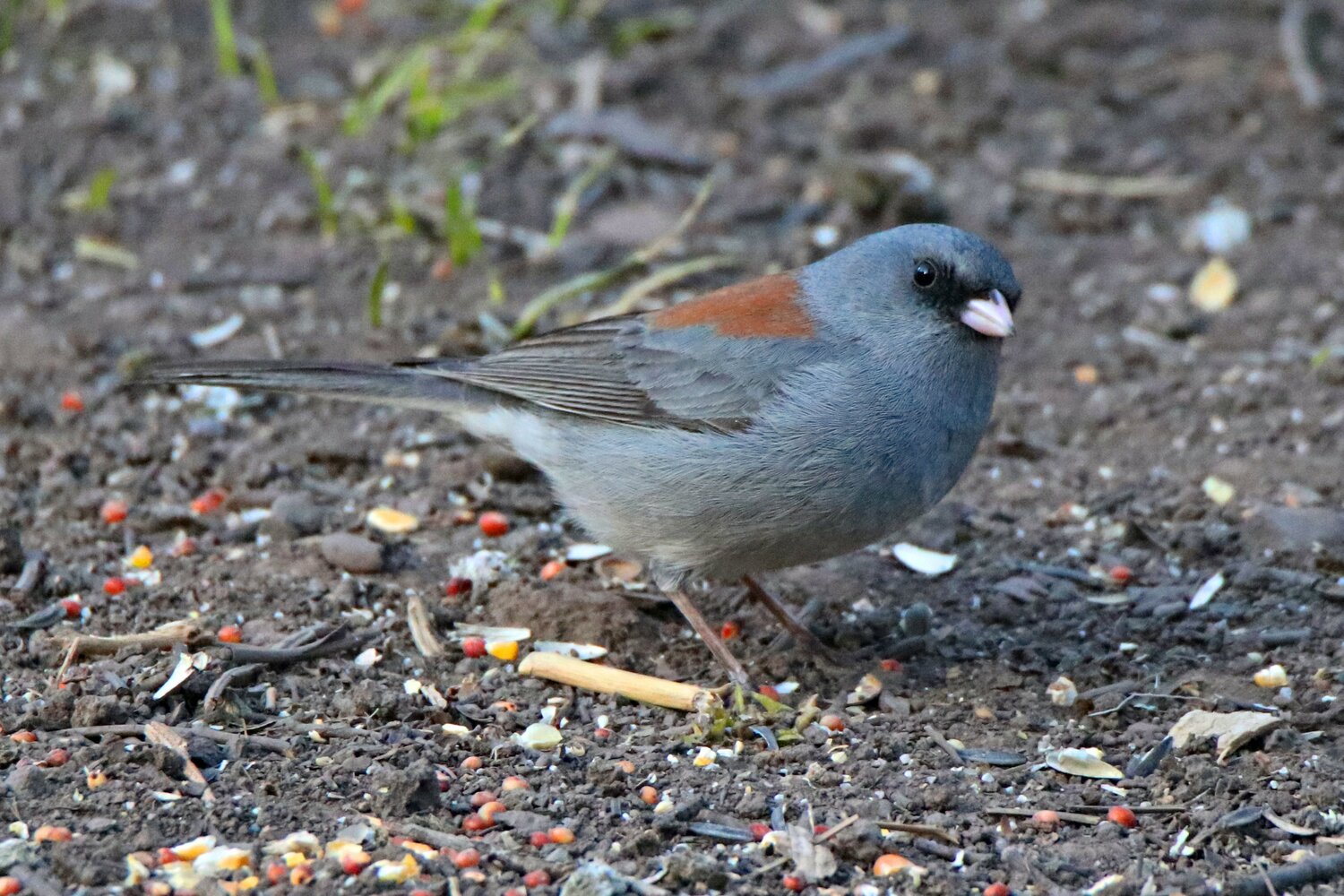
This week’s Bird of the Week, compliments of the Weminuche Audubon Society and Audubon Rockies, is the dark-eyed junco.
When the forecast calls for winter weather, look for these hardy forest birds to show up in your neighborhood. When the ground turns white, these “snowbirds” show up, pecking for seeds on the snow under feeders or shrubs, or competing for seed at platform feeders, where they prefer millet over sunflower seeds.
These colorful little sparrows are among the most abundant forest birds of North America, spending summers in western mountains and in the boreal forests of Alaska and Canada, and wintering across the lower United States. We are within their year-round range.
Mountain populations are altitudinal migrants, moving to lower elevations when the snow gets too deep to find food on the ground in higher forests. Three-fourths of their diet consists of seeds. They typically forage by hopping on the ground, pecking and scratching in the leaf litter and may feed in fairly large flocks in winter.
Dark-eyed juncos come in a range of colors, but there are some physical characteristics which all share. These include their small size; dark eyes; rounded head; short, stout pinkish bill; fairly long tail; and prominent white outer tail feathers that flash in flight. Four forms can be found here in winter: the slate-colored, Oregon, pink-sided and gray-headed. Forms have different summer ranges but come together in winter.
Depending on the situation, juncos use different calls to communicate. When they fly or forage in a group, juncos produce a high, short chip note to stay in touch. They will fly to the nearest cover when alarmed. During confrontations between birds, a high, fast call, described as sounding like they are aiming lasers at each other, is used to establish who’s the boss.
In summer, males claim their territory by perching in sight and singing a musical trill that is hard to distinguish from the songs of chipping sparrows and orange-crowned warblers. Females typically build their nests hidden on the forest floor near edges and clearings.
You can spend some time with juncos this winter and challenge yourself to pick out the different forms that you see.
For information on events, visit www.weminucheaudubon.org and www.facebook.com/weminucheaudubon/.
Photo courtesy Charles Martinez


 >
>