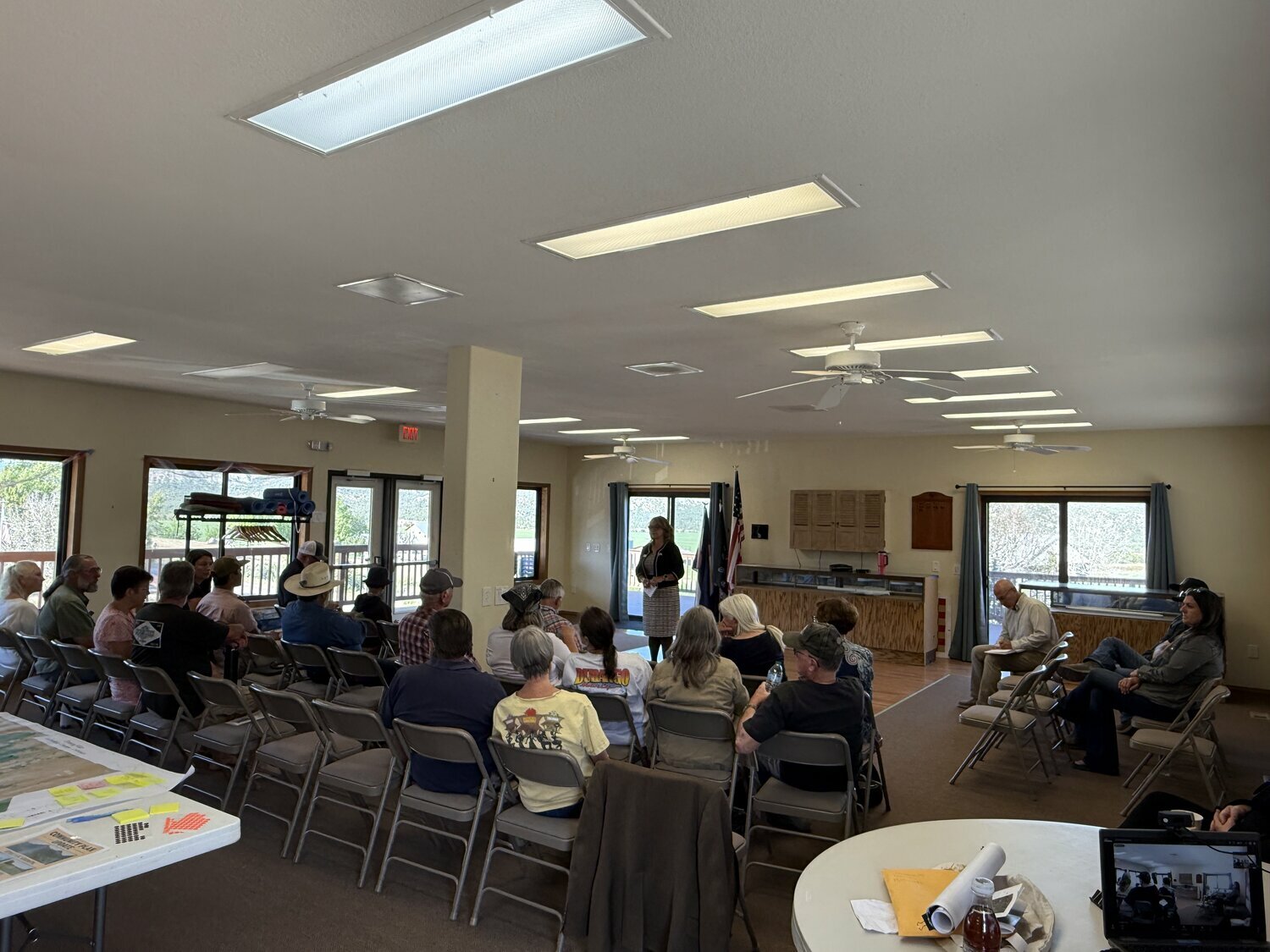
A group of constituents gathered in Arboles last Wednesday, May 27, for a community forum hosted by Archuleta County Commissioner Veronica Medina.
Residents brought up concerns in regard to oil drilling and natural gas operations occurring across the state line in San Juan County, N.M., involving Gore Energy, Phelps Energy and Hilcorp Energy.
One resident asked what Archuleta County can do in terms of enforcement collaboration with San Juan County, N.M., mentioning environmental concerns over the project and the amount of dust coming from the project sites.
Medina explained that Colorado does not have any jurisdiction as the business is based in New Mexico, although Archuleta County’s roads are being used by the company’s drivers to haul large amounts of material and equipment through the area.
In response to another question from the crowd, Medina explained that the county’s roads are public roads.
She noted that her understanding is that the energy companies are using “back roads” instead of Colo. 151, adding that this is a “bigger question and an ongoing conversation.”
County Manager Longinos Gonzales encouraged residents to send in any information about the situation, with Medina mentioning she has been attempting to contact these energy companies to see what can be done about the amount of traffic on county roads.
Residents indicated that the energy company’s trucks are using County Road 977, “and they speed at night.”
One resident claimed they have to wear ear plugs at night to sleep due to the amount of traffic noise on the road.
Gonzalez indicated that he would continue looking into the situation.
Medina explained that the situation was brought to her attention recently by a resident and that conversations with law enforcement and the county’s Public Works Department are taking place.
“We don’t have all the answers yet,” she said, adding that the county is trying to get “real answers” and that it will take more than a day or two to do so.
Another resident mentioned that the trucks leaving the fracking sites are overloaded, suggesting the county could charge for an overweight permit to get some sort of financial benefit from the project.
Medina indicated that with the business being based in New Mexico, Archuleta County does not receive any tax revenue from it.
Public Works Director Mike Torres provided some information on the matter, stating that it has been an ongoing issue for multiple years now, and “it seems like more now this year than it has been in the past.”
Torres explained that he is reaching out to La Plata County to make sure Archuleta County has matching policies in regard to regulations on dirt roads.
Torres mentioned that an overweight permit fee won’t solve the issue of the energy companies using county roads, but at least the county would be getting something in return.
“We are looking into it,” Torres said.
La Plata Electric
Association
Representatives from La Plata Electric Association (LPEA) were also in attendance and provided information on public safety power shutoffs (PSPS) and what LPEA is doing in terms of fire mitigation work.
LPEA Vice President of Operations Jerry Sutherlin explained that fire mitigation and wildfire have been a No. 1 concern over the past six years he’s been in his position, noting that LPEA’s goal is to always keep the lights on and improve reliability.
One way of improving reliability is through raptor protection devices that protect wildlife and prevent fires caused by electrocution, Sutherlin explained.
He also mentioned that LPEA aims to inspect all of its lines every 10 years, including more than 40,000 poles throughout its service area.
The “last tool in the tool box” Sutherlin spoke about was PSPS, explaining that LPEA has had enhanced power safety settings (EPSS) over the last four years, which have been enacted on red flag warning days.
He explained that with EPSS, reclosure equipment is switched to a “one shot,” meaning that if something comes in contact with a power line (wildlife or trees), the line tries to reenergize a single time and if the problem is still there the system will lock out and power will be shut off to that specific area.
Sutherlin noted that over the past four years, power has been shut off using EPSS in the Arboles area just one time.
“So, it’s improving the safety of our system and not really affecting the reliability of our electrical system,” he said.
Sutherlin then explained that LPEA has hired a third-party company called Firescape, which has developed a program that looks at an extensive list of factors and real-time weather data to predict when there is a high wildfire risk and when a PSPS might be necessary.
Sutherlin stressed that a PSPS will only occur in the “most extreme conditions.”
LPEA Key Accounts Specialist Emily Missildine provided information on how LPEA intends to communicate to its members when a PSPS may occur, describing a PSPS as a “proactive shutoff.”
Missildine noted that LPEA’s goal is to have all partners and members notified ahead of a PSPS ahead of time to help people prepare by charging devices, arranging medications and checking on neighbors.
She explained that LPEA is able to send out a notification up to 48 hours in advance, encouraging residents to sign up for its text notification program.
Missildine also emphasized that a red flag warning “does not equal power shut off,” as it is just one of a series of factors used in making that determination.
In response to a question from the audience, Sutherlin noted that the Firescape service for one year cost LPEA roughly $90,000.
He also explained that Firescape uses additional equipment on the ground as LPEA has 23 weather stations scattered throughout its membership area, though data from all of those stations is not publicly available.
Sutherlin mentioned that with the additional equipment being used, LPEA is able to be “very granular” when considering a PSPS or using EPSS.
Federal Emergency
Management Agency
The meeting concluded with Medina taking a few final questions that were centered around the county being denied disaster relief funding from the Federal Emergency Management Agency (FEMA) for damage that occurred in Archuleta County due to the historic flooding events in October 2025.
One resident inquired as to why the Board of County Commissioners recently decided to sign a neutral letter on its stance in regard to the newly proposed Disaster Declaration Transparency Act.
Without speaking for the other county commissioners, Medina explained that she felt the letter supporting the bill offered “no real substance” and indicated that there has been a recent turn of events politically.
“We may have a different opportunity and I think because we did a neutral letter we may have a better opportunity to get some FEMA funding,” she said.
The next community forum is scheduled for June 18 in Aspen Springs at Ute Park, located at 981 Ute Drive, at 5:30 p.m.
clayton@pagosasun.com


 >
>