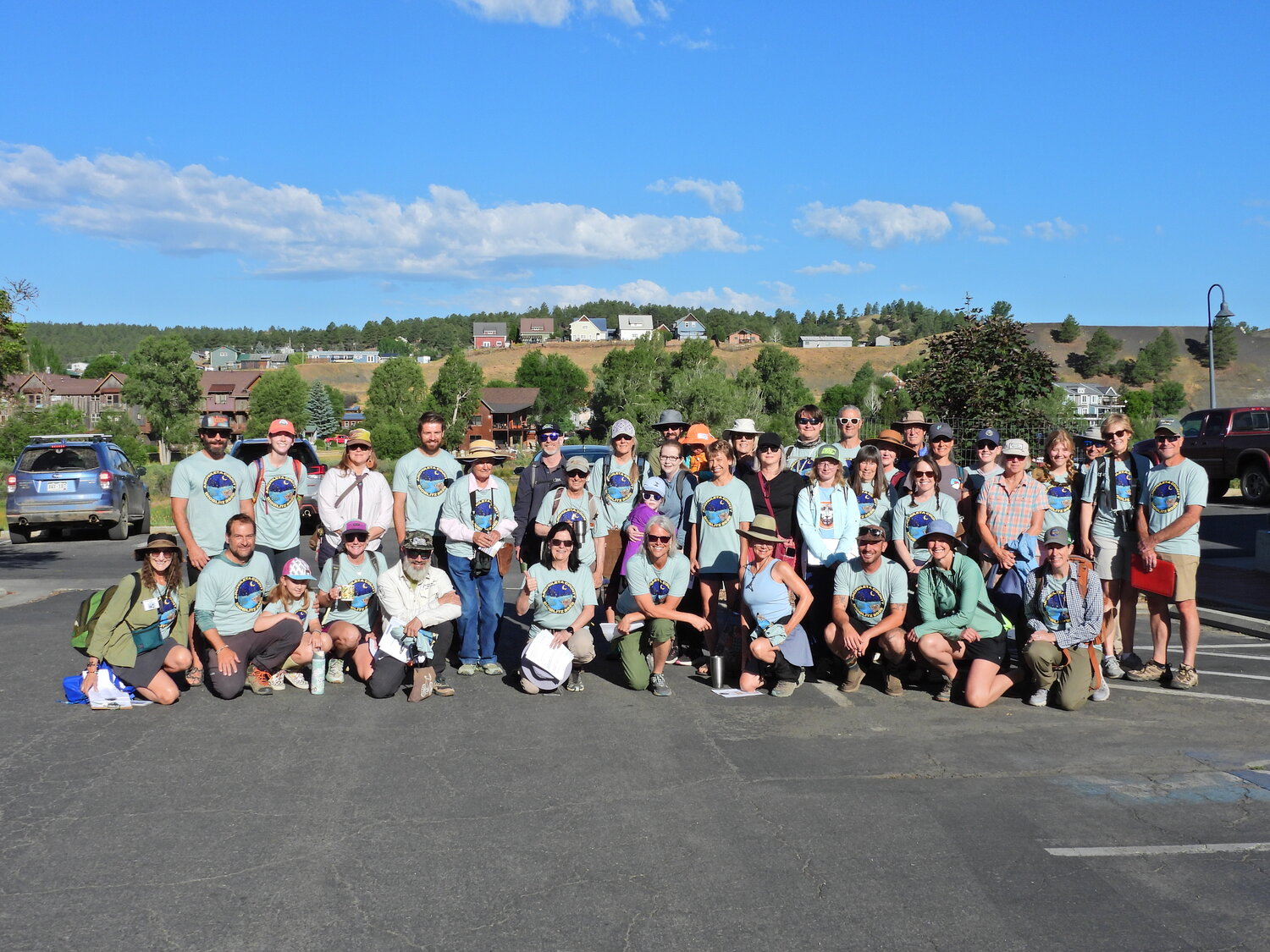
This year, Colorado State University Extension, Archuleta County Weed and Pest, the Town of Pagosa Springs Recreation Department, Weminuche Audubon Society (WAS), and Audubon Rockies teamed up to plan, organize and implement an exciting event.
As you may have noticed in the “thank you” ad in the July 30 issue of The SUN, it took a lot of folks to pull off our inaugural Archuleta County BioBlitz at the downtown wetlands and on Reservoir Hill in late June.
Everyone from volunteers who worked long, hot hours directing, shuttling and feeding event participants and the statewide professionals who joined us from Colorado Natural Heritage Program (CNHP), Colorado Parks and Wildlife (CPW), and other agencies, collectively made our first effort a memorable one.
The event’s 292 recorded plant, fungi, insect, mammal, bird, amphibian, reptile and other species can be found on iNaturalist, a year-round community science platform that allows for observations to be made by the citizenry and then validated (or corrected) by industry oversight.
BioBlitzes effectively serve to identify the biota (living organisms) in a given area. This inventory creates a baseline to determine what species live in that area in a sampled season.
Moving forward, it allows natural resource professionals to monitor changes and species presence or absence over time and hopefully discern the drivers behind those changes.
Together, 75 participants made 855 observations, identifying close to 300 species.
Groups simultaneously combed the alkaline grasses and rushes of the wetlands, montane forests of the north and south slopes of Reservoir Hill, identifying and counting birds and mammals, and whatever flying insects would stay still long enough to photograph.
Inventories included macroinvertebrate samples with aquatic ecologist Patti Spindler from both the San Juan River and the Ross Aragon Community Center pond. Amy Dolan of the Xerces Society led folks through catch-and-release bee identification sessions. Lake McCullough led participants on a medicinal plant walk. Colin Tucker of the Mountain Studies Institute got granular parsing out lichen species growing on rocks and trees. CNHP and CPW walked participants through difficult plant identifications. WAS volunteers took folks on bird walks. The Riverwalk Naturalists characterized not only the biota of the wetlands, but also spoke to the impacts that geology and hydrology have on the ecology of our downtown treasure.
Eighty-six percent of BioBlitz attendees who completed surveys reported an increase in knowledge of local ecosystems and species. Anecdotally, everyone commented on learning “something new” from the day. Some exciting finds from the day included Wright’s deervetch, northern leopard frogs, twelve-spotted skimmers, cedar waxwings and green starburst lichen.
The planning committee plans to host another BioBlitz in Archuleta County in 2027 at a location that is yet to be determined. Stay tuned for that information next year and join in for another incredible learning opportunity.


 >
>