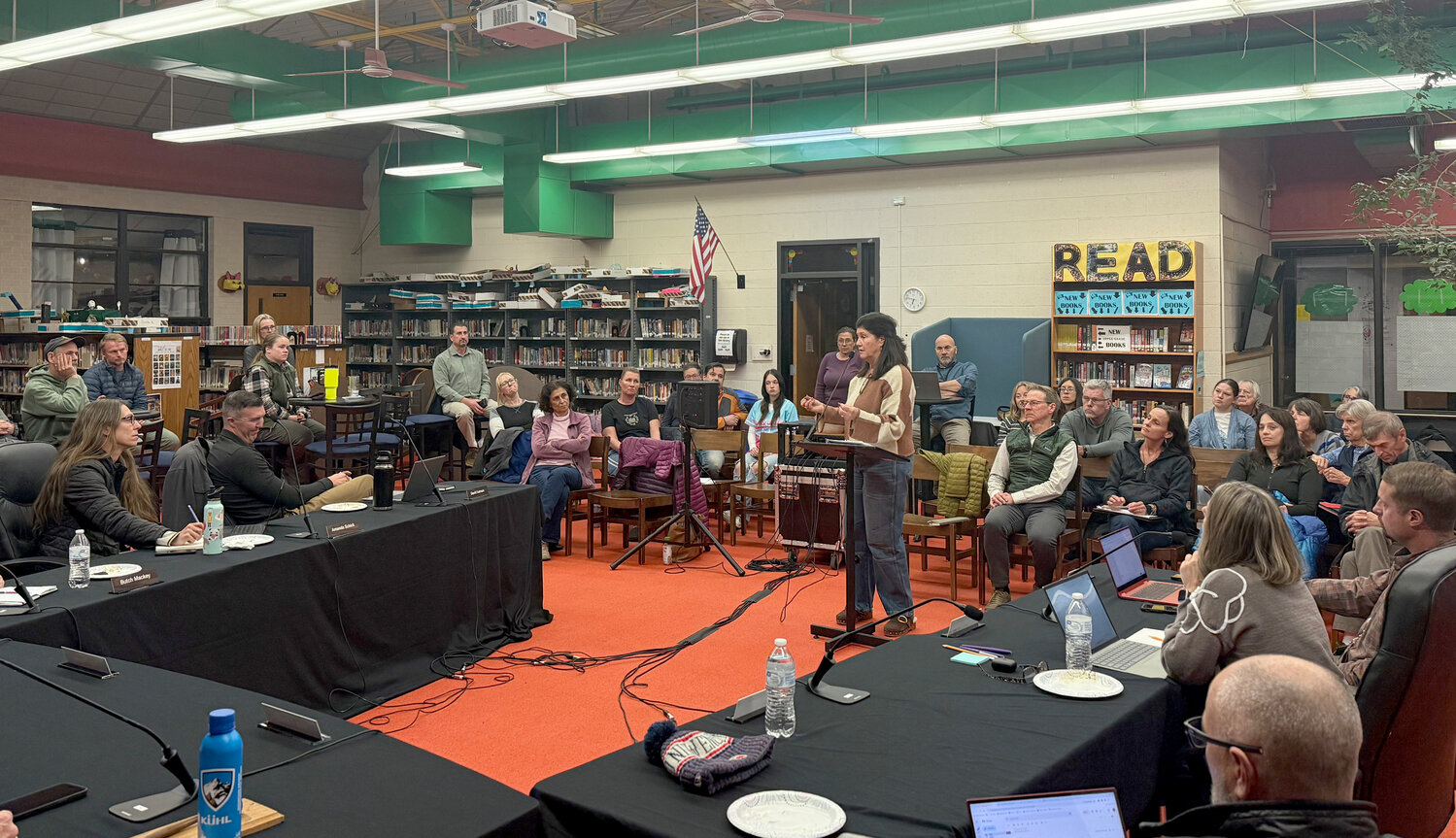
The Archuleta School District (ASD) Board of Education (BoE) held a community listening session on Tuesday, Dec. 2, where numerous community members shared their thoughts on the school district’s plans to build a new school, either uptown at the Vista Boulevard site or downtown on the south end of the high school campus site.
BoE president Bob Lynch opened the discussion by explaining that the district is assessing the two possible sites and information that has been provided by the district’s Master Planning Advisory Committee (MPAC).
“The assessment, not a recommendation, has come to us,” he said.
With it being a work session, the BoE allowed members of the public more than the traditional three minutes to speak.
“We’re here to listen,” Lynch said, noting the goal was to have a “respectful discussion all around.”
ASD Superintendent Rick Holt also provided background information on what the district has been doing over the past year by hosting community listening sessions, multiple MPAC meetings, working with demographers, and hiring architects and engineers to evaluate each site.
Holt also explained that the MPAC started to look at building options in March, comparing the cost of building two new schools or a K-8 school, and the costs of renovating existing buildings.
“And at that point, the [MPAC] started to land on this notion of a pre- K-8 school,” Holt said, noting that was partly due to the goals laid out by the board to help guide its decision “and it being fiscally responsible.”
Holt indicated that building one new school compared to two new schools would save the district roughly $20 million to $25 million.
Holt also explained that the MPAC began looking at how much the district could bond for and also how it could go after a Building Excellent Schools Today (BEST) grant to help cover the costs.
Initial estimates from RTA Architects showed that a new K-8 school will cost roughly $123 million.
Holt explained that the district receives operational funds through property taxes, but that if it wants to build a new school, the community needs to raise the money for that.
Holt also mentioned the district hired Hansen Communications and New Bridge Strategies to conduct a community poll, which took place at the end of the 2024-2025 school year.
He indicated that there was “enough positive” reaction received from that poll that 54 percent of respondents would support some sort of bond.
The MPAC reconvened in August to assess the polling data, and also heard a presentation on safety and security in schools.
“The big thing with safety and security is all around traffic flow,” Holt said. “The vast majority of accidents on school campuses involve car and human interaction.”
While reviewing the poll data, the MPAC discovered that respondents had a strong preference on where a new school would be located, Holt explained, noting at that point the BoE asked for a more in-depth site analysis for both locations.
Holt also indicated that the district deciding on a location for a new school would help its BEST grant application.
At the November MPAC meeting, SGM Engineers shared its site analysis that included a traffic evaluation and looked at available infrastructure for both sites.
Holt explained that SGM provided a comparison matrix, but since then “there’s been a change in, kind of, thinking about the high school site.”
He explained the district asked RTA to revise the originally proposed placement of the new school at the high school from being on the hillside on the southern end of the property and to the more level portion of the property where current baseball and softball fields are.
“And it’s really changed some of the things making the original site difficult by reducing the amount of excavation and wetland impact, so this new site appears to be more favorable,” Holt said, adding that the revised high school site is “pretty comparable” in cost to the Vista site.
Holt noted that the original high school site proposal came with a cost estimate of an additional $12 million to $18 million to build there, whereas the revised site has an additional cost estimate of $7 million to $11 million.
He noted the Vista site has an additional cost estimate of $6 million to $9 million to build on.
Lynch indicated the BoE is anticipating to make a decision on a site at its January 2026 meeting.
A total of 16 community members gave public comment, with arguments for both sites being put forward.
The first speaker stated he is a licensed engineer and expressed concerns about a traffic light and turning lanes that would be needed at the intersection of Vista Boulevard and U.S. 160, along other concerns about a sewage pump issue and potential electric upgrades that might be needed in order to serve a new school at the Vista site.
Ruby M. Sisson Memorial Library Director Barbara Brattin spoke next, noting that she was not speaking on behalf of the library board as the topic has yet to come up in any of its public meetings, but rather sharing experiences of working at the library and how it is connected to the schools in the community.
Brattin encouraged the district to consider keeping its schools downtown and to work together with the library providing benefits to students and their families.
“Keeping the schools within walking distance of the library is a great start,” she said.
One MPAC member spoke about the statistic shared by the district that 68 percent of its students live west of Piedra Road, but that it does not necessarily reflect the lived daily reality of families in Pagosa Springs.
She explained that having schools separated between uptown and downtown will cause more stress and ongoing fuel costs for most families.
“We’re layering the burdens on the very families we’re trying to serve,” she said.
Town of Pagosa Springs Parks and Recreation Director Darren Lewis commented, explaining part of his comment was coming from being a parent who raised kids in the school district, and part of his comment was as the parks and recreation director.
Lewis mentioned that the convenience of having all of the schools downtown is “huge.”
“The convenience for parents and their families of having everything downtown is huge,” he said, explaining there are several parks and trails that kids are able to access and explore after school.
Lewis then spoke about the parks provided by the town, indicating that he believes parks are needed uptown as well, but questioned if the community could afford it right now.
He mentioned the importance of the ballfields at the high school site, and how it serves students and adults in the community.
“For now, I need those three ballfields,” he said. “It’s pretty important to those families to have that.”
Lewis explained that plans to build additional ballfields at the Yamaguchi Park South have been scrapped due to the town needing a new wastewater treatment facility.
“So, there is no place for ballfields,” he added, noting that the one ballfield located at Yamaguchi Park will not handle the parks and recreation department’s needs, and that club teams in the community are also looking for space.
Lynch indicated that both of the proposed building spots at the high school site are still a possibility.
Former Pagosa Peak Open School board member Elly Heitkamp commented on the district going after a BEST grant, stating that its chances will be influenced by community support.
She explained that the downtown location being close to a community center, parks, a library and nature trails are important aspects that can be leveraged with the grant application.
Heitkamp also commented on the downtown community and nature available to kids, noting the views from the downtown location “are so memorable for those children.”
She added, “When you give a kid a sense of belonging, everything just falls into place,” and explained that with the schools being downtown, kids are immersed into a community.
Two other commenters also expressed the importance of partnerships when applying for grants, claiming that the district should look at the grant application before choosing a site, not the other way around.
One commenter claimed that building a school into a hillside actually has the potential of saving money with designs that can reduce energy use, while also expressing the importance of younger students being able to experience a sense of independence downtown by being able to walk to so many different after school programs and activities.
Bill Hudson commented that the district went to voters in 2011 proposing a K-8 school at the high school site, but that the initiative failed.
Hudson encouraged the BoE to consider what this project could offer to other members in the community, such as additional athletic fields or parks.
Hudson explained that the community was able to get behind building the high school in 1999 because it included an auditorium that would be available to the community to use.
One student gave public comment, explaining she has started an independent softball team that is planning to use the softball fields at the high school site.
The student expressed support for the idea of building a new K-8 school, but urged the BoE to come up with a plan that also accommodates the community’s need for athletic fields.
Pagosa Lakes Property Owners Association (PLPOA) Lifestyle and Communications Manager Jenifer Pitcher stated she had no real preference on the location of a new school, but had an opinion on the facilities associated with the project, noting that it “seems like you’re kind of maxing out downtown.”
Pitcher stated that, from a personal standpoint, PLPOA welcomes ASD at the Vista site and that there are numerous greenbelt spaces in the area with the possibility of adding new trails to connect to a school.
PLPOA General Manager Alan Roth also explained that partnership opportunities are available, mentioning PLPOA worked with Vets 4 Vets to create the Veterans Memorial Park.
One community member asked Holt if there are any plans to engage students to see where they would like the new school to go.
Holt explained that the district has not engaged students yet, but will approach them once a site is selected for input on building design and spaces around the school.
Parks and Recreation Supervisor Amanda Gadomski spoke about how the town partners with the school for multiple after-school programs, while also offering a perspective as a local business owner.
She noted that businesses downtown often have students who walk from school to either come and learn about a business or go to work.
Gadomski noted that having a school uptown would eliminate the “walking school bus” the community currently has with students being able to walk to various activities and events.
MPAC chair Lisa Scott commented that getting a bond passed will not be an easy task, and that “we’re not gonna have an unlimited amount of money.”
Scott encouraged everyone to advocate for this project, whether they like the ideas or not, but that talking about it with as many people in the community is important to mitigate rumors or misinformation associated with the project.
“The misinformation and the rumor will derail this,” she said.
James Dickhoff, the town’s development director, also commented on the idea of asking for student input, expressing support for that idea.
After more than an hour of public comment and a short break, the BoE then reflected on the comments given.
BoE member Butch Mackey commented, “We have not made any decisions. We’re not leaning towards any decisions that I’m aware of.”
BoE member Tim Taylor expressed support for the idea of engaging students in the process, noting that “kids will have a lot to say.”
Holt indicated that he would communicate with the Pagosa Springs Middle School principal to set up a time for BoE members to visit the school and engage students on the matter.
BoE member Amanda Schick expressed concern with the idea that the district may not be able to achieve building a new school without being destructive in other ways, noting the importance of supporting a new school and recognizing the community’s use of other facilities.
She stated, “There’s a part of me that believes that we have let outsiders come in and be the voice and best perspective of Pagosa, when actually we are the professionals of Pagosa. We understand our community. We understand our families. We are hearing from our stakeholders.”
Lynch noted that the one “unmovable constraint” the district is working with is funding.
Taylor also commented on the proposed building location on the high school site being built into the hillside, noting he had concerns with hydrological challenges in that area.
“I had a lot of concerns about that, personally,” he said.
BoE member David Iverson mentioned that navigating wetlands would be a challenge, as well.
“So, it’s not just the hillside that’s the problem,” Iverson said, also acknowledging there is value in having a walkable downtown community.
Questions were then asked about what the estimated cost of $123 million would actually include.
Holt indicated that he would ask RTA for what exactly is included in that estimate.
Scott commented that the district has other needs as well, noting the current high school has some stuff in the “red.”
“We’ve got to reserve some money for these other things,” she said, noting the district may have other pots of money to pull from for other needs, “but there are other needs besides a brand new school.”
Taylor mentioned that several folks from PLPOA have approached the board with talks of collaboration, but that no meetings have been scheduled.
Holt indicated he would work to set up meetings with other entities in the community, including the Town of Pagosa Springs and Archuleta County.
The BoE will hold an ASD staff listening session on Monday, Dec. 8, at 5:30 p.m. in the Pagosa Springs Middle School library.
clayton@pagosasun.com


 >
>