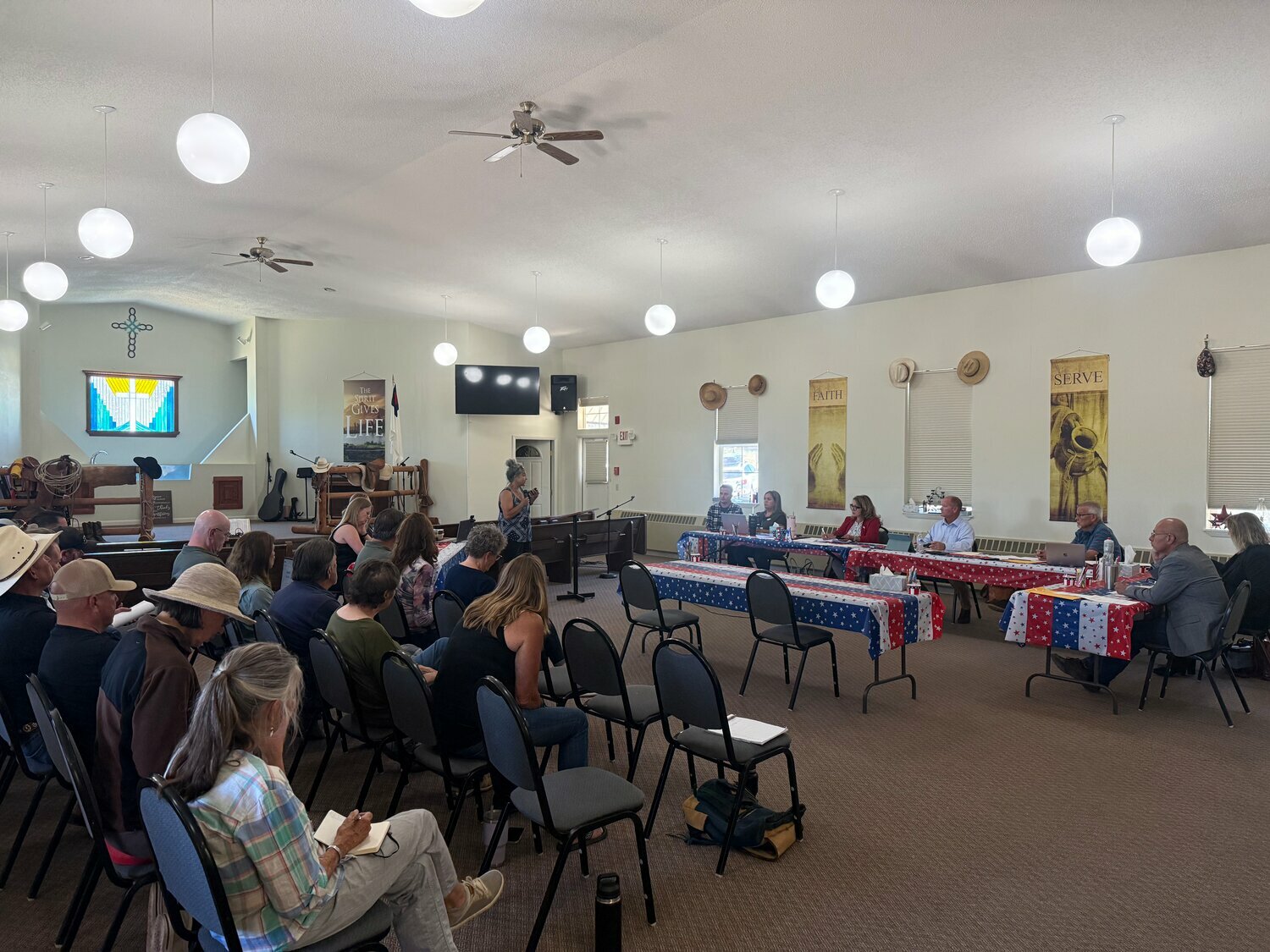
On Tuesday, June 16, the Archuleta County Board of County Commissioners (BoCC) voted unanimously to not submit a Colorado Circular Communities Enterprise (C3) grant application for the future construction and relocation of the Pagosa Springs transfer station.
The grant application would have requested $500,000 through the Colorado Department of Public Health and Environment, with a local match to not have exceeded $204,000.
The matter was previously discussed with multiple public comments during a work session held by the BoCC on Tuesday, June 9.
During that work session, Commissioner John Ranson initiated a discussion on the county’s plans for relocating its Pagosa Springs transfer station.
Ranson expressed that “a lot of this was before my time” in regard to decisions made and plans for the county to relocate the Pagosa Springs transfer station.
“I still have an issue with this process,” Ranson said, adding that no notices have been sent out to neighboring property owners.
Ranson also mentioned that he’s received feedback “from many sources” wondering why the county is looking to move the facility.
During a regular meeting held on June 5, 2025, the BoCC unanimously approved a design for utilities and an auxiliary building at a new transfer station facility located on Cloman Boulevard at a cost of $19,000.
In December 2024, the BoCC unanimously approved a $37,000 bid from Reynolds Ash + Associates for continuing the design of the new transfer station.
Funds for both of those projects came out of the county’s capital outlay fund, according to Public Works Director Mike Torres.
During the June 9 work session, Ranson expressed that he was bringing up the matter to ask if there is a reason why the county does not have to follow the same regulations as individual developers and send notices out before the project gets this far along.
County Attorney Cathleen Giovannini explained, “We are held to the same standards as other developers,” but that notices are usually sent out during the planning process of proposed developments.
She added, “This is really a preplanning process.”
She explained that it is fine to give public notices ahead of time, but that it is not a legal requirement to do so.
“We’ll still have those notices,” she said, explaining those will come further down the line as part of the planning process.
Giovannini also commented that she is “sympathetic” to the idea that by the time the project reaches that point, “we’re a long ways down that line.”
Ranson explained that “several weeks back” the BoCC had conversations about funding the facility, “and that’s pretty far along the line, in my opinion.”
Ranson commented that if the county is starting to talk about how to fund the facility, then “it’s not preliminary anymore, in my opinion.”
He added that “it’s only fair to let the people come forward and talk.”
Commissioner Warren Brown then explained some of the history of the project, explaining the current Pagosa Springs transfer station and recycle center location is owned by the Town of Pagosa Springs.
He noted that a number of items the location was taking in were getting damaged and having to be sent to the county’s landfill instead of being able to recycle the materials, specifically noting situations with cardboard.
“One of the primary purposes of recycling is to keep those materials out of the landfill, save space,” Brown said, adding that in order to recycle those materials they have to be in particular conditions for vendors to agree to haul it away, “which is usually at a loss,” but better than nothing.
Brown went on to explain that the discussion started out with the idea of building a structure at the current transfer station location to cover and protect those recyclable items, “but it’s not the county’s property.”
He also mentioned that the current transfer station site “would have to be monitored forever” because it is built on an old town landfill site.
Brown commented that it then made sense if the county were to put money into creating structures to help with recycling, that those structures be built on county-owned property “that we would not have to monitor forever.”
He added, “So, that’s how this started.”
Brown also explained that the town had previously offered to sell the current transfer station property to the county for $1, describing that as a great deal, “unless you’re responsible for a landfill site forever.”
Brown then noted that the newly proposed transfer station site is on land that was donated to the county by the Bureau of Land Management (BLM), “but it has specific conditions that it must be for county use.”
He added that the land donated by the BLM brought no additional cost to the taxpayers.
Brown also commented that these conditions do not alleviate the county from reaching out to the community to obtain feedback on the project.
He mentioned he’s received mixed feedback so far, with some folks expressing positive feedback and others giving negative feedback.
Some of the “positives” listed by Brown included that the new location would be more centralized, possibly encouraging more recycling participation from the community.
The “negative” listed by Brown is that the current location is fine and does not need to be moved.
“I’m not sure it’s just fine where it is,” Brown said while acknowledging that constituents may be correct about that.
Brown added that a lot of the discussion about the transfer station is that the community needs and wants it, but the sentiment is, “I don’t want it near me.”
“And I mean, this is the internal struggle we put up with with every situation, virtually, in the county, from gravel pits to paved roads to recycling centers,” he added, noting this is “definitely a thing the commissioners need to get right.”
In response to a question from Ranson, Brown explained that the new location would not have to be monitored “because we’re not going to have anything buried.”
Road and Bridge Manager Eric McRae explained that the new facility would give the county ability to cover and protect recyclable items.
“We’re losing trust with vendors,” McRae said, explaining that once the trust is lost, vendors will no longer pick up items from the county.
“So, you’re right, they do end up in the landfill,” McRae said about some of the recyclable items at the transfer station.
McRae also commented that the new location would be more centralized, explaining that he was at the BoCC’s work session to receive direction on whether or not to move forward with a grant application for potential funding for the new facility.
He commented that he’s “all ears ... because I have about a dozen reasons why it needs to be moved.”
McRae also commented on the working conditions for employees at the current transfer station location, describing it as having poor office space.
“It’s not a great condition,” he said, adding that the county can’t really invest into property that it doesn’t own.
McRae also commented that nothing going to the transfer station should end up at the landfill, and “right now that’s happening,” noting the county is also currently trying to save airspace at the landfill.
“It has a lot of great purpose to be moved to a better location,” McRae said in regard to the transfer station.
McRae also stated that he agrees with Ranson in that the county is moving along with the project and is being faced with funding opportunities at the moment, suggesting that conversations can continue if more discussion on the matter is needed.
“I think that could be sold with just education,” McRae said.
“This should be done in public,” Ranson commented.
McRae also explained that his understanding is that discussions in regard to the new transfer station project took place last year, explaining that the funding set aside is not sufficient for the whole project and that he had found a grant to possibly assist with funding it.
Brown offered a comment of clarification, stating, “This conversation has taken place over several years and several different meetings.”
He stated that it is not a new thing.
“It has taken place in this very room,” he said while suggesting the county could do a better job engaging with the community.
Torres then stated that any comments of the county not following its own policy are false.
“Everything we’re doing is preliminary,” he said.
Torres explained that going after the grant would help the county with constructing the new transfer station, and in order to go for the grant, the county needs to have a project.
“This is it” he said, but explained that the county is still in conversation with the Humane Society of Pagosa Springs over land issues. “We haven’t even got the land to provide access for us to build the transfer station.”
In response to a question from the audience, McRae stated the new transfer station would be located at 329 Cloman Blvd.
More public comment was allowed during the work session, with J.R. Ford stating that it’s “disingenuous” of the county to go after the grant while expressing that it may change its mind if constituents present a better idea.
“I’ve been around this block a few times,” he said, explaining that if the county starts spending money to go down a certain path, then it’ll likely continue on that same path.
Ford then mentioned that La Plata Electric Association (LPEA) leases a property next to the current transfer station site and that multiple property owners in the Cloman Boulevard area pushed back on the idea from the beginning.
He then commented on how the county has expressed that it can’t build on leased lands, “then why is [LPEA] doing it?”
In March 2025, the Town of Pagosa Springs reached an agreement with LPEA for it to use five acres of the transfer station property at 2140 County Road 500 to be used for a new electrical substation.
During the work session, Ford commented that if the county were to move the transfer station from its current location, similar issues will be experienced at the new location.
Ford expressed that the county needs to “clean that site up” in regard to the current transfer station site, and that simply moving the facility to another area “is just gonna make that the junk hole that you have right now.”
Ford also mentioned that the newly proposed location would be on the same road as the county’s airport, potentially blowing trash into the area.
“And that’s the last place we want it,” Ford said.
Ford noted the county has invested millions of dollars into the airport over the years.
“And you’re gonna put one of your trash facilities on the road leading to the airport,” he said, “I just don’t really think this has been thought out.”
Ford encouraged the county to develop “more of a plan” and to not just go after any grant it can.
“I mean, do it the right way. Do it the way you make the rest of us do it,” he said.
In response to a question from County Manager Longinos Gonzalez, McRae indicated that the deadline for the grant application is June 30.
June 16 meeting
The matter was brought up again during the BoCC’s regular meeting on June 16 with the consideration of approval to submit the C3 grant application.
More public comment was given by residents who stated they own property near the proposed new transfer station location along Cloman Boulevard and cited concerns about trash near the county’s airport that could be generated from the new transfer station location.
The first commenter acknowledged that the county needs a new transfer station facility and offered to assist the county in looking for alternate properties, noting that the location on Cloman Boulevard would “bring a lot of extra traffic, heavy trucks and just trash blowing around the airport,” calling that a major concern.
The next commenter explained that a group of residents had “teams” come out and evaluate the site along with the current transfer station location.
“We do agree that the county needs a new transfer station,” he said,
He stated that residents understand the difference between a transfer station and a landfill.
“A transfer station is just a smaller version of trash blowing,” he said, also noting noise concerns from compactors.
He mentioned how communities typically try to keep “those types of facilities” away from the community, instead of bringing them into it.
The commenter also mentioned that his teams flew drones over the current transfer station facility and witnessed trash up to 1,300 yards away from the facility.
He explained that the airport runway is about 600 yards away from the proposed transfer station site, cautioning about potential liabilities if an aircraft “ingests a plastic bag or something and people die.”
He went on to state that the transfer station is not wanted in that area next to the airport, “especially when you’re looking at doing such a large improvement to that airport — it’s not the appropriate place.”
He also stated that resources could be pooled between the county and residents to find a “more suitable location.”
Torres then commented, “As previously stated in last week’s meeting, this project is in preliminary stages.”
He explained that the grant doesn’t specifically tie us to any specific property” and is only tied to the value of the property, noting “it wouldn’t be out of the question” for the county to move forward with the grant application and also find an alternative location.
Torres noted the value of the Cloman Boulevard property is about $409,000.
In response to a question from Commissioner Veronica Medina, Torres indicated that the C3 grant is a “recycling grant,” later noting that it is in its first year and is intended to be a three-year grant.
In response to a question from Ranson, Torres noted the entire Cloman Boulevard property is roughly 28 acres, but the county is only looking to use about three or four acres for the transfer station.
Ranson then explained that he previously asked for a recap of meetings that had to do with the transfer station relocation, noting he’s been on the BoCC for just over a year in his current term.
“I’m just one commissioner, but I don’t think this has been vetted for the public and for the neighbors like a private development would have to,” Ranson said.
Ranson also noted that the county may have another opportunity at the grant next year, explaining that the county airport is about to undergo a $16 million renovation with roughly $650,000 of that coming from the county.
“Well, here’s an idea, let’s go put a trash dump, recycle center next to our newly improved airport. It just doesn’t make sense to me,” he said, adding that he’d rather delay the grant process until next year with the possibility of exploring alternative sites.
Medina then asked Torres what the process has been to this point and if the appropriate steps have been followed, even if it were a private venture.
Torres indicated the county has followed policy as required, explaining that if any structure was being built then official sketch plans would have to be submitted to the Planning Department and public meetings would be held to gather public comment on the matter.
Torres also noted that there have been some discrepancies on the land the county is wanting to use to access the proposed property, adding that the project is not even at the point of submitting sketch plans.
McRae spoke on the timeline of the grant, explaining that acceptance would be in August and the project start date would be pushed back to April 2027.
He described the grant as a “good opportunity to get some money for the project,” noting there would be time to establish alternative properties.
Finance Director Chad Eaton also explained that the agenda item was just for the submittal of the grant and that the location could change up until the point of acceptance.
Medina then commented that it might make sense to wait another year to go for the grant.
Torres mentioned that “tomorrow’s not promised” and that the funding could be taken away, but that it is listed as a three-year grant as of now and should open again next year.
Ranson then recalled comments from Ford from the June 9 work session, stating that he’s never seen the county submit a grant application for a project and then not go through with it.
“It’s like you can’t be half pregnant,” he said, suggesting the county go back to the drawing board.
Brown commented that if the county were to not go through with the grant, then there needs to be “some activity” in the meantime, asking the public commenters for a commitment in assisting the county on finding an alternate site.
Brown also noted that he is “not married” to the Cloman Boulevard location, but stressed that the county does need a new facility in order to protect its resources and get money back for recycled materials, adding that currently it’s “more miss than hit” with recycling.
Medina then motioned not to approve the submission of the C3 grant application, which was seconded and unanimously approved by the BoCC.
clayton@pagosasun.com


 >
>